Introduction
Imagine running a construction business in 2009. One state required a 10-page SWMS for working at heights, while the next state treated the same job as low-risk with no formal statement needed. Chaos. Confusion. And far too many preventable incidents.
Welcome to Week 3 of SWMS Mastery: 52 Weeks with MiSAFE. This week we trace the fascinating evolution of SWMS requirements — from fragmented state rules to today’s harmonised national framework — and why understanding this history is the key to future-proofing your safety system.
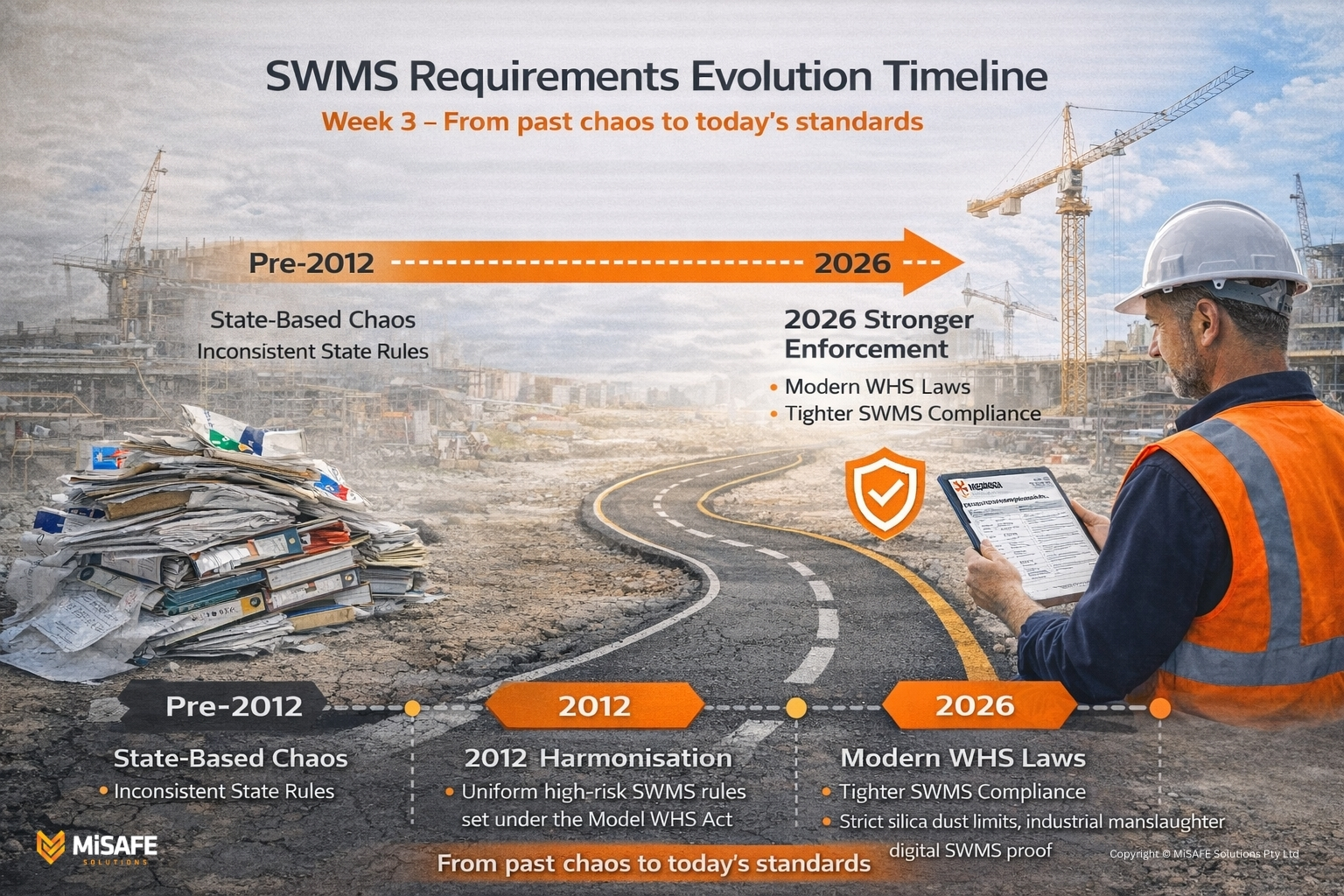
The Early Days: State-Based Chaos Before 2012
Before 2012, Australia had no uniform national approach to SWMS. Each state and territory had its own rules, terminology and enforcement styles. Queensland might demand detailed risk assessments for every high-risk task, while Victoria’s OHS framework took a different path entirely.
This patchwork created real problems: contractors crossing borders struggled with compliance, audits were inconsistent, and workers paid the price with higher injury rates.
The 2012 Harmonisation Milestone
The big shift came in 2011–2012 when most states adopted the model Work Health and Safety (WHS) laws. SWMS became a national requirement for high-risk construction work under Regulation 291 and 299.
For the first time, the same core rules applied across NSW, Queensland, SA, TAS, ACT, NT and the Commonwealth. Western Australia joined later in 2022. This harmonisation dramatically reduced confusion and raised the bar for what a compliant SWMS must contain.
Victoria’s Unique Path
Victoria never fully adopted the harmonised WHS laws and still operates under its own Occupational Health and Safety Act 2004. While many principles are similar, the terminology, some triggers and enforcement differ. Understanding this distinction is critical if you work across borders.
2026: Stronger Enforcement and New Pressures
Today, SWMS requirements are stricter than ever. Industrial manslaughter laws, psychosocial hazard rules, the engineered stone ban, tighter silica dust limits and increased regulator scrutiny mean that “good enough” SWMS are no longer enough. The evolution has moved from “have a document” to “prove it works on site every day”.
Why This Evolution Matters for Your Business
Knowing how SWMS requirements have changed helps you move beyond minimum compliance. Businesses that understand the history are the ones building systems that actually protect people and withstand audits — rather than scrambling when regulators knock.
Lessons from History for Your SWMS Today
- Never assume one state’s rules apply everywhere
- Document everything — the harmonised laws reward evidence
- Review and update regularly (the law now demands it)
- Involve workers from day one — genuine consultation has always been key
These lessons from the past are your roadmap for the future.
What Comes Next in the Series
Next week we dive into the harmonised WHS jurisdictions and the important differences you need to know.
Discover MiSAFE SWMS Today
Register for MiSAFE SWMS here: https://swms.misafesolutions.com.au/register Find out more about MiSAFE SWMS here: https://misafesolutions.com.au/swms2 Contact MiSAFE Solutions Pty Ltd at contact@misafesolutions.com.au or call 07 5641 2101, or fill in our contact form: https://misafesolutions.com.au/contact-misafe-risk-management-software/
This article is general guidance. Check the legislation that applies in your state, or talk to us about your situation.