Before you write a single control, you make one decision that shapes the whole SWMS. You decide which high risk construction work applies to the job. Get that wrong, and everything downstream is wrong too.
The Work Health and Safety Regulation lists 18 kinds of high risk construction work. The law wants a SWMS for each one that applies. Miss a category, and there is no SWMS where the law demands one. Over-list, and the SWMS fills with controls that do not fit the job.
So misclassification is the root defect. This post looks at the two ways it happens, why it undermines a good SWMS, and how to classify the work correctly.
What the WHS Regulation actually requires
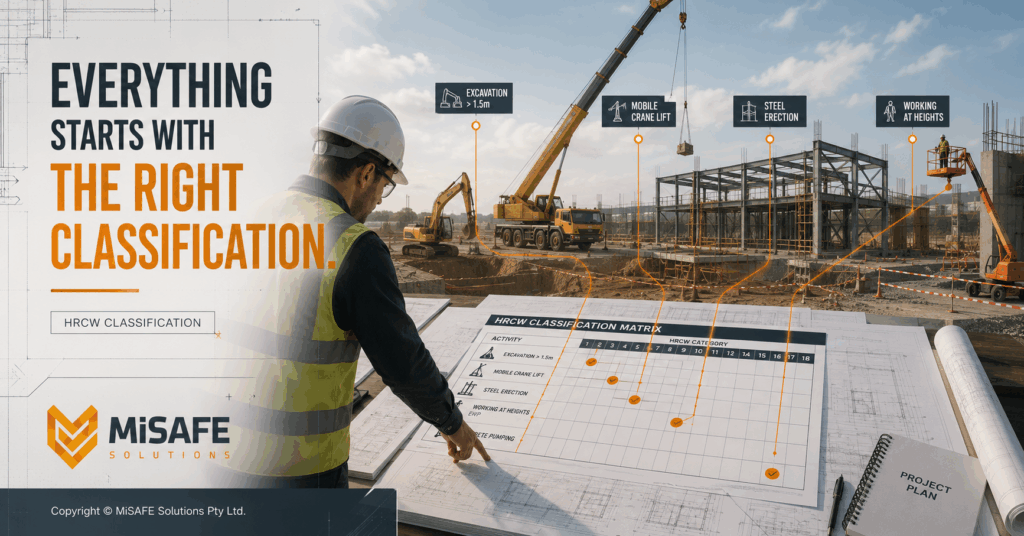
Regulation 291 of the Work Health and Safety Regulation 2017 defines high risk construction work. It sets out 18 categories, from a risk of falling more than two metres to work near energised electrical services, work in a confined space, and work near powered mobile plant.
Regulation 299 then requires a SWMS for each high risk construction work activity. That means one SWMS per activity that applies, and you prepare it before the work starts.
So the classification is not paperwork. It is the trigger for the whole SWMS duty. If an activity is high risk construction work, you must prepare a SWMS. If it is not, you do not need one for it.
The two ways PCBUs misclassify high risk construction work
The first way is under-listing. A crew works in a trench 1.6 metres deep, but no one flags it as a category, so nobody writes a SWMS. The work then runs with no SWMS where the regulation demands one.
The second way is over-listing. Someone ticks every category to be safe, so the SWMS carries controls for confined spaces and demolition on a job that involves neither. The document balloons, and the controls that matter get lost among the ones that do not apply.
Both come from the same root. No one checked the work against the 18 categories properly. One version misses a real risk. The other buries it.
Why misclassifying high risk construction work sinks a good SWMS
A SWMS can have excellent controls and still fail if the classification is wrong. If no one identified the activity as high risk construction work, no one wrote the controls. The quality of the template does not matter, because the document does not exist.
Over-listing fails differently. The crew has to read past controls that do not apply to find the ones that do. On site, that means the real controls compete with noise, and the SWMS becomes a document people skim rather than use.
A regulator sees both. A missing SWMS is a straight breach. A bloated SWMS shows that no one properly assessed the work against the categories.
How to classify high risk construction work correctly
Start with the work, not the template. Walk the job and list what the crew will actually do. Then test each task against the 18 categories in regulation 291, one by one.
Tick a category only when the work genuinely meets it. A trench at 1.6 metres meets the shaft and trench category. A trench at 1.2 metres does not. Precision here keeps the SWMS honest.
For every category that applies, make sure a SWMS exists and you reference it. For every category that does not, leave it out. That is how you get one SWMS per real activity, with no controls that do not belong.
A short classification checklist makes this repeatable. Run the 18 categories against each job, record what applies, and link the SWMS. The check becomes a habit, not a guess.
Practical Application
Picture a small commercial refurbishment. The crew removes a load-bearing wall, works off a scaffold three metres up, and runs new power. Three categories apply: demolition of a load-bearing element, a fall over two metres, and work near energised electrical services.
The team runs the checklist and confirms those three. Confined space, asbestos and explosives do not apply, so they stay off the list. The team prepares and references three SWMS, one for each activity that applies.
Nothing gets missed, and nothing gets padded. So if a regulator reviews the job, the checklist shows how the team assessed the work against all 18 categories, and each high risk activity has its own SWMS.
Conclusion
Classification is the decision that makes or breaks a SWMS. Under-list, and you leave a legal gap. Over-list, and you drown the controls that matter.
Test each job against the 18 categories, tick only what genuinely applies, and give every real high risk activity its own SWMS. Get the classification right, and the rest of the SWMS has a chance to work.
MiSAFE SWMS starts every document by identifying the high risk construction work, so it scopes the SWMS to the activity from the first step rather than leaving it to a guess at the end.
Ready to act? Contact us today or book a free 45-minute consultation.
Download the Free Template
Download the free HRCW Classification Checklist (.xlsx) and test every job against the 18 categories before you write the SWMS.
This article is general guidance. Check the legislation that applies in your state, or talk to us about your situation.