A confined space kills quietly. A worker climbs into a pit, the atmosphere is wrong, and two breaths later they are on the floor. Then the mate at the hatch goes in after them. That second death is the one the incident reports keep recording, and a properly built confined space SWMS prevents almost all of it.
Most confined space SWMS carry a single atmospheric line. Gas test before entry. Yet the model WHS Regulation asks for far more than one reading. It asks for a written permit, isolation of connected plant, continuous communication, a standby person who never enters, atmospheric limits maintained while the work runs, and rescue procedures that were rehearsed before anyone climbed in.
This post walks that full sequence and shows where each control belongs in the document, so the SWMS gates the entry rather than describing it.
What the WHS Regulation asks of a confined space SWMS
Start with the definition, because the classification decides everything after it. Regulation 5 sets the definition, and it has four limbs. The space is enclosed or partially enclosed. Nobody designed it primarily for a person to occupy. It sits at normal atmospheric pressure while anyone is inside. Finally, it carries a risk from an unsafe oxygen level, harmful or flammable airborne contaminants, or engulfment. Size alone never makes a space confined. The hazards do.
Regulation 291 then catches work carried out in or near a confined space as high risk construction work, so regulation 299 requires a SWMS before the work starts. Separately, regulation 66 requires a competent person to assess the risks, record that assessment in writing, and review it whenever the risks change. Regulation 67 then sits on top of both. A PCBU must not allow or direct a worker to enter until it issues an entry permit.
One overlap catches crews out regularly. A trench is not a confined space because of collapse risk alone. However, a trench that holds harmful airborne contaminants meets the regulation 5 definition. The confined space duties then stack on top of the excavation duties from last week’s post.
Why one gas test before entry is not enough
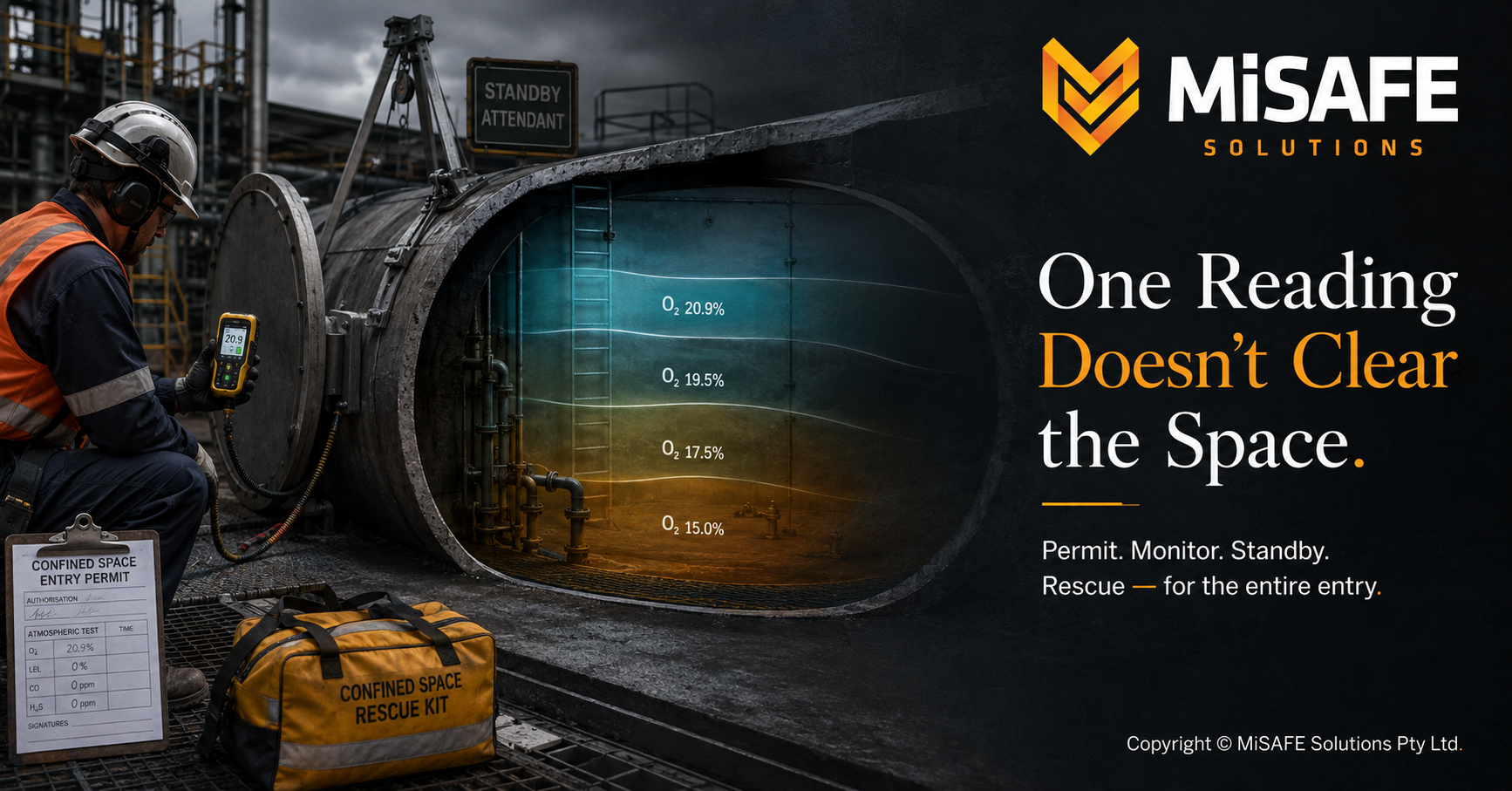
Gases stratify. Hydrogen sulfide sits heavier than air and settles at the bottom of an unventilated space, while methane rises and collects at the top. A single probe reading at the hatch therefore tells the crew almost nothing about the floor of a wet well. Competent testing samples side to side and top to bottom, from outside the space, before anyone opens the gate.
The numbers matter too. Air normally holds about 21 per cent oxygen, and 19.5 to 23.5 per cent counts as safe. Regulation 72 then sets hard limits for flammable atmospheres. Concentrations must stay below 5 per cent of the lower explosive limit so far as is reasonably practicable. Between 5 and 10 per cent of the LEL, workers come out unless a suitably calibrated continuous monitoring detector runs in the space. At 10 per cent or above, workers come out immediately with no exception.
Conditions also change while the work runs. Disturbing sludge releases trapped gas. Welding consumes oxygen and adds fume. A forklift idling near the hatch pushes carbon monoxide down into the space. Consequently the confined space SWMS should call for continuous monitoring rather than a single clearance. It should also state the alarm set points and the evacuation trigger. One more rule catches people out. The regulation prohibits purging with pure oxygen, or any mixture above 21 per cent oxygen, because extra oxygen makes the space more flammable rather than safer.
The permit is a gate, not paperwork
A permit signed after entry proves nothing. Regulation 67 requires a competent person to complete the permit in writing before entry. The permit names the specific space, the workers who may enter, and the period it runs. It also sets out the control measures drawn from the risk assessment. Finally, it carries space to acknowledge that the work finished and that every person left.
Re-validation is the step most teams skip. Re-issue the permit when the person with direct control changes, when work stops and restarts, or when the job shifts beyond what the current permit covers. New controls trigger the same step. Remember also that entry occurs the moment a person’s head or upper body crosses into the space, not when their boots hit the floor.
Records close the loop, and the confined space SWMS should point to them. Regulation 77 sets the retention periods. Keep the risk assessment for 28 days, or for two years where a notifiable incident occurs. Keep the entry permit until the work finishes, and again for at least two years after a notifiable incident. Regulation 76 adds training records, which you keep for two years.
Rescue arrangements the confined space SWMS must name
Regulation 74 separates a real confined space SWMS from a hopeful one. The PCBU must establish first aid and rescue procedures. It must also practise them so they actually work, and it must be able to start them from outside the space as soon as practicable. Openings need to be large enough for emergency access, and they must stay unobstructed. Rescue and first aid equipment needs maintenance that keeps it working.
Regulation 69 supplies the other half. The system of work must give the entrant continuous communication from outside the space. It must also put a standby person nearby to monitor conditions and, where practicable, watch the work. That standby person holds the authority to order everyone out. They keep the rescue equipment to hand, take on no other duties, and never enter the space to attempt a rescue. That last rule breaks the two-fatality pattern.
Anyone who does enter to rescue must wear air-supplied respiratory protection. Where a worker has collapsed, treat entry as unsafe without it. The atmosphere that dropped them will drop the rescuer just as fast. Leaning on the local fire brigade works only in narrow circumstances. You need prior arrangements, a known response time, and a brigade that holds the specialist retrieval equipment for that space. Naming Triple Zero in the SWMS is not a rescue plan.
How to build the sequence into the confined space SWMS
Four gates turn a generic document into a confined space SWMS that holds up. Gate one classifies the space against the regulation 5 definition, then asks whether the crew can do the work without entering at all. The second gate isolates connected plant, piping and stored energy, then cleans, purges and ventilates. Next comes the permit, which sets the atmospheric regime: the test points, the monitoring during the work and the evacuation triggers. Finally, gate four confirms rescue readiness. It names the rescuers, the equipment on site, the communication method, the standby person and the date the crew last rehearsed the plan.
Sequenced this way, the document answers the questions an inspector asks after an incident. Why was entry necessary, what was isolated, who issued the permit and when, what did the atmosphere read through the shift, and who was standing by ready to pull the worker out?
Practical Application
Picture a maintenance crew clearing a blockage in a wastewater pump station wet well. The well is enclosed, nobody works in it routinely, and decomposing organic material generates hydrogen sulfide. So the space meets all four limbs of the regulation 5 definition, and a SWMS becomes mandatory. The first draft lists a gas detector, a harness and a tripod, then moves on.
The supervisor, J. Smith, works the gates instead. Could a jetting truck clear the blockage from the surface? Not on this occasion, so entry stands. Next, the crew isolates the inflow penstock and locks out the pump starters. Each worker keeps the key to their own lock. A blower then ventilates the well for the period the risk assessment specifies.
Gate three follows. A. Jones tests from outside through the hatch at three depths. Oxygen reads 20.4 per cent and hydrogen sulfide sits below the exposure standard. J. Smith then issues the permit naming A. Jones as the only entrant for a four-hour window. A four-gas detector goes down with the entrant and runs continuously, and any alarm means immediate exit. Finally, C. Brown takes standby at the hatch with the retrieval winch rigged, radio contact every two minutes, and no other duties. The crew ran their rescue drill six weeks earlier, and that date sits on the permit.
Midway through, the detector alarms as A. Jones disturbs the sludge. C. Brown calls the exit and A. Jones climbs out on the winch line. The crew re-ventilates, runs a fresh test and re-validates the permit. Nobody gets hurt, and the paperwork shows exactly why.
Conclusion
A confined space SWMS has to punish assumptions, because confined spaces certainly do. The space looked fine, the meter read clear at the hatch, the mate went in to help. Each of those decisions feels reasonable in the moment and each has killed Australian workers.
MiSAFE SWMS builds the entry sequence into the document itself. It prompts authors to classify the space before the task rows appear. It ties the permit and the atmospheric regime to the controls. Above all, it carries the rescue arrangement and its rehearsal date rather than leaving them to a note in the margin.
Ready to act? Contact us today or book a free 45-minute consultation.
Download the Free Template
Download the free Confined Space SWMS Control Checklist (.xlsx). It gates each entry through classification, isolation, the permit and rescue readiness before anyone goes in.
This article is general guidance. Check the legislation that applies in your state, or talk to us about your situation.