A ticket in the wallet is not the same as competence on the tools. Competency assessment is how you close that gap. It is the difference between assuming a worker can do the job safely and knowing it.
Every IMS rollout depends on people doing the work the way the system says. If they cannot, the best procedure on the shelf changes nothing. So before you trust a control to a person, you check that the person can deliver it.
What competency assessment means under ISO Clause 7.2
Clause 7.2 Competence appears in ISO 9001, ISO 14001 and ISO 45001. It asks four things. Determine the competence each role needs. Make sure people are competent on the basis of education, training or experience. Take action to close any gap. Then keep evidence that you did.
So competency assessment is the step that turns a training record into proof. Training shows that someone attended. Assessment shows that they can actually perform the task to the standard, in the real conditions of your site.
Trained is not the same as competent
This is where many systems fall short. A worker sits through an induction, signs the sheet, and is marked off. But sitting and understanding are not the same as doing. Competence is demonstrated ability, under normal conditions, without close supervision.
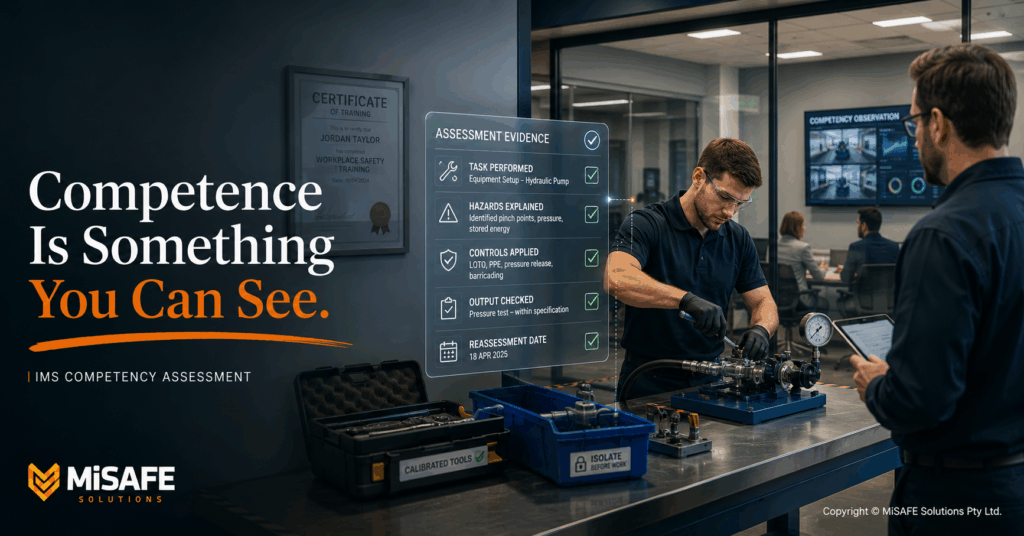
The fix is to assess the doing, not just the knowing. Watch the task performed. Ask the worker to explain the hazards and the controls. Check the output against the standard. Only then can you record the person as competent for that task.
Choose the right assessment method
Different tasks need different checks. For a physical task, use direct observation or a verification of competency, where the worker performs the job while a qualified assessor watches. For knowledge, use a short written or verbal test. For licensed work, check that the licence or ticket is current and matches the task.
Match the method to the risk. High-risk work deserves observation every time, not a tick in a box. Low-risk knowledge might need only a short check. Record the method you used, so the assessment stands up to scrutiny later.
Verify high-risk work and licences
Some tasks carry legal competence requirements. High-risk work such as operating a crane, a forklift or a boiler needs a national high-risk work licence under the WHS Regulations. Construction work needs a general construction induction, the white card. Section 19 of the WHS Act also requires you to provide the information, training, instruction and supervision needed to protect workers.
So verify these before the work starts, not after an incident. Sight the licence, confirm it is current, and record the reference. A verification of competency on top of the licence is good practice for higher-risk plant, because a ticket earned years ago does not prove current ability.
Reassess, do not set and forget
Competence is not permanent. Skills fade, plant changes, and standards move. So set a reassessment date for each competency and hold to it. Reassess sooner when conditions change, after an incident, or when a worker returns from a long break.
A simple register makes this manageable. Record who is competent in what, how it was assessed, and when it is due again. One glance then shows you who is current, who is due soon, and who has lapsed. Competency assessment becomes a rhythm, not a scramble before an audit.
Practical Application
Picture an Australian civil contractor with 25 staff across several sites. The QHSE coordinator builds one competency register. Every worker is mapped to the tasks they perform, with the assessment method, the result and a reassessment date against each one.
Now the gaps are visible. Two forklift licences are close to expiry, so they are booked for renewal. A new operator sits at Not Yet Competent, so supervised work continues until an assessor signs off. When the auditor asks who is competent to enter a confined space, the contractor opens one file and shows the evidence.
Conclusion
Competency assessment is what makes an IMS real on the ground. Decide the competence each role needs, assess the doing and not just the knowing, and verify every licensed task before it starts. Then reassess on a rhythm and keep the evidence. Do that, and every control you rely on rests on a person you know can deliver it.
The MiSAFE All-in-One QHSE subscription runs your competency register inside DS Site, with assessment records, licence checks and reassessment reminders held in one place.
Ready to act? Contact us today or book a free 45-minute consultation.
Download the Free Template
Download the free QHSE Competency Assessment and Verification Register (.xlsx) and record who is competent, how it was proven, and when it is due again.
[author] [author_image timthumb=’on’]https://misafesolutions.com.au/wp-content/uploads/2026/08/1781760144180-1.jpeg[/author_image] [author_info]Micah Wicham is the Founder and Director of MiSAFE Solutions, with more than 10 years’ experience in Quality, Health, Safety and Environment. A qualified QHSE professional and certified Lead Auditor, Micah and his team work with Australian businesses to build practical compliance and safety systems that can scale as teams grow. To read more, visit the MiSAFE blog feed or Micah’s LinkedIn [/author_info] [/author]
This article is general guidance. Check the legislation that applies in your state, or talk to us about your situation.