Most sites staple the SDS to the back of the SWMS and call the chemical risk managed. But an attached SDS is information, not a control. A hazardous substances SWMS has to turn that information into something the crew actually does.
Chemicals burn skin, poison lungs and start fires. The Safety Data Sheet describes those hazards in detail, yet a document in a folder controls nothing. The gap between the SDS and the task is where chemical incidents happen.
So this post looks at what the regulation requires for hazardous chemicals, why the attachment habit fails, and how to link the SDS to real controls in the SWMS.
What the WHS Regulation requires for hazardous substances in a SWMS
Chapter 7 of the Work Health and Safety Regulation 2017 carries the hazardous chemicals duties. A current Safety Data Sheet must be obtained and made available for each hazardous chemical, and regulation 346 requires a register of those chemicals with their SDS, accessible to the workers who use them.
Information is only the start. The PCBU must also manage the risks of using, handling and storing each chemical, which means selecting controls from the hierarchy, planning for spills, and arranging health monitoring where the chemical triggers it.
Where the chemical work is high risk construction work, for example in or near a confined space or a contaminated or flammable atmosphere, regulation 299 requires a SWMS. That SWMS has to carry the chemical controls, not just reference the SDS.
Why an attached SDS is not a hazardous substances SWMS control
An SDS is a reference document, often sixteen pages of classification data, first aid measures and transport codes. Nobody reads it at the workface. Stapling it to the SWMS moves paper, not risk.
The habit also hides the gap. The hazardous substances SWMS looks complete because the SDS is attached, so nobody asks the real questions. What does this chemical do to a person? Which controls does the task need? What happens when it spills?
A regulator sees through it quickly. An attached SDS with no matching controls in the SWMS shows the chemical risk was filed, not managed.
How to turn the SDS into hazardous substances SWMS controls
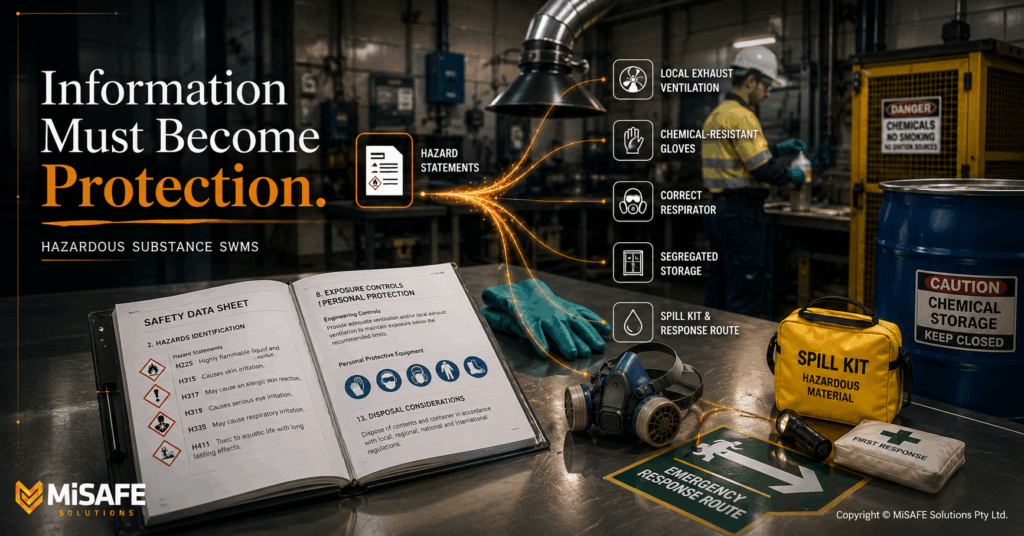
Start at section 2 of the SDS. The hazard statements tell you what the chemical does: causes serious eye damage, may cause cancer, highly flammable. Each statement points to a control the SWMS must carry.
Then work the hierarchy. Ask first whether a safer product can substitute. If not, engineer the exposure down with ventilation or enclosed processes. Administrative controls and PPE come last, and the SDS sections on exposure controls and personal protection tell you exactly which gloves, respirator and eye protection the task needs.
Next, cover storage and incompatibilities in the hazardous substances SWMS. The SDS names what the chemical must stay away from, and the SWMS should say where it lives on site and what it cannot share a store with.
Finally, plan the failure. Take the spill response from the SDS accidental release section and put it in the SWMS as steps the crew can follow, with the spill kit named and located. Where the chemical triggers health monitoring, such as for silica or isocyanates, the SWMS should say so and name the arrangement.
Practical Application
Picture a crew applying a solvent-based waterproofing membrane in a basement. The SDS flags flammable vapours, skin sensitisation and poor ventilation risk. The old approach staples that SDS to the SWMS and starts work.
The better approach reads those hazards into hazardous substances SWMS controls. Mechanical ventilation runs before and during the work, ignition sources stay out of the basement, and the crew wears the exact gloves and half-face respirator the SDS specifies. The membrane drums store away from the oxidising pool chemicals, and a marked spill kit sits at the basement entry.
One worker reports skin irritation at the end of the shift. Because the SWMS names the chemical and its sensitisation hazard, the supervisor connects the symptom to the substance, reports it, and reviews the glove selection. The SDS did its job because the SWMS translated it.
Conclusion
An SDS in a folder protects nobody. The value sits in the translation: hazard statements into controls, exposure data into PPE, the accidental release section into a spill plan the crew can run.
Link every chemical on the task to its SDS, pull the controls into the hazardous substances SWMS, and flag the ones still outstanding. Do that, and the chemical risk is managed rather than filed.
MiSAFE SWMS links each hazardous substance to its controls inside the document, so the SDS informs the SWMS instead of hiding behind it.
Ready to act? Contact us today or book a free 45-minute consultation.
Download the Free Template
Download the free Hazardous Substance SWMS Control Sheet (.xlsx) and turn every SDS on the job into controls the crew can use.
[author] [author_image timthumb=’on’]https://misafesolutions.com.au/wp-content/uploads/2026/08/1781760144180-1.jpeg[/author_image] [author_info]Micah Wicham is the Founder and Director of MiSAFE Solutions, with more than 10 years’ experience in Quality, Health, Safety and Environment. A qualified QHSE professional and certified Lead Auditor, Micah and his team work with Australian businesses to build practical compliance and safety systems that can scale as teams grow. To read more, visit the MiSAFE blog feed or Micah’s LinkedIn [/author_info] [/author]
This article is general guidance. Check the legislation that applies in your state, or talk to us about your situation.