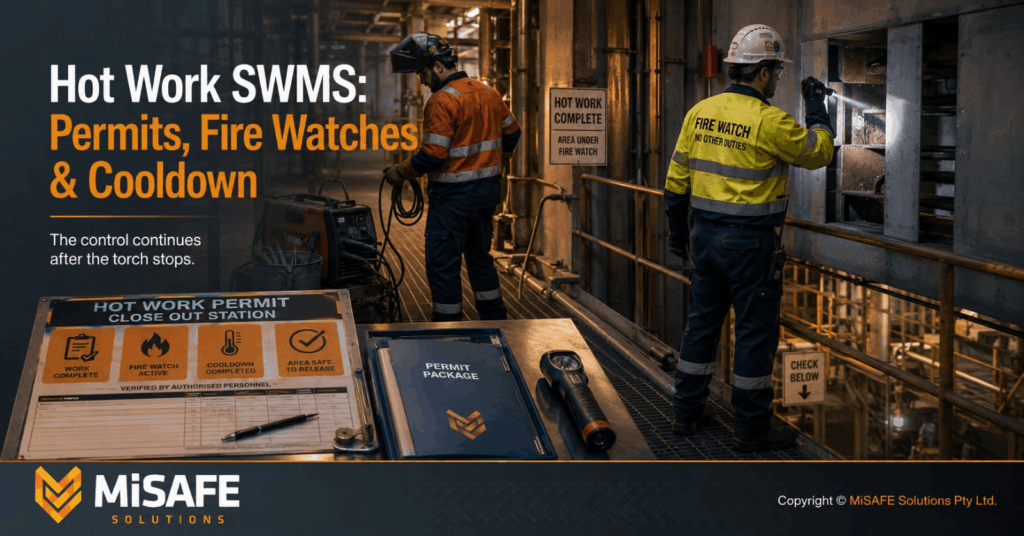
Hot work fires rarely start while the welder is welding. Instead they start an hour later, in the void behind the wall, once the crew has packed the truck and driven home. A spark travelled further than anyone expected, landed in something combustible, and smouldered quietly until it found enough air. A hot work SWMS should close that gap.
Most hot work SWMS never reach that far. They list a fire extinguisher, a welding screen and a permit number, then move on to the task steps. Yet the model WHS Regulation, AS 1674.1 and the fire loss record all point at the same weak link. The danger sits in the period after the torch goes down.
This post walks the full chain, from classification and permit through to the timed cooldown watch, and shows where each control belongs in the document.
What the WHS Regulation asks of a hot work SWMS
Start with classification, because it decides whether a SWMS is mandatory at all. Regulation 291 lists the eighteen categories of high risk construction work. Paragraph (l) catches construction work carried out in an area that may have a contaminated or flammable atmosphere. Regulation 299 then requires a SWMS before that work starts.
Grinding a bracket in an open yard does not automatically meet paragraph (l). However, cutting a penetration next to a solvent store does. Several neighbouring categories catch hot work as well. Those include work in or near a confined space, work on or near chemical, fuel or refrigerant lines, and work on or near pressurised gas mains or piping. Run the job against all of them before you decide.
Beyond the SWMS trigger, the general duties still apply. Regulations 34 to 38 require you to identify hazards, eliminate or minimise the risk, maintain the controls and review them when conditions change. Ignition sources attract a duty of their own under regulation 355, wherever hazardous chemicals create a fire or explosion risk. Fire protection and firefighting equipment sit in regulation 359. Airborne contaminants must stay below the workplace exposure standard under regulation 49, which matters a great deal for welding fume. Above all of these sits AS 1674.1, the Australian standard on fire precautions for welding. The Welding Processes and Construction Work Codes of Practice fill in the rest.
Why sparks travel further than the crew expects
Molten spatter from oxy cutting behaves like shot. It bounces, it rolls, and it drops. WorkSafe guidance asks you to identify and control fire hazards out to fifteen metres from the work. That radius covers the area outside the immediate zone as well as inside it. Flammable liquids, gases, dusts, timber, paper, textiles, packaging, plastics, tyres and dry grass all count.
Horizontal distance is only half the problem. Sparks fall through floor penetrations, service risers, drains, expansion joints and the gap at the base of a wall. Consequently the most dangerous ignition point is often on the level below, or in the ceiling void behind the plasterboard, where nobody is watching.
A hot work SWMS should therefore require a physical walk of the area below and behind the work, not just a glance around the welder. Where the crew cannot clear a combustible, they cover it, seal the penetration or wet it down. Where they cannot do either, the work moves.
The hot work permit is a gate, not a signature
A permit signed at smoko proves nothing. A competent and authorised person should inspect the area first, then issue the permit in writing before the work starts. The permit names the specific location, the equipment, the workers, the period it runs and the controls drawn from the risk assessment.
Re-validation is the step crews skip. Re-issue the permit when the shift changes, when the work stops and restarts, when the weather turns, or when the job moves beyond the area the current permit covers. A total fire ban changes the picture as well.
Vessels deserve their own gate. Before hot work on or near a drum, tank, pipe or vessel, identify the previous contents and read the safety data sheet. Then remove caps and bungs, drain, and clean by the method the contents demand. Next, test for flammable gas or vapour and confirm the concentration sits below five per cent of the lower explosive limit. Finally, displace the remaining air with water or an inert gas, because residues hide in seams and crevices. Where readings exceed five per cent, hot work stops and further controls follow. Never use oxygen to blow dust off clothing or benches either, since oxygen enrichment makes everything nearby far easier to ignite.
Fire watch during the work and the cooldown after
A fire watch is a person, not a role on a form. That person carries the correct extinguisher and holds no other duties. They also keep line of sight on every area a spark can reach, including the level below and the far side of the wall.
The watch does not finish when the welder puts the torch down. Australian practice treats thirty minutes of continuous monitoring after the work as the minimum, and AS 1674.1 sits behind that expectation. Extend the period well beyond thirty minutes where insulation, conveyor belts, dust, timber framing, voids or stored product are in play. Many sites run sixty minutes as standard for that reason, and some run longer. Let the risk assessment set the number rather than the clock on the wall.
Close the watch properly. The final inspection confirms that no smouldering material remains, and someone signs it with a time against their name. Until that signature exists, the permit stays open. That single discipline prevents most of the fires that start after everyone has gone home.
Cylinders, hoses and welding fume in the hot work SWMS
Equipment failure starts fires just as reliably as stray sparks. Fit flashback arrestors on the operator side of each regulator connection and at the blowpipe. Secure cylinders upright, protect the valves, and inspect hoses for cuts, abrasion and leaks before every shift. Leak test the connections rather than trusting the sound of them.
Fume is the slower hazard. Ventilate the area and place extraction as close as practicable to the point of welding. Safe Work Australia reduced the workplace exposure standard for welding fume, not otherwise classified, from five milligrams per cubic metre to one milligram per cubic metre as an eight-hour average. Individual components such as manganese and hexavalent chromium from stainless steel carry their own standards, so meeting the total does not automatically mean you have met the rest.
PPE closes the gap the other controls leave. Fire resistant clothing, correct lens shade, gloves, boots and eye protection are the baseline, with respiratory protection where the fume assessment calls for it. Record every one of these controls in the hot work SWMS against the step that creates the hazard, rather than in a generic list at the back.
Practical Application
Picture a fabrication crew cutting and welding a new services penetration through the plant room floor of an operating warehouse. The first draft of the hot work SWMS lists a nine litre extinguisher, a welding screen and a permit. It runs to two pages and reads fine in the office.
The supervisor, J. Smith, works the gates instead. First he classifies the work. A solvent store sits on the far side of the plant room wall, so the area may hold a flammable atmosphere and regulation 291(l) applies. Next he walks the level below the penetration, which the original SWMS never mentioned. There he finds a stack of cardboard pallets and a cable tray running directly under the cut line.
Preparation follows. The crew relocates the pallets, covers the cable tray with a fire blanket, seals the floor drain and blanks the penetration from below once the pilot hole is through. A. Jones tests the plant room atmosphere before the torch lights, and the reading sits well below five per cent of the lower explosive limit. J. Smith then issues the permit for a four-hour window, naming A. Jones as the operator and C. Brown as the fire watch on the level below rather than beside the welder.
Because the ceiling void carries insulation, the permit sets a sixty-minute cooldown watch. At forty minutes C. Brown finds a warm spot on the cable tray, wets it down and extends the watch by a further thirty. The final inspection clears at 4:20 pm, C. Brown signs the time, and J. Smith closes the permit. Nobody gets hurt, and the record shows exactly why.
Conclusion
A hot work SWMS earns its keep in the last hour, not the first. The cutting is the easy part. Everything that decides whether the building is still standing tomorrow happens in the area preparation before the arc strikes and in the watch that runs after it stops.
MiSAFE SWMS builds that sequence into the document itself. It prompts authors to classify the work before the task rows appear. It also ties the permit and the atmospheric checks to the controls that depend on them. Above all, it carries the fire watch and cooldown period as fields rather than as a note in the margin.
Ready to act? Contact us today or book a free 45-minute consultation.
Download the Free Template
Download the free Hot Work Permit and SWMS Control Checklist (.xlsx). It gates every hot work job through classification and permit, area clearance, equipment and atmosphere, and a timed fire watch and cooldown sign-off.
This article is general guidance. Check the legislation that applies in your state, or talk to us about your situation.