
Australian owned QHSE software and consulting
Incidents and investigations

Incidents reported in minutes, investigated properly and closed with evidence.

Anyone can report an incident, near miss or hazard from a phone, and the form fills itself from their description. Serious and notifiable incidents are flagged, and every investigation runs through to a checked close.
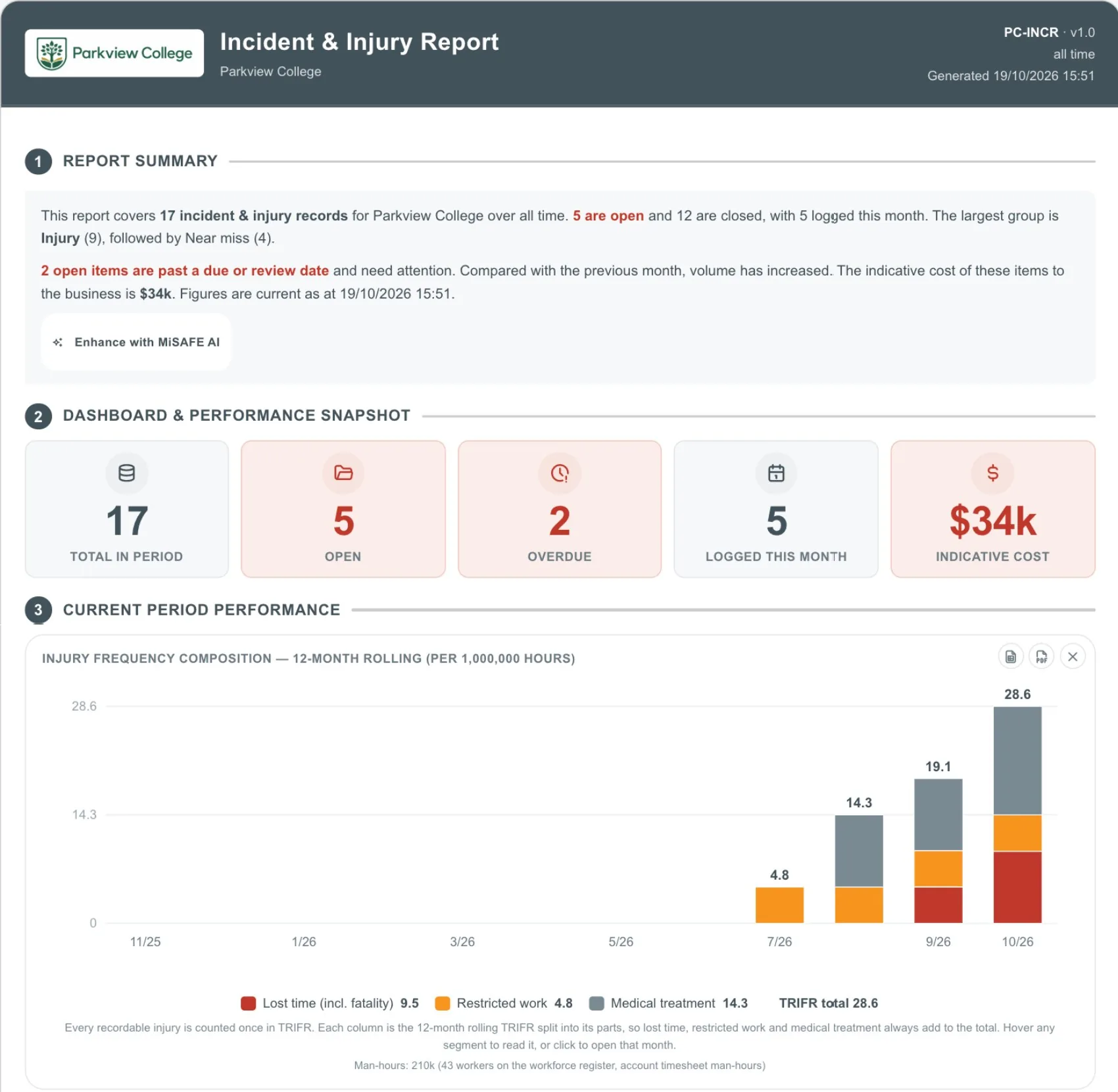
An Incident & Injury Report for the demo school, built from its incident register
What we see

Where incident reporting breaks down.

Reports arrive late, or not at all.

Paper forms and long screens mean near misses go unreported.

Nobody is sure what must be notified.

The deadline passes while someone looks up the rule.

Investigations stop at blame.

Actions are written down and never checked.

How it works

From first report to verified close out.

Incident management flowchart: report, classify, investigate and closeHow an incident runs in MiSAFE QHSE. Step 1, Report: describe what happened in plain words from a phone, and the form fills itself. Step 2, Classify: the incident is given a level and administrators are alerted; a notifiable or serious incident is flagged with the time limit that applies. Step 3, Investigate: a guided method with a timeline, evidence, five whys and contributing factors. Step 4, Close: corrective actions are tracked and checked before the case closes. Learnings then become a toolbox presentation for your people.Copyright © 2026 MiSAFE Solutions Pty Ltd. All rights reserved. 1 Report Describe what happened inplain words, from a phone. Theform picks up the people,place, injury and kind ofincident, with a body map andphotos. 2 Classify The incident is reviewed andgiven a level, andadministrators are alertedstraight away. 3 Investigate A guided method with atimeline, evidence, five whysand contributing factors,signed off by theinvestigation team. 4 Close Corrective actions areassigned and tracked. Someoneelse confirms each one workedbefore the case closes.Notifiable or serious?Flagged with the time limit thatapplies.Learnings become a toolbox presentation for your peopleReport, notify, investigate, correct and check: the WHS Act and ISO 45001 clause 10.2.Incident management flowchart: report, classify, investigate and closeHow an incident runs in MiSAFE QHSE. Step 1, Report: describe what happened in plain words from a phone, and the form fills itself. Step 2, Classify: the incident is given a level and administrators are alerted; a notifiable or serious incident is flagged with the time limit that applies. Step 3, Investigate: a guided method with a timeline, evidence, five whys and contributing factors. Step 4, Close: corrective actions are tracked and checked before the case closes. Learnings then become a toolbox presentation for your people.Copyright © 2026 MiSAFE Solutions Pty Ltd. All rights reserved. 1 Report Describe what happened in plain words,from a phone. The form picks up thepeople, place, injury and kind ofincident, with a body map and photos. 2 Classify The incident is reviewed and given alevel, and administrators are alertedstraight away.Notifiable or serious?Flagged with the time limit thatapplies. 3 Investigate A guided method with a timeline, evidence,five whys and contributing factors, signedoff by the investigation team. 4 Close Corrective actions are assigned andtracked. Someone else confirms each oneworked before the case closes.Learnings become a toolbox presentationfor your peopleReport, notify, investigate, correct and check: the WHSAct and ISO 45001 clause 10.2.
What you get

What you get, set up with you.

MiSAFE QHSE is implemented with you in five phases, starting with the features you need most.

  • Near miss and hazard reports on the same form, by phone, QR code or MiCompanion
  • First aid records and witness details on one case page
  • A prompt to secure the scene, with photos kept on the record
  • Student incidents record year level and class
  • Incident and injury heat maps across your own site plans
  • A full case file and investigation report, with privacy choices for sharing
Compliance built in

What regulators and auditors expect.

What each one asks of you, in plain words. The steps above are built to meet them.

Tell the regulator immediately about a death, a serious injury or illness, or a dangerous incident Work Health and Safety Act s 35 to s 38. Victoria has its own Occupational Health and Safety Act 2004
Preserve the incident site until an inspector arrives or directs otherwise Work Health and Safety Act s 39
Early learning services: keep a record of every incident, injury, trauma and illness Education and Care Services National Regulations r 87
Early learning services: tell a parent as soon as practicable, and within 24 hours Education and Care Services National Regulations r 86
Early learning services: notify the regulatory authority of a serious incident within 24 hours National Law s 174(2)(a) ยท National Regulations r 176(2)(a)(ii)
Investigate, fix the cause and check the fix worked ISO 45001:2018 cl 10.2
Questions

What people ask about incidents.

Can staff report without sitting at a computer?

Yes. They report from the app or a QR code, in their own words.

Does it tell us when an incident is notifiable?

It flags any report that matches the notifiable list and shows the time limit. The decision to notify stays with your people.

Can we keep an investigation confidential?

Yes. Sensitive and privileged cases are open only to the people you name, and every view is logged.

Incidents and investigations, set up for your organisation.

A demo built around your sites, your people and the records you keep today.