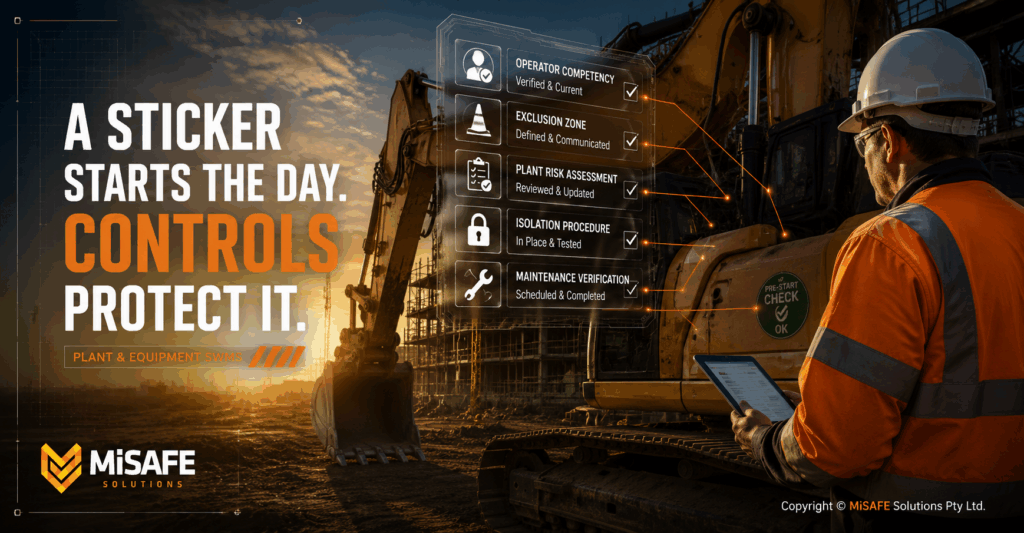
A green pre-start sticker on the excavator tells you someone walked around it this morning. It does not tell you the operator holds a licence, the guarding works, or the SWMS carries the real controls. A plant and equipment SWMS has to do more than point at a sticker.
Plant hurts and kills people on construction sites. It overturns, it crushes, and it strikes workers who stray into its path. A pre-start check is a good habit, but it is one small control, not the whole risk picture.
So this post looks at what the regulation requires for plant, why the sticker is not the control, and how to build the real plant and equipment controls into the SWMS.
What the WHS Regulation requires for plant and equipment in a SWMS
Regulation 203 of the Work Health and Safety Regulation 2017 makes the PCBU manage the risks associated with plant. That duty does not stop at a daily check. It runs for the whole time the plant is on site.
The regulation then gets specific. Regulation 208 requires guarding on dangerous moving parts. Maintenance and inspection come under regulation 213. And regulation 214 makes you control the risks of powered mobile plant: overturning, falling objects, an ejected operator, and collision with people or other plant.
Movement of powered mobile plant is also high risk construction work under regulation 291. So regulation 299 requires a SWMS for it. That SWMS has to carry the plant controls, not just record that a pre-start happened.
Operators add another duty. A high risk work licence is required under regulation 81 for plant such as cranes, forklifts and boom-type elevating work platforms. Competency is a control, and the SWMS should name it.
Why a pre-start sticker is not a plant control
A pre-start sticker records one thing: someone checked the machine before the shift. That matters, but it is a snapshot. It says nothing about who operates the plant, how you keep people clear of it, or how you isolate it for a repair.
The sticker also drifts. Crews sign the same card day after day, and the check becomes a signature rather than an inspection. On its own, the sticker proves activity, not control.
The real plant risk sits in the operation, not the morning walk-around. A licensed operator, a clear exclusion zone, a spotter, working guards and a safe isolation method do the controlling. The SWMS is where those controls belong.
The plant and equipment controls a SWMS must carry
Start with competency. Name the licence or verification of competency the operator must hold, and check it before the plant runs.
Then the plant itself. Reference the plant risk assessment, confirm the guarding is in place, and record the pre-operational and maintenance checks that keep it working. A pre-start sticker fits here as one control among several, not as the whole answer.
Next comes separation. Set the exclusion zone around moving plant, decide where spotters stand, and plan how people and plant stay apart. This is where regulation 214 lives on the ground.
Finally, isolation. Spell out how the plant shuts down and locks out for cleaning, clearing a blockage or a repair, so a machine that starts unexpectedly cannot catch anyone.
How to build plant and equipment controls into the SWMS
List every item of plant the task uses, from the excavator to the angle grinder. Each one brings its own hazards and its own controls.
For each item, work through the same checks: operator competency, plant risk assessment, guarding, isolation, exclusion zones and spotters, and the pre-operational and maintenance checks. Record the control, not just a tick.
A short plant control checklist makes this repeatable. Run each item of plant through the list, capture the control for each, and the SWMS carries a real plant picture rather than a sticker.
Practical Application
Picture an excavator loading trucks next to a work crew. The pre-start card is green, but that is where most sites stop. A plant and equipment SWMS goes further.
The SWMS names the operator’s ticket, sets a five-metre exclusion zone, puts a spotter on the truck movements, and confirms the reversing alarm and the isolation method for clearing the bucket. So the sticker becomes one line in a full set of controls.
When a truck driver needs to leave the cab, the SWMS already says how: eye contact with the operator, plant stopped, and a safe path clear of the swing. That is control, and no sticker delivers it.
Conclusion
A pre-start sticker is a good habit and a weak control. It records a check. It does not manage the risk of plant that overturns, crushes and strikes.
Put the real controls in the SWMS: operator competency, guarding, isolation, exclusion zones and spotters, and the pre-operational checks. Do that, and the plant and equipment controls hold up long after the morning walk-around.
MiSAFE SWMS builds the plant and equipment controls into each document, so competency, separation and isolation sit alongside the task steps rather than on a sticker by the cab.
Ready to act? Contact us today or book a free 45-minute consultation.
Download the Free Template
Download the free Plant and Equipment SWMS Control Checklist (.xlsx) and run every item of plant through the controls before the work starts.
This article is general guidance. Check the legislation that applies in your state, or talk to us about your situation.