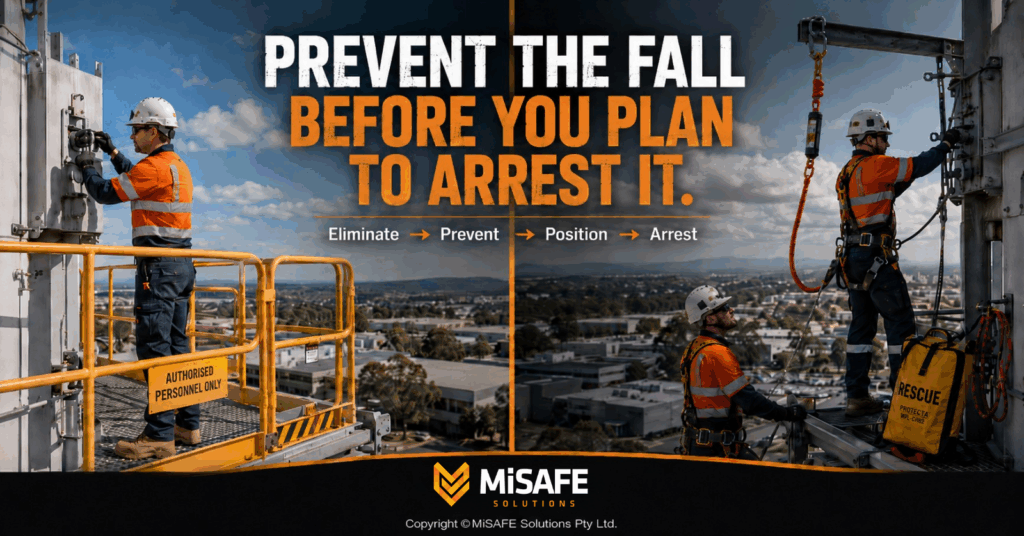
Walk onto almost any Australian site and the answer to height risk hangs in the crib room. A harness on a hook. The working at heights SWMS behind it usually reads the same way. Harness on, lanyard clipped, job done. Yet the law never starts with the harness, and neither should the SWMS.
Fall arrest does not stop a fall. Instead, it interrupts a fall already underway, with forces that can injure the worker it just saved. Fall prevention stops the fall from ever starting. The WHS Regulation ranks these options in a strict order. A SWMS that jumps straight to the bottom rung therefore skips one legal question. Why was prevention not reasonably practicable?
This post walks the falls hierarchy from top to bottom. It explains when fall arrest genuinely belongs in the working at heights SWMS. It also covers the extras a harness drags in. Think anchorage, free fall distance, swing, equipment inspection and a rescue plan.
What the WHS Regulation requires for a working at heights SWMS
Two parts of the model WHS Regulation carry the load here. First, regulation 291 lists the 18 categories of high risk construction work. The first entry covers work with a risk of a person falling more than 2 metres. Once the work meets that description, regulation 299 requires a safe work method statement before the work starts. South Australia adopted the national 2 metre threshold on 1 July 2026. As a result, the trigger now reads the same across the country.
Second, Part 4.4 of the WHS Regulation sets out the falls duties for every workplace, not just construction. Regulation 78 requires the PCBU to manage the risk of a fall from one level to another. Where reasonably practicable, the PCBU must eliminate that risk by working on the ground or on a solid construction. Regulation 79 then ranks the controls when elimination is not reasonably practicable. A fall prevention device comes first, a work positioning system second, and a fall arrest system last. Finally, regulation 80 adds the duty most SWMS forget. Wherever a fall arrest system is in use, the PCBU must establish rescue procedures and test them.
Read together, these provisions leave the working at heights SWMS no free choice of control. The hierarchy is law, and the SWMS must show the reasoning.
Why fall prevention beats fall arrest every time
A fall prevention device is physical and passive. Guardrails, edge protection, decked scaffolds, elevating work platforms and penetration covers all work without any action from the worker. Nobody has to clip on, inspect a lanyard or judge an anchor point. The protection stands there all shift, for every worker, in every state of fatigue.
A fall arrest system, by contrast, depends on a chain of human decisions holding up every single time. The harness must fit and the lanyard must suit the fall zone. The anchorage needs a rating, and the worker still has to clip on. Break one link and the system quietly becomes decoration. Even when everything works, the worker still falls and still absorbs the arrest forces. After that, they hang suspended until someone gets them down.
That is why regulation 79 ranks prevention above arrest rather than treating them as equals. The working at heights SWMS should reflect the same logic on paper. Before a harness appears in the control column, the document should record one thing. Why could a guardrail, a scaffold or an EWP not do the job? Sometimes a solid answer exists, such as short duration work on a fragile roof that cannot take edge protection. More often, the honest answer is that the harness was simply faster to write down.
The fall arrest extras most working at heights SWMS miss
When fall arrest truly is the right control, the working at heights SWMS inherits four extra subjects. Each one needs its own line in the document.
Anchorage comes first. An anchor point needs a rating for fall arrest loads, and someone must verify it before use. Guesswork from the ground does not count. Next comes the arithmetic. Free fall distance, lanyard extension, deceleration and worker height add up quickly. A lanyard that lets the worker strike the level below has failed at its only job. Swing risk belongs in the same row. A worker anchored off to one side pendulums into structure during a fall.
Equipment inspection is the third subject. Harnesses, lanyards and connectors need a documented check before each use, plus a periodic detailed inspection. Damaged gear comes out of service on the spot. Finally, regulation 80 demands a rescue plan. Suspension in a harness restricts blood flow within minutes. A suspended worker is therefore a medical emergency, not an inconvenience. The SWMS must name the rescuer, the equipment and the time target. The crew must also have practised the plan. A rescue plan that starts and ends with calling emergency services fails this test. It leaves the worker hanging until the nearest crew arrives.
How to build the decision into the working at heights SWMS
The fix is a visible decision trail. For each task in the working at heights SWMS, the document should answer four questions in order. Can the crew do the work from the ground or a solid construction? If not, which fall prevention device will do the job? If prevention is not reasonably practicable, will a work positioning system hold the worker clear of the fall? Only after those three answers does fall arrest enter the document. With it come the anchorage, distance, inspection and rescue rows above.
Written this way, the SWMS does two jobs at once. It steers the planning conversation toward the stronger controls. It also evidences the reasoning an inspector will ask for after an incident. The document shows the control you chose and why you ruled out the better ones.
Practical Application
Picture a roof plumbing crew replacing sheets on a warehouse in an industrial estate. The job sits 6 metres up, well past the 2 metre trigger. A SWMS is therefore mandatory before anyone climbs. The first draft lists harnesses and roof anchors for all four workers and moves on.
The supervisor, J. Smith, walks the decision trail instead. Nobody can replace the sheets from the ground, so elimination is out. Prevention comes next. This structure takes perimeter edge protection, and an EWP can land materials away from the edge. With guardrails up, three of the four workers never need a harness at all. Only A. Jones, cutting in around the ridge ventilators, works beyond the protected zone. That task keeps fall arrest in the working at heights SWMS. The rows behind it record a rated anchor, a fall clearance calculation and a pre-use gear inspection.
Because one harness remains, regulation 80 still applies. The crew carries a rescue kit on the roof, and C. Brown holds the rescue role. Their plan targets retrieval within minutes, not a wait for emergency services. When a WHS inspector visits mid-job, the SWMS shows the full reasoning. Prevention sits everywhere practicable, arrest covers one task, and a rescue plan backs the arrest. The conversation lasts ten minutes and the work continues.
Conclusion
Fall prevention protects everyone on the level without asking anything of them. Fall arrest protects one clipped-on worker, after a fall, with arrest forces and a race to rescue attached. The WHS Regulation ranks them in that order. A working at heights SWMS should show the same order, with reasons rather than habits.
MiSAFE SWMS builds the falls hierarchy into the document itself. It prompts authors to rule out prevention first, and it carries the rescue plan beside the harness rows. As a result, the reasoning sits on the page before the crew leaves the ground.
Ready to act? Contact us today or book a free 45-minute consultation.
Download the Free Template
Download the free Working at Heights SWMS Control Checklist (.xlsx). It walks each height task down the hierarchy before a harness reaches the SWMS.
[author] [author_image timthumb=’on’]https://misafesolutions.com.au/wp-content/uploads/2026/08/1781760144180-1.jpeg[/author_image] [author_info]Micah Wicham is the Founder and Director of MiSAFE Solutions, with more than 10 years’ experience in Quality, Health, Safety and Environment. A qualified QHSE professional and certified Lead Auditor, Micah and his team work with Australian businesses to build practical compliance and safety systems that can scale as teams grow. To read more, visit the MiSAFE blog feed or Micah’s LinkedIn [/author_info] [/author]
This article is general guidance. Check the legislation that applies in your state, or talk to us about your situation.