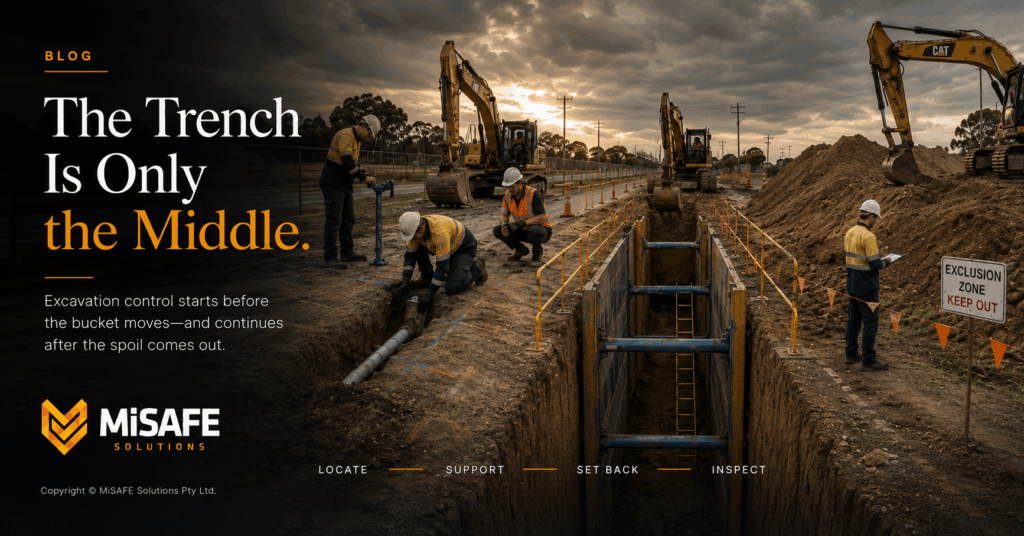
On most Australian sites, the excavation SWMS opens at the trench. Position the excavator, dig, keep clear of the edge, backfill. Yet the two events that kill people sit outside those steps. One happens before the bucket goes in. The other happens after the spoil comes out.
Service strikes and trench collapses give almost no warning. A crew clips an unmarked gas main because nobody potholed the mark-up. A wall lets go at smoko because the spoil pile sat hard against the edge and it rained overnight. Neither failure shows up in an excavation SWMS that starts at the dig.
This post walks the full sequence, from the underground service locate through the ground support decision to spoil and plant placement, and shows exactly where each step belongs in the document.
What the WHS Regulation requires before an excavation SWMS exists
Three provisions carry the load here. First, regulation 291 of the model WHS Regulation lists the 18 categories of high risk construction work. Paragraph (g) captures work carried out in or near a shaft or trench with an excavated depth greater than 1.5 metres, or a tunnel. Once the work meets that description, regulation 299 requires a safe work method statement before the work starts.
Second, regulation 304 sits ahead of the SWMS entirely. The person with management or control of the workplace must take all reasonable steps to obtain current underground essential services information before directing or allowing excavation work to commence. They must then hand that information to whoever carries out the work, and both parties must have regard to it. In addition, the information must stay available for inspection until the work finishes, or for at least two years where a notifiable incident occurs.
Third, regulation 305 imposes the general duty to manage risks associated with excavation work, and regulation 306 adds specific controls for trenches at least 1.5 metres deep. Read together, these provisions decide what the excavation SWMS has to prove.
Why the excavation SWMS starts too late
A Before You Dig Australia enquiry produces plans, not certainty. Asset owners draw those plans from their own records, and records drift over decades of repairs, relocations and abandoned assets. As a result, a mark-up on the ground tells the operator roughly where a service runs, not exactly where it sits or how deep it lies.
Regulation 304 uses the word current for that reason. Plans pulled six months ago for a different stage of the job are not current. Neither is a set of drawings that names three asset owners when four operate in the street. The excavation SWMS should therefore record the enquiry date, the assets identified and the assets still unconfirmed.
Verification closes the gap. Non-destructive digging, usually hydro or vacuum excavation, exposes the service so the crew can see it before mechanical plant arrives. Potholing at the crossing points converts an indicative line into a known depth and alignment. Above all, the SWMS should name who potholes, at which chainages, and what happens when the service turns up somewhere other than the mark.
Ground support decisions the excavation SWMS must show
Regulation 306 applies to any trench at least 1.5 metres deep. The PCBU must secure the work area against unauthorised access, including inadvertent entry, so far as is reasonably practicable. More importantly, the PCBU must minimise the collapse risk by ensuring all sides of the trench are adequately supported by shoring, shielding or other comparable means. Only one exemption exists. Written advice from a geotechnical engineer confirming that all sides are safe from collapse.
Benching and battering also prevent collapse, and the Excavation Work Code of Practice explains both. Battering cuts the wall back to a stable slope. Benching steps the wall down in horizontal levels. However, both consume room at the surface, and neither suits a narrow street or a boundary trench. Shoring and shields work where space runs out.
Most excavation SWMS name one method and stop. A stronger document records the ground conditions the choice depends on, the depth at which the method changes, and the trigger for stopping work and reassessing. Soil type, groundwater, previous excavation and nearby traffic loads all move that decision. Because ground rarely behaves uniformly along a run, the SWMS should treat the support method as a decision, not a constant.
Spoil, plant and the zone of influence
Spoil is the part of the job the excavation SWMS most often ignores. Material stockpiled beside a trench loads the ground above the wall, and that surcharge pushes the wall inward. Rain makes it heavier. Vibration from passing plant shakes it loose. For that reason, the Excavation Work Code of Practice directs that spoil sit clear of the edge, and that anything else with weight stays clear too.
The zone of influence describes the ground that carries the wall. Anything inside it becomes a load on the excavation: the spoil pile, the excavator tracks, a delivery truck, a site hut, a stack of pipes. Once the SWMS marks that zone, plant placement becomes a control rather than an afterthought.
Ground also changes overnight. Rain saturates a batter, frost lifts a face, and a passing truck vibrates a shored wall. Therefore the SWMS needs a daily inspection gate before entry, and a repeat gate after any rain, vibration or ground movement. A competent person walks the excavation, checks the support, checks the spoil setback and signs the entry off.
How to build the sequence into the excavation SWMS
Four gates turn a generic document into an excavation SWMS that holds up. Gate one covers the service locate: the enquiry reference, the assets identified, the potholing done and the assets still unverified. Gate two covers ground support: the depth, the ground conditions, the method chosen and the engineering advice where the method relies on it. Gate three covers spoil and plant: the zone of influence, the spoil setback and the exclusion for plant and deliveries. Gate four covers daily inspection: who inspects, when, and what stops entry.
Written this way, the document tracks the job from before the first cut to after the last load. It also answers the questions an inspector asks after an incident. What did you know about the services, how did you verify it, why did you choose that support method, and who checked the excavation that morning?
Practical Application
Picture a civil crew installing stormwater in an established industrial estate. The trench runs 2.1 metres deep along a service road, so regulation 291 catches the work and a SWMS is mandatory before anyone breaks ground. The first draft lists the excavator, the trench box and a spotter, then moves on.
The supervisor, J. Smith, walks the sequence instead. Plans came back from the Before You Dig Australia enquiry three weeks earlier and name water, telecommunications and electricity. Nobody has confirmed the gas main a neighbouring occupier mentioned. So the SWMS adds a hydro excavation pothole at every crossing and a hold point until the gas asset owner responds. A. Jones runs the potholing and photographs each exposure against the chainage.
Ground support comes next. The trench sits in mixed fill over clay, which rules out battering in the available width. The crew therefore uses a trench shield rated for the depth, with the shield set before entry and lifted with the excavator, never with workers alongside. Spoil goes to a windrow well clear of the edge, and the excavator tracks stay outside the marked zone of influence. Deliveries drop at a laydown area away from the trench line.
Because rain fell overnight midway through the job, the daily inspection gate does its work. C. Brown inspects before entry, finds slumping at the northern face and stops entry until the shield is repositioned. When a WHS inspector arrives the following week, the excavation SWMS shows the whole chain: the enquiry, the potholing evidence, the support decision, the spoil setback and the signed inspections. The conversation takes ten minutes.
Conclusion
An excavation kills in two ways that the trench steps never describe. Something under the ground goes unverified, or something above the ground surcharges the wall. A document that starts at the dig misses both.
MiSAFE SWMS builds the sequence into the document itself. It prompts authors to record the service locate and the verification before the plant rows appear, and it carries the ground support decision, the spoil setback and the daily inspection gate as controls rather than notes.
Ready to act? Contact us today or book a free 45-minute consultation.
Download the Free Template
Download the free Excavation SWMS Control Checklist (.xlsx). It runs each excavation through the four control gates before the plant moves in.
[author] [author_image timthumb=’on’]https://misafesolutions.com.au/wp-content/uploads/2026/08/1781760144180-1.jpeg[/author_image] [author_info]Micah Wicham is the Founder and Director of MiSAFE Solutions, with more than 10 years’ experience in Quality, Health, Safety and Environment. A qualified QHSE professional and certified Lead Auditor, Micah and his team work with Australian businesses to build practical compliance and safety systems that can scale as teams grow. To read more, visit the MiSAFE blog feed or Micah’s LinkedIn [/author_info] [/author]
This article is general guidance. Check the legislation that applies in your state, or talk to us about your situation.