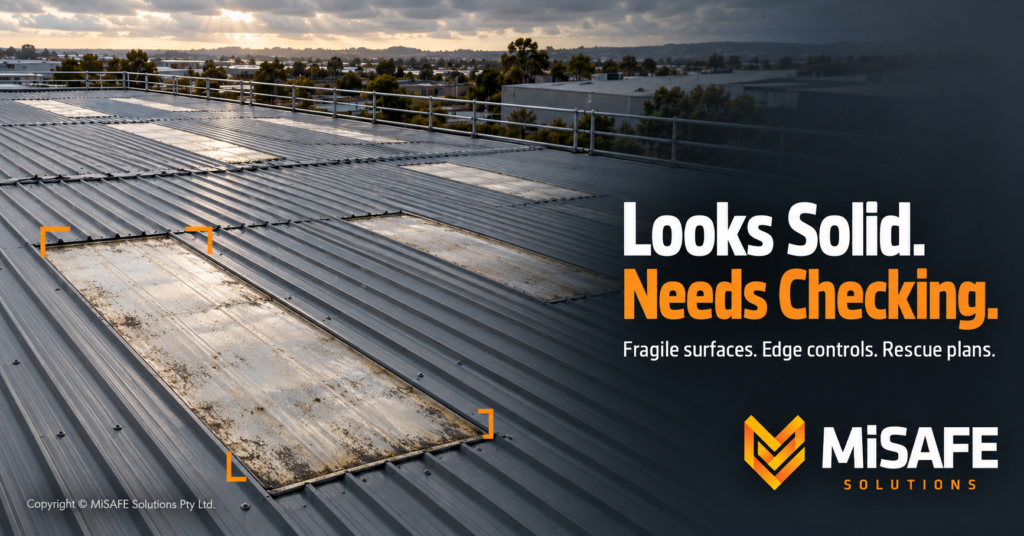
A roofer steps off the safe edge onto a sheet that looks like every other sheet on the roof. It is old fibre cement, and it cannot carry a person. The SWMS on the clipboard says fall protection in place. It does not say how the crew found that sheet, marked it or kept people off it. A roofing SWMS should answer those questions before the first person climbs the ladder.
Most roofing SWMS documents list edge protection and harnesses and then move on. They rarely name how the crew identifies fragile surfaces. They rarely say who decides between edge protection, safety mesh, work positioning and fall arrest. As a result, the decision happens on the roof, under time pressure, by whoever is nearest.
This post sets out the WHS Regulations that apply to roof work. It then names four points the SWMS must state: the roof survey and fragile surface map, the hierarchy decision for each roof zone, the access and edge controls, and the rescue plan. The free Roofing Fall Protection and Fragile Surface Control Checklist turns those four points into a record you can audit.
What the WHS Regulations require for a roofing SWMS
Roof work usually triggers Regulation 291 of the model Work Health and Safety Regulations. Regulation 291(a) makes construction work high risk when a person could fall more than two metres. A roof ridge sits well above that line. Regulation 299 then requires a SWMS before the work starts, and Regulation 300 requires the crew to follow it.
The falls chain sits in Part 4.4. Regulation 78 requires the person conducting the business or undertaking to manage the risk of a fall that could injure anyone. Regulation 79 sets the order of controls. A fall prevention device comes first. Work positioning comes second, and fall arrest comes last. Regulation 80 then requires emergency and rescue procedures, and the crew must be able to carry them out.
The Managing the Risk of Falls at Workplaces Code of Practice fills in the roof detail. It counts a fall through a fragile surface as a fall that Regulation 78 covers. Safe Work Australia guidance on fragile roofs adds the practical steps, including testing nothing by foot and marking every fragile area.
Why a roofing SWMS misses the fragile surface
The SWMS author writes from the plans. The plans show the roof pitch, the sheeting and the edge. They rarely show the skylight that a previous owner added, or the translucent sheet that weathering has made brittle. The crew finds those on the day.
Fibre cement, old polycarbonate and rusted metal sheeting look sound from above. A fragile sheet can carry a person on Monday and fail on Tuesday after the sun has baked it. Consequently, a roof that looks uniform can hide a fall of several metres.
The fix is a survey that happens before access, a map the whole crew sees, and a SWMS that names both as controls with a named owner. The roofing SWMS then describes the roof that actually exists, not the roof on the plan.
The roof survey and fragile surface map in a roofing SWMS
First comes the survey. A competent person inspects the roof from a safe position, such as a scissor lift, an elevated work platform or the ground. They record every skylight, every translucent or rusted sheet, every opening and every edge condition. Nobody walks the roof to find out.
The map follows. It marks each fragile area, each opening and each edge on a simple roof plan. Next, the supervisor photographs the plan and posts it at the access point. Every crew member signs to say they have read it. Meanwhile, the SWMS states who updates the map when conditions change.
In addition, the survey sets the zones. A roof divides into zones such as the open field, the edges, the valleys and the penetrations. Each zone gets its own control decision in the next step.
The hierarchy decision for every roofing SWMS zone
Regulation 79 puts prevention first, so the SWMS records the decision for each zone. Edge protection or safety mesh comes first wherever it is reasonably practicable. A work positioning system comes next. A harness on a fixed anchor is the last choice, and the SWMS says why the higher controls were not practicable.
Most roofing SWMS documents skip this record. They state that the crew wears harnesses, which means every zone defaulted to the lowest control. A harness only works if the anchor holds, the lanyard length is right and the rescue happens fast. An inspector will ask why edge protection was not used.
The decision record answers that question in one line per zone. For example, safety mesh under the sheets covers the open field, a temporary edge protection system protects the eaves, and the valley uses a work positioning system. The supervisor signs each decision before access.
Edge protection and access controls on the roof
Temporary edge protection must suit the roof. Roof edge protection systems follow AS/NZS 4994, and the installer follows the manufacturer’s instructions. The SWMS names the system, the installer and the person who inspects it. A missing section of edge protection is a stop-work item, not a note in the diary.
Access matters as much as the edge. The crew reaches the roof by an access ladder that extends above the eave, a scaffold stair or a scissor lift. The SWMS states which one, who checks it and who stops people using the wrong route. Below the roof, an exclusion zone protects anyone walking past from dropped tools and sheets.
Plant and powerlines add their own hazards. A crane delivering sheets must not swing loads over people. Overhead electric lines near the roof need a recorded clearance. Both belong in the roofing SWMS, because the roof crew controls them.
Safety mesh, skylights and the roofing SWMS
Safety mesh works as a fall prevention device when the installer fixes it correctly and covers the whole area. Mesh under the sheets stops a person falling through a weak sheet. The installer fixes it to the structure before the sheets go on. AS 4389 covers the product, and the installer follows the manufacturer’s fixing rules.
Skylights need their own line in the SWMS. The crew covers each skylight with a rated cover or a guard that can carry a person, and nobody removes it until the work needs the opening. A cover that sits loose in the wind is not a control. The crew fixes it down.
Likewise, the SWMS treats a fragile surface that nobody can protect as a no-go zone. The crew marks it, bars it and works around it. Standing on the sheet to reach the next ridge is never an option.
Rescue before the first sheet goes down
Regulation 80 requires emergency and rescue procedures. In practice, many roofing SWMS documents say that the crew will call 000. A person hanging in a harness needs rescue within minutes, and an ambulance will not arrive in time. Suspension trauma starts quickly.
The SWMS therefore names the rescue method. It lists the equipment, the trained rescuers and the person who calls it. A competent person tests the plan before the first sheet goes down, and the crew rehearses it on a dummy load or a real person in a controlled setting. If the plan fails, the roof stays closed.
The rescue plan also covers a worker who falls through a sheet onto the floor below. A mesh or a platform stops that fall, and the plan states who reaches the person and how.
Practical Application
Consider a re-roof on a two-storey factory, with a 4 degree pitch and 600 square metres of old fibre cement sheeting. J. Smith, the site supervisor, books a scissor lift and surveys the roof from above before anyone climbs. The survey finds six translucent sheets and two skylights.
A. Jones, the roofing leader, marks each fragile area on the roof plan. The SWMS records the zone decisions. Safety mesh covers the open field, the eaves carry a temporary edge protection system, and the skylights get fixed rated covers. S. Wilson, the crew member trained in rescue, runs the rescue test at the access ladder before the first sheet comes off.
On day two, the register reads DO NOT ACCESS ROOF because the edge protection inspection is not signed. The crew waits twenty minutes while J. Smith inspects the system. That delay costs far less than a fall through a sheet. The roofing SWMS now describes the roof that stands in front of the crew.
Conclusion
A roofing SWMS that says only fall protection in place leaves the decision to the person on the roof. The Regulations require more. Regulation 291 makes the work high risk, Regulations 299 and 300 require the SWMS, and Regulations 78 to 80 require the control hierarchy and a rescue plan. Four points carry most of the weight. They are the roof survey and fragile surface map, the hierarchy decision for each roof zone, the access and edge controls, and a rescue plan tested before work starts. Write those in plain terms and the document protects the person who steps onto the roof.
MiSAFE SWMS builds those controls into the document from the first prompt. The AI drafts the roofing SWMS around the roof and the crew you describe, and you keep control of every field. Workers then sign on site by scanning the QR code on the document, so the supervisor sees live who has read the fragile surface map before they climb.
Ready to act? Contact us today or book a free 45-minute consultation.
Download the Free Template
Download the free Roofing Fall Protection and Fragile Surface Control Checklist (.xlsx) and keep every roof behind a status gate that reads DO NOT ACCESS ROOF until the survey, the control decision and the rescue plan are all signed.
This article is general guidance. Check the legislation that applies in your state, or talk to us about your situation.