Walk onto most Australian sites and ask a second-year apprentice what the environmental policy commits to. You will usually get a shrug. That shrug is the gap a QHSE awareness campaign exists to close. It is not training and not another procedure. Instead, it is a planned, repeated effort to help every worker understand the system they work inside and the part they play in making it work.
External auditors see the same pattern everywhere. The manual looks polished, the registers are current, and the policies hang framed in reception. Then the auditor interviews a worker on the tools, and awareness stops at the QHSE Manager’s door. The system exists on paper but not in people’s heads.
The good news is that awareness is one of the cheapest clauses in the standards to get right. It just needs the discipline you would apply to any campaign. That means a message, an audience, a channel, a schedule and a way of checking the message landed.
What Clause 7.3 requires of a QHSE awareness campaign
ISO 9001:2015, ISO 14001:2015 and ISO 45001:2018 each carry Clause 7.3 Awareness. Under all three standards, persons doing work under the organisation’s control must know the relevant policy and the objectives that apply to them. They must also understand their contribution to the effectiveness of the management system, the benefits of improved performance, and the implications of not conforming.
ISO 14001 extends this to the significant environmental aspects linked to a person’s work. ISO 45001 goes further again. Workers must know about incidents and investigation outcomes relevant to them, the hazards and risks in their work, and their right to remove themselves from serious and imminent danger without reprisal.
Australian law sets the same expectation. Under section 19(3)(f) of the Work Health and Safety Act 2011, a person conducting a business or undertaking must provide the information, training, instruction or supervision needed to protect people from risks arising from the work. Awareness is the information half of that duty. Safe Work Australia’s codes of practice consistently point to communication and consultation as the way to discharge it.
Why a QHSE awareness campaign beats posters and inductions
Most businesses treat awareness as an event. A worker sits through induction once, signs a form, and everyone presumes awareness for the rest of their employment. A poster goes up in the crib room and everyone presumes the crew read it. Neither survives contact with an audit interview.
Induction content decays fast. People lose most of the detail within weeks unless something reinforces it. Posters suffer the wallpaper effect, because after a fortnight nobody sees them at all. On top of that, neither method adapts when the risk profile changes, the business sets a new objective, or an investigation surfaces a lesson every crew should hear.
The evidence for awareness is simple and brutal. Pick a worker at random and ask three questions in their own words. What does the policy commit us to? Which risks matter most in your job, and what controls protect you? And what happens if someone bypasses them? If the answers are blank, the campaign has not worked, no matter how good the artwork was.
How to plan a QHSE awareness campaign that sticks
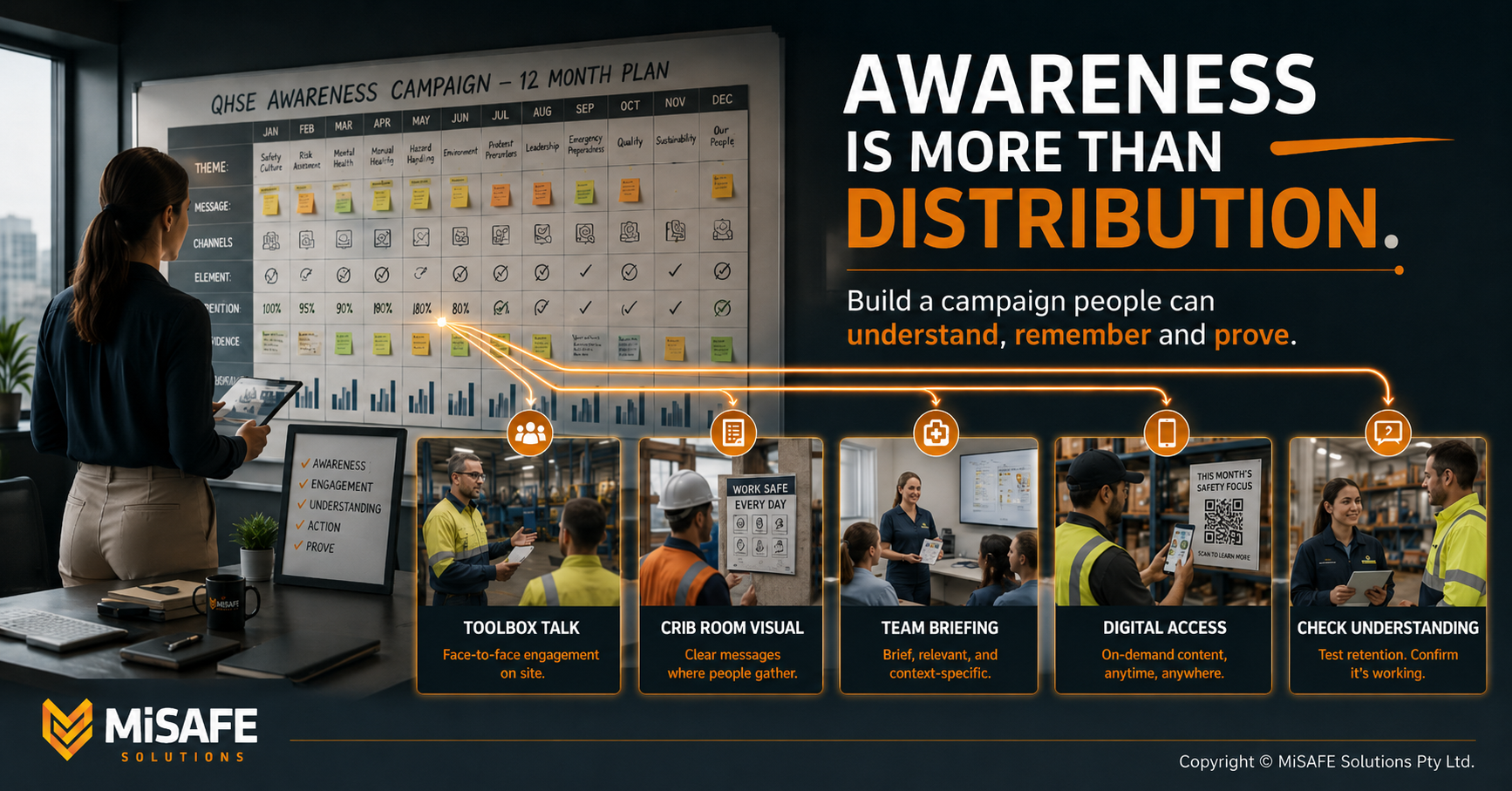
Treat your QHSE awareness campaign the way a marketer treats a product launch. Define the audience, because a message pitched at supervisors will miss labour hire crews. Pick one message for the month, because ten messages at once means none of them land. Choose the channels that actually reach your people. Set the frequency, name an owner, and decide up front what evidence you will keep.
Build the campaign around a rolling twelve-month calendar of monthly themes. Anchor each theme to something real. Use your highest-rated risks, your current objectives, the season, incident trends and the items Clause 7.3 names. For example, run heat illness before summer and storm water management before the wet. A theme a month, delivered through three or four channels, beats fifty-two random toolbox topics every time.
Then close the loop that most campaigns leave open: record every delivery. Note which crew, which site, which date, who led it, and what evidence exists. When an auditor challenges the campaign, the register is the proof. When an activity slips, the gap shows up in time to fix it rather than twelve months later.
Channels that reach every worker, and how to test the message landed
The strongest campaigns mix channels. Toolbox talks and pre-starts carry the spoken message, while screens in crib rooms and QR codes on noticeboards carry the visual one. Supervisor briefing notes keep every leader telling the same story. SWMS and permit briefings tie the theme to live work. Payslip messages and text blasts reach the workers who never set foot in the shed. None of these need a budget; they need a schedule.
Testing effectiveness does not require an exam. Ask two quiz questions at the month’s last toolbox and record the hit rate. Have supervisors ask one campaign question during site walks. Use audit and inspection interviews as sampling. Then feed the results into Management Review under Clause 9.3, because all three standards expect evidence that communication and awareness are working. A weak result triggers next month’s reinforcement rather than a shrug.
Practical Application
Consider an Australian manufacturer with 40 staff across two sites, running day and afternoon shifts with a mix of permanents, casuals and labour hire. The QHSE Manager builds a twelve-month QHSE awareness campaign calendar in the planner. Machine guarding runs in month one, driven by the two highest-rated risks on the register. Hazardous chemicals follow in month two alongside an SDS refresh, and energy and waste targets take month three, tied to the new environmental objectives.
Each theme runs through four channels. Every supervisor receives a five-minute pre-start talk script. The crib room display carries a one-screen visual, a QR code links to a two-minute explainer, and the final toolbox of the month closes with two quiz questions. The team logs every delivery in the register with the crew, date and evidence. Next-due dates then flag any crew that missed the theme while there is still time to catch them up.
Six months later, the surveillance auditor interviews a casual on afternoon shift. The worker explains the guarding rules, names the interlock check on their machine, and knows exactly what to do if someone defeats a guard. That interview, multiplied across a workforce, is what Clause 7.3 conformity actually looks like.
Conclusion
Awareness is where an IMS stops being a document set and starts becoming a culture. A QHSE awareness campaign gives that transformation a structure: one theme at a time, delivered through channels that reach everyone, logged as evidence and tested for effect. Run it for a year and the audit interviews change, the near-miss reports get sharper, and the system finally lives in the heads of the people it protects.
The MiSAFE All-in-One QHSE subscription includes configuration of your awareness campaign calendar inside your QHSE platform, with scheduled toolbox content, automated delivery tracking and Management Review-ready effectiveness summaries.
Ready to act? Contact us today or book a free 45-minute consultation.
Download the Free Template
Download the free QHSE Awareness Campaign Planner (.xlsx) and start running awareness as a planned, measured campaign instead of a set-and-forget poster.
[author] [author_image timthumb=’on’]https://misafesolutions.com.au/wp-content/uploads/2026/08/1781760144180-1.jpeg[/author_image] [author_info]Micah Wicham is the Founder and Director of MiSAFE Solutions, with more than 10 years’ experience in Quality, Health, Safety and Environment. A qualified QHSE professional and certified Lead Auditor, Micah and his team work with Australian businesses to build practical compliance and safety systems that can scale as teams grow. To read more, visit the MiSAFE blog feed or Micah’s LinkedIn [/author_info] [/author]
This article is general guidance. Check the legislation that applies in your state, or talk to us about your situation.