
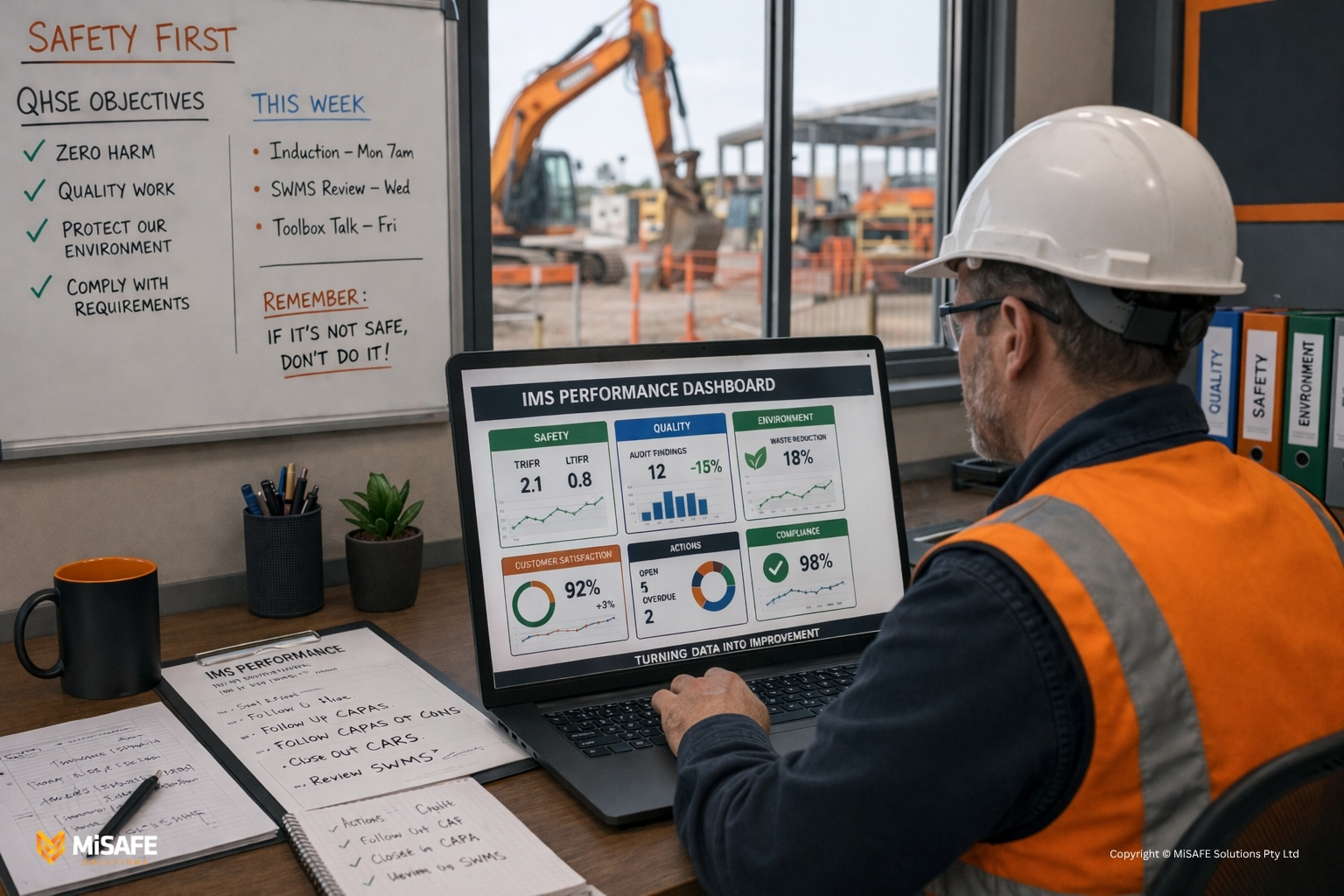
Welcome to Week 15 of MiSAFE Solutions Pty Ltd’s IMS Mastery Series: “Build Your IMS Empire: 53 Weeks of QHSE Insights with MiSAFE”. Following Week 14’s focus on smart communication, this week we move into performance evaluation. Under the ISO Annex SL structure (Clause 9), monitoring and measuring your Integrated Management System (IMS) is essential to know if it is actually delivering results across Quality (ISO 9001), Health & Safety (ISO 45001), and Environment (ISO 14001).
You can’t improve what you don’t measure.
Why Monitoring and Measuring Matters
Without clear data, your IMS operates in the dark. You won’t know if risks are reducing, objectives are being met, or whether the system is truly effective. In Australian businesses, especially SMEs in construction and manufacturing, poor measurement often leads to repeated incidents, failed audits, and wasted resources. Regular, targeted monitoring turns your IMS into a data-driven tool that proves value to leadership, regulators, and customers.
Key Areas to Monitor and Measure
Annex SL Clause 9 requires you to evaluate performance in these core areas:
- QHSE Objectives and Targets: Are you meeting your goals?
- Operational Controls: Are processes (including SWMS) working as planned?
- Compliance: Are legal and other requirements being met?
- Risk and Opportunity Effectiveness: Are controls reducing risks and capturing opportunities?
- Customer and Stakeholder Satisfaction: Are expectations being fulfilled?
Practical Steps to Measure What Matters
Follow this clear process to build an effective monitoring system:
- Define Key Performance Indicators (KPIs): Choose 5–8 meaningful metrics (e.g., incident rate, audit findings, waste reduction, customer complaints).
- Set Up Data Collection: Decide how, when, and who will collect the data (forms, apps, dashboards).
- Analyse Trends: Review data monthly or quarterly — look for patterns, not just numbers.
- Take Action: Use insights to drive corrective actions and continual improvement.
- Report and Communicate: Share results with leadership and teams (linking back to Week 14).
Common Challenges and Solutions
Many organisations collect too much data or none at all. Solution: Keep it simple and focused on what drives real decisions. Use free or low-cost tools (spreadsheets, apps) and review KPIs regularly to ensure they remain relevant.
Benefits of Effective Measurement
When done right, monitoring gives you clear visibility, early warning of problems, proof of improvement, and confidence during audits. It transforms your IMS from a compliance exercise into a powerful business tool.
Get Started with Your Free Tool
Download the QHSE Performance Monitoring Tool (Document ID: MISAFE-IMS-TMP-012-V1.0) to define, track, and review your key QHSE metrics.
Stay Tuned
Next week: “Internal Audits That Add Value: Checking Your IMS Health”. Subscribe for updates.
Ready to act? Contact us today for expert support at https://misafesolutions.com.au/contact-us/ or book a free 1hr consultation meeting to discuss your IMS requirements with MiSAFE at https://calendly.com/misafe/1-hour-ims-development.
This article is general guidance. Check the legislation that applies in your state, or talk to us about your situation.