Workers cutting, grinding, or drilling into concrete and masonry have always dealt with dust. What has changed is what the law now demands you do about it, and the bar has been raised significantly. Australia’s respirable crystalline silica exposure standard was halved in 2020. Then, in 2024, the country became the first in the world to ban engineered stone entirely. These are not minor updates to policy documents. They represent a fundamental shift in what regulators expect of every person conducting a business or undertaking that exposes workers to silica dust. Your SWMS must reflect these changes.
The Engineered Stone Ban
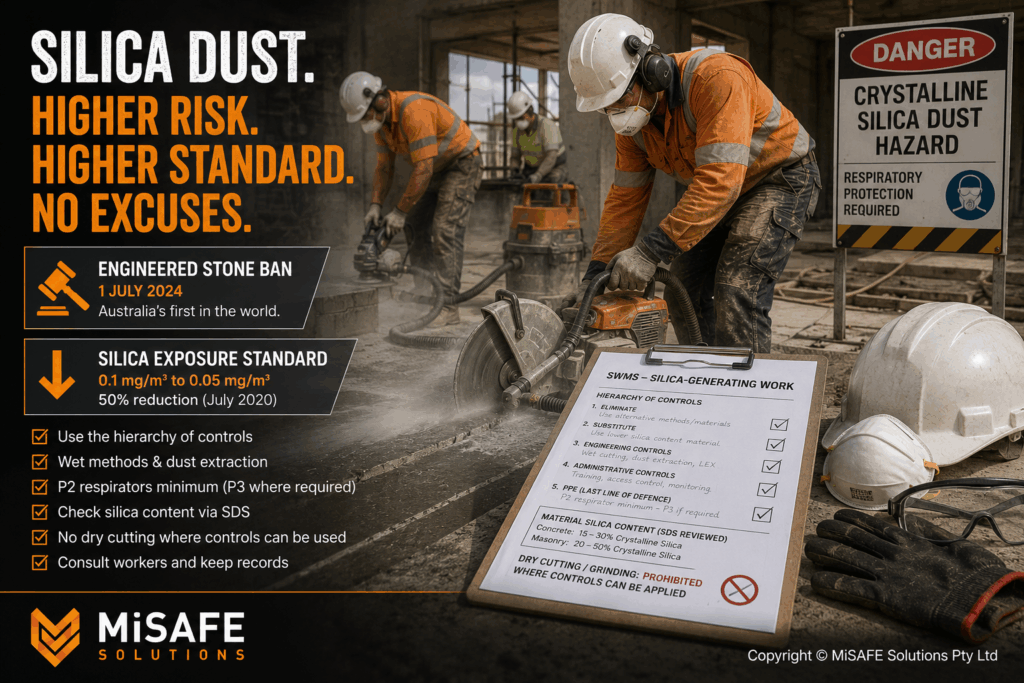
On 1 July 2024, the manufacture, supply, and processing of engineered stone benchtops, panels, and slabs became prohibited across Australia. This applied in all WHS-harmonised jurisdictions simultaneously, making Australia the first country in the world to implement a national ban on a workplace material of this kind.
The ban followed a Senate inquiry and years of clinical evidence directly linking engineered stone processing to accelerated occupational silicosis, a progressive and incurable disease that has ended careers and shortened the lives of workers in their thirties and forties. Engineered stone can contain up to 95% crystalline silica, far exceeding the silica content of natural stone and most other construction materials.
For PCBUs transitioning out of engineered stone work, SWMS obligations do not disappear at the point of the ban. Decommissioning of plant, residual material handling, and site remediation involving legacy engineered stone materials still generate silica dust. Those tasks require current, compliant SWMS documentation with controls appropriate to the exposure risk.
The Revised Workplace Exposure Standard for Crystalline Silica
In July 2020, Safe Work Australia reduced the Workplace Exposure Standard (WES) for respirable crystalline silica (RCS) from 0.1 mg/m³ to 0.05 mg/m³, a 50 per cent reduction. This standard now applies across construction, tunnelling, quarrying, manufacturing, and any other industry where workers may be exposed to crystalline silica during the course of their work.
For construction and trades businesses, this is not a marginal adjustment. Activities considered adequately controlled under the previous standard may now exceed the revised WES without stronger engineering controls in place. Concrete cutting, grinding, surface preparation, drilling into block or masonry, and tunnelling through rock are all silica-generating tasks that must be managed to a tighter threshold.
The Work Health and Safety Regulation 2017 (and state and territory equivalents) imposes specific obligations on PCBUs regarding air monitoring, health surveillance, and control measures where workers are regularly exposed to RCS. Where the risk of exceeding the WES exists, air monitoring should be conducted to verify that controls are effective. Workers regularly exposed to RCS must be offered health surveillance as required under the relevant regulation.
What Your SWMS Must Now Include
High risk construction work involving silica-bearing materials already required a SWMS under the Work Health and Safety Regulation 2017. The revised WES and the engineered stone ban have raised the compliance standard for what those SWMS must actually document.
A compliant SWMS for silica-generating construction work must document the hierarchy of controls in sequence. Elimination and substitution are addressed first, followed by engineering controls such as wet cutting methods, on-tool dust extraction, enclosed plant cabs, and local exhaust ventilation. Administrative controls come next, with respiratory protective equipment (RPE) positioned as the last line of defence and never the primary control.
The class of RPE must be specified precisely. P2 respirators are the minimum standard for work involving respirable crystalline silica. Where engineering controls cannot reduce exposure sufficiently, P3 may be required. A generic reference to a dust mask is not adequate. The SWMS must be specific about the equipment required and the conditions under which it is worn.
The SWMS must also confirm material silica content by reference to the Safety Data Sheet (SDS). The SDS for concrete, masonry, and any other silica-bearing material must be reviewed and the silica content noted in the risk assessment that underpins the SWMS. Dry cutting, grinding, or drilling of silica-bearing materials must be explicitly prohibited where engineering controls can be applied. This must be a documented control, not an implied one.
As with all SWMS for high risk construction work, workers must be genuinely consulted on these controls before the SWMS is approved and signed. This is a legal requirement under the Work Health and Safety Act 2011 (Cth) and its state and territory equivalents, not an optional step.
Practical Application
Start with your highest-risk tasks. If workers are regularly cutting concrete, grinding surfaces, drilling into block, or performing any work that generates visible dust from silica-bearing materials, pull those SWMS now. Check whether engineering controls are specified, not just referenced, and confirm that the RPE requirement aligns with the current WES of 0.05 mg/m³.
If those SWMS predate July 2020, they are operating under superseded exposure standards and must be updated. Review them, re-consult with the workers performing the tasks, obtain re-approval, and re-issue. Retain copies in accordance with your SWMS management obligations under the WHS Regulation. SWMS for high risk construction work must be kept until the relevant work is completed.
MiSAFE SWMS makes it straightforward to build updated SWMS quickly, with full version control ensuring that outdated documents cannot remain in circulation on site.
The Baseline Has Changed
The engineered stone ban and the revised silica exposure standard represent the most significant shift in Australian work health and safety regulation in the past decade. Both are now in full effect and apply to every PCBU whose workers may be exposed to crystalline silica. If your SWMS for silica-generating tasks have not been reviewed since mid-2020, they are not compliant with the current standard. Update them, consult your workers, and keep the records.
Download the free SWMS Checklist here.
Ready to act? Contact us today for expert support at https://misafesolutions.com.au/contact-us/ or book a free 1hr consultation meeting at https://calendly.com/misafe/1-hour-ims-development
This article is general guidance. Check the legislation that applies in your state, or talk to us about your situation.