On a busy construction site, the principal contractor does not write most of the SWMS on the job. The subcontractors do. The concreter brings theirs, the formworker brings theirs, the crane crew brings theirs, and each one lands at the site office on the morning the work starts.
Most of those documents are never properly read. They are stamped, filed and forgotten, and the principal contractor assumes that because a SWMS exists, the risk is controlled. It is not. A generic SWMS written for someone else’s job controls nothing, and when it fails, the exposure does not stay with the subbie.
This post is about the risk a principal contractor inherits the moment it accepts a subcontractor’s SWMS without reviewing it, and how to close that gap at induction.
What the WHS Act actually requires
Section 19 of the Work Health and Safety Act 2011 places a primary duty on every PCBU to ensure, so far as is reasonably practicable, the health and safety of workers, including workers whose activities are influenced or directed by the business. Section 20 adds a duty on any person with management or control of a workplace to ensure the workplace is without risks. A principal contractor carries both at once, across every crew on the site, not just its own.
Under the Work Health and Safety Regulation 2017, regulation 293, a construction project where the work is valued at $250,000 or more has a principal contractor, and that role carries specific duties. The PCBU carrying out the high risk construction work must prepare a SWMS before the work starts (regulation 299), ensure the work is carried out in accordance with it (regulation 300), and give a copy to the principal contractor before the high risk work starts (regulation 301).
The principal contractor must prepare and maintain a written WHS management plan for the project (regulations 309 and 310) and put arrangements in place to obtain, assess and monitor those SWMS. The duty to take all reasonable steps to obtain a SWMS is not discharged by collecting paper. It is discharged by reviewing it.
Accepting a SWMS is not the same as reviewing it, and only one of those discharges the duty.
Why subcontractor SWMS review collapses into tick-and-flick
Three pressures turn the review into a formality.
The first is timing. The SWMS arrives at six in the morning on the day the work starts, with a crew standing around waiting to begin. There is no time to read fourteen pages, so the supervisor signs the acceptance line and the work proceeds.
The second is volume. A medium site might run eight or ten subcontractors, each with multiple SWMS for different activities. Reviewing every one properly is real work, and without a system it quietly does not happen.
The third is the assumption of competence. They are licensed, they do this every day, their SWMS will be fine. Sometimes it is. Often it is a generic template carrying the wrong site, the wrong plant and controls that do not match the actual task, and nobody has checked.
What a real subcontractor SWMS review checks
A real review is not a read-through. It tests the SWMS against this site and this task. The first question is whether the high risk construction work is correctly identified, because a SWMS is required for each category of HRCW under regulation 299, and a missing category means an uncontrolled risk hiding in plain sight.
The second question is whether each control is physically possible here and matched to the hierarchy of controls. Generic SWMS list controls in the abstract. The review checks whether the control can actually be applied on this site, with this plant, by this crew.
The third question is whether the SWMS is specific to the plant, the materials and the work named on it, rather than a document that could belong to any job. A SWMS that fits any site was not written for this one, and it is the one most likely to fail when the work turns dangerous.
How to run the review at induction
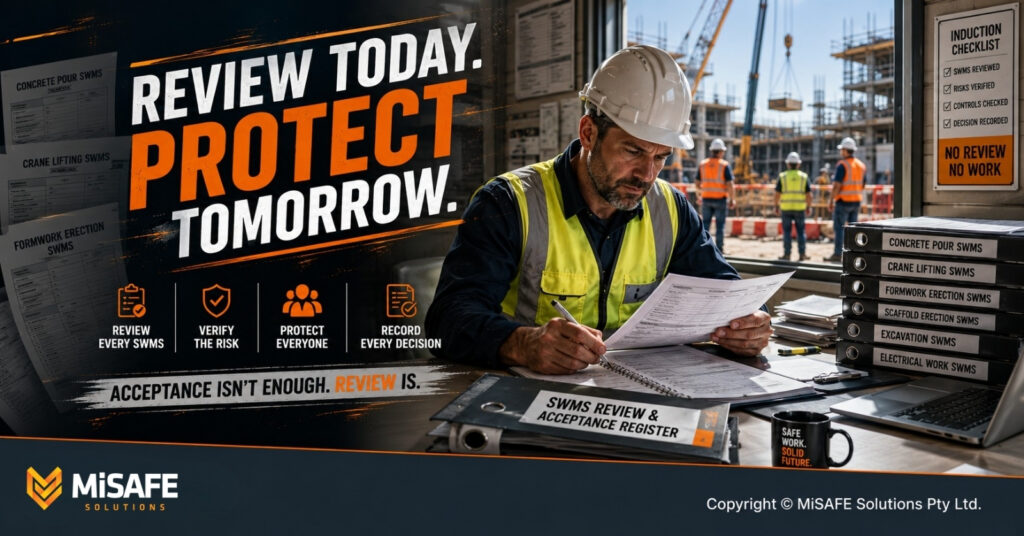
The fix is to make SWMS review a gate at induction, not a paperwork drop. When a subcontractor inducts onto the site, their SWMS is reviewed against a short, consistent checklist before they are accepted to work. The reviewer records the SWMS document and revision, whether the HRCW is correctly identified, whether the controls match the site and task, and an Accept, Revise or Reject decision.
Where a SWMS is rejected or needs revision, the subcontractor does not start the relevant work until it is fixed and re-accepted. That single discipline, applied consistently to every subbie, is what converts the principal contractor’s duty from a stack of collected paper into a defensible system that a regulator can read in one document.
Practical Application
Picture a principal contractor on a 1.2 million dollar fit-out running six subcontractors. At induction, each subbie’s SWMS is reviewed against the register before sign-on. The electrician’s SWMS covers live electrical work that is not part of this scope, so it is revised to de-energised work with test before touch before it is accepted. The rigger’s SWMS names a crane that is not on site, so it is corrected.
Two SWMS are accepted as they stand, three are revised at induction, and one is held until the subcontractor supplies a site-specific version. Every decision is recorded against the subcontractor, the SWMS revision and the date, with the reviewer’s name beside it.
Six weeks later a near miss on the fit-out triggers a regulator visit. The principal contractor produces the register showing that each SWMS was reviewed, what was changed, and who accepted it. The duty to take all reasonable steps to obtain compliant SWMS is evidenced in one document. The contractor down the road who only collected paper has nothing equivalent to show.
Conclusion
A principal contractor does not escape liability by collecting subcontractor SWMS. The duty is discharged by reviewing them, matching them to the site and the task, and recording the decision. A consistent induction review is the difference between a controlled site and a stack of paper that fails under scrutiny.
MiSAFE SWMS gives principal contractors a single place to issue, review and approve subcontractor SWMS, with each worker signing on by scanning the QR code at the top of the document, so the head contractor sees live which subbies are reviewed, accepted and signed on.
Ready to act? Contact us today or book a free 45-minute consultation.
Download the Free Template
Download the free SWMS Subcontractor Review and Acceptance Register and turn subcontractor SWMS from a pile of collected paper into a reviewed, accepted and traceable record.
This article is general guidance. Check the legislation that applies in your state, or talk to us about your situation.