
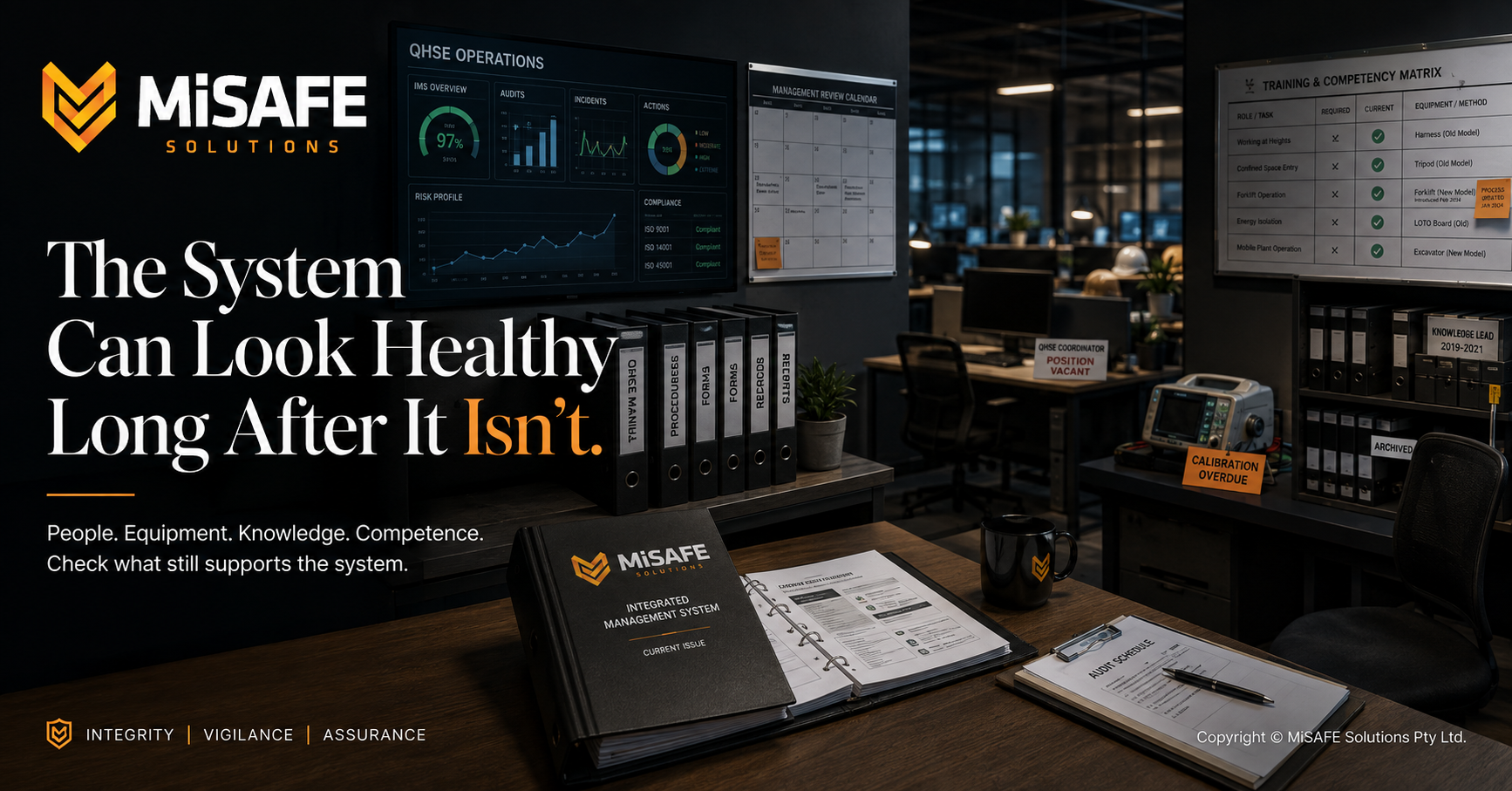
Nobody defunds a management system on purpose. IMS support resources decay quietly instead. A calibration slips a quarter. A safety adviser leaves and the role sits vacant for five months. The training budget absorbs a bad month. Each decision looks reasonable on the day.
Two years later the system still looks impressive on paper. The manual reads well. The registers exist. But the plant inspection tags are eighteen months old, three supervisors never finished their competency refresher, and the only person who understood the environmental licence conditions retired in March.
That is the failure mode Clause 7 exists to prevent, and almost nobody audits it deliberately.
What Clause 7 actually asks of your IMS support resources
ISO 9001:2015, ISO 14001:2015 and ISO 45001:2018 all open Support with Clause 7.1 Resources. The organisation determines and provides the resources needed to establish, implement, maintain and continually improve the management system. Simple wording, wide reach.
ISO 9001 then breaks it down. Clause 7.1.2 covers people. Infrastructure sits at Clause 7.1.3, meaning buildings, equipment, hardware, software, transport and information technology. Under Clause 7.1.4 you address the environment for the operation of processes, which includes physical, social and psychological factors. Clause 7.1.5 covers monitoring and measuring resources, including the calibration and verification that make your measurements defensible. Organisational knowledge lands at Clause 7.1.6, the corporate memory that walks out the door when an experienced person leaves.
ISO 45001 carries the same 7.1 requirement and adds Clause 7.2 Competence, Clause 7.3 Awareness, Clause 7.4 Communication and Clause 7.5 Documented information. ISO 14001 mirrors the structure. Together those clauses describe everything that has to exist for the system to keep working when nobody is watching it.
Here is the part most businesses miss. Clause 9.3 in all three standards makes the adequacy of resources a mandatory management review input. You are already required to form a view on whether your IMS support resources are sufficient, and to record that view. Very few businesses do it with any rigour.
Section 27 makes IMS support resources a personal duty
Resourcing your IMS support resources is not just a budget conversation. Section 27 of the Work Health and Safety Act 2011 requires every officer of a business to exercise due diligence. Subsection 27(5)(d) puts it plainly. An officer must take reasonable steps to ensure the business has, and uses, appropriate resources and processes to eliminate or minimise risks to health and safety.
That duty attaches to the person, not the company. A director who signs off a budget that quietly strips the safety function carries that decision personally. Subsection 27(5)(c) adds the obligation to stay informed about the hazards and risks of the operation, and 27(5)(e) covers the resources and processes for receiving and responding to incident information.
Section 19 sits underneath it. The primary duty of care requires you to provide and maintain safe plant and structures, safe systems of work, adequate facilities for the welfare of workers, and the information, training, instruction and supervision necessary to protect people. Every one of those is a resource. Underfund any of them and you have not made a savings decision, you have made a compliance decision.
Where resourcing quietly decays
IMS support resources decay in four patterns that show up again and again in Australian businesses.
The first is the vacancy that becomes the new normal. A QHSE role goes unfilled, the work spreads across an operations manager and an administrator, and after six months nobody remembers it was ever a full role. The system keeps producing paperwork and stops producing analysis.
Second comes measurement drift. Gas detectors, torque wrenches, test and tag equipment, noise dosimeters and environmental monitors all need calibration to stay meaningful. Once a calibration lapses, every reading taken since becomes evidence you cannot rely on. Clause 7.1.5 is explicit about this, and so is an auditor.
Third, knowledge loss. Clause 7.1.6 asks you to determine the knowledge necessary to operate your processes, maintain it, and make it available. Most businesses hold that knowledge in three or four heads and have no plan for the day one of them resigns.
Finally, competence inflation creeps in. A training matrix says everyone is current because nobody has checked whether the ticket matches the task the person actually performs today. Roles change faster than matrices do.
How to health check your IMS support resources
To begin, build a single IMS support resources health check with one row per Clause 7 element, plus rows for the specific WHS resource duties under sections 19 and 27. For each row, write what good looks like in your context, then record the evidence you actually hold.
Then rate each row honestly. Adequate, marginal or inadequate. Marginal is the most useful rating on the sheet because it catches the slow decay before it becomes a finding. Resist the temptation to mark everything adequate; a health check with no marginals is a health check nobody ran properly.
After that, size the gap and rate the risk if it stays unresolved. A marginal rating with a critical risk gets funded this month. A marginal rating with a low risk goes on the watch list with a review date. That distinction is what turns a compliance checklist into a resourcing argument the board can act on.
In addition, attach a cost and an owner to every action. An unfunded action is a documented decision to accept the risk, so treat it that way and record who accepted it. Then set a next review date on every row and let the sheet tell you what has lapsed.
Take the completed IMS support resources health check into management review. Clause 9.3 already requires you to discuss resource adequacy, so arrive with ratings, gaps, costs and owners rather than a general feeling that the team is stretched.
Practical Application
For example, consider an Australian manufacturer with 40 staff running two shifts and holding all three certifications. Its annual review of IMS support resources takes half a day and covers about sixteen rows.
The people row flags that the QHSE coordinator carries both quality and safety across two shifts, and only ever sees day shift. Meanwhile, the infrastructure row flags that the extraction system servicing the welding bays has no scheduled maintenance contract. Next, the monitoring resources row flags four gas detectors overdue for calibration and one noise dosimeter that has never been calibrated. Finally, the organisational knowledge row flags that one maintenance fitter is the only person who can commission the line after a shutdown.
As a result, each of those becomes a costed action with an owner and a date. The gas detector calibrations cost little and close inside a fortnight. Night shift QHSE coverage, by contrast, becomes a business case for management review. That fitter’s knowledge turns into a documented commissioning procedure and a second trained operator by the end of the quarter.
Twelve months later, the same half day tells you what moved and what did not. That is a resourcing trend, and a trend is far harder for a board to wave through than an anecdote.
Conclusion
Long-term IMS health is not a function of how good your documents are. It is a function of whether the people, plant, calibration, knowledge and competence behind those documents are still adequate this year. Rate them honestly, cost the gaps, name the owners and review the ratings on a cycle. Your IMS support resources then become a managed asset rather than a slow leak, and your officers can point to the reasonable steps section 27 asks for.
The MiSAFE All-in-One QHSE subscription includes configuration of your support resource health check inside DS Site, with calibration and competency expiry alerts, automatic escalation of inadequate ratings, and a management review pack that assembles itself.
Ready to act? Contact us today or book a free 45-minute consultation.
Download the Free Template
Download the free IMS Support Resource Health Check (.xlsx) and turn a vague sense that the team is stretched into rated gaps, costed actions and named owners.
This article is general guidance. Check the legislation that applies in your state, or talk to us about your situation.