Introduction
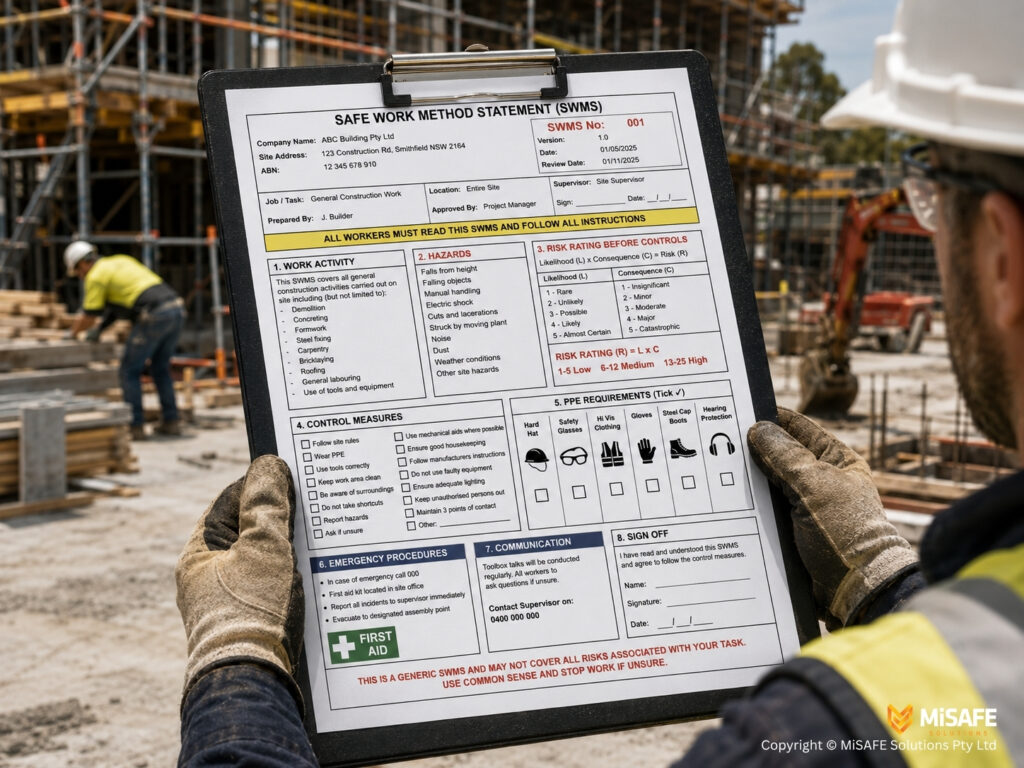
A generic SWMS template is the quiet failure point on most Australian sites. It looks compliant. It has the right cover page, the right field labels, the right signature blocks. It satisfies the procurement checklist. It passes the client induction email. And then, when something goes wrong, it doesn’t survive five minutes of scrutiny from the regulator.
The Work Health and Safety Regulation 2017 is precise about what a Safe Work Method Statement has to do. Regulation 299 doesn’t ask for a document. It asks for a document that identifies the high risk construction work, the hazards arising from it, the control measures, and the way those controls will be implemented, monitored and reviewed. The legislation is specific because the work is specific. A SWMS that could apply to any site, any team, any plant and any sequence of work fails that test before the cover sheet is even turned.
This article is about the trap. Why generic SWMS templates persist on Australian sites, why they fail under scrutiny, what specificity actually looks like in practice, and how to test whether your own SWMS is specific enough to survive an incident or an inspector. The free template at the end of this post is a one-page Specificity Audit Checklist you can run over any SWMS before it is approved.
Why Generic SWMS Templates Persist
Generic SWMS templates exist because they solve a real commercial problem. A builder is awarded a new contract, the head contractor asks for a SWMS within forty-eight hours, the subcontractor pulls the same Word document they used on the last three jobs, changes the project name in the header, swaps the date, and emails it back. The job starts. Nobody is harmed. The pattern repeats.
Three pressures keep the trap in place. First, time. The administrative window to produce a SWMS before mobilisation is small, and a generic template fills it. Second, cost. Building a SWMS from scratch every job feels like duplicated effort when most of the work looks the same. Third, perceived risk. If the last twenty SWMS were signed without complaint, the twenty-first is assumed safe by precedent.
None of those pressures change the legal test. Section 19 of the Work Health and Safety Act 2011 imposes the primary duty of care on the PCBU to do what is reasonably practicable to ensure the health and safety of workers. Reasonably practicable is measured against the actual work being done, not against the template used to describe it. A generic SWMS that does not reflect the work cannot ground the consultation, training or supervision that follows it.
What Regulators Look For
Inspectors read SWMS for evidence that the document was written for the work in front of them. The cues are practical and consistent. Reviewers in Australian jurisdictions look at four things before anything else.
They check whether the high risk construction work is correctly identified against Regulation 291. A SWMS for working at height should reference the specific height, the specific edge condition, the specific fall arrest system. A SWMS for working with asbestos should reference the asbestos register, the specific material, the licensed remover. Generic descriptions of “work at height” or “asbestos works” without site specifics signal that the document was not written for this job.
They check whether the hazards are specific to the site and the sequence. A SWMS that lists “slips, trips and falls” and “manual handling” as the controlling hazards on a structural demolition is a SWMS written for a generic risk register, not for the work. The inspector reads the site, then reads the SWMS, and looks for the match.
They check whether the controls follow the hierarchy in Regulation 36 and are anchored to the actual plant, materials, design and personnel. “Wear gloves and safety glasses” is not a control. “Use Class 5 chemical resistant nitrile gloves and indirect-vent goggles when decanting hydrochloric acid from drum to spotting tank, in line with SDS Section 8” is a control. The first is a generic instruction. The second is a SWMS.
They check whether the SWMS shows evidence of consultation with the workers carrying out the work, in line with sections 47 and 48 of the WHS Act and Regulation 300. If the names in the signature block are the same names that appear on every SWMS for every job, the document is not specific.
Where Generic Templates Break Down
There are five points where a generic template predictably fails when audited.
Task Steps That Don’t Match the Site
The most common failure. The SWMS describes the work in textbook terms: “set up exclusion zone, install fall protection, commence work”. The actual sequence on site has fourteen steps, three handovers between crews, two changes of plant, and a temporary works element that the template does not mention. The SWMS becomes irrelevant to the workers carrying out the job.
Plant, Materials and Substances That Aren’t on Site
A SWMS that references “appropriate scaffolding” without naming the scaffold type, ticket class or supplier, or that lists chemicals not actually present, fails the specificity test the moment the workers walk to the work face. The SDS controls won’t match. The plant pre-start won’t match. The competency check won’t match.
PPE Written as a Default Rather Than a Control
Generic PPE listings – gloves, safety glasses, hi-vis, hard hat – are common in templates. They aren’t wrong, but they don’t address the specific exposure. A SWMS for grinding stainless steel should reference P2 disposable respirators, fire-retardant clothing, and full-face shields. A SWMS for working in a confined space should reference appropriate atmospheric monitoring equipment, harnesses, and retrieval systems. Default PPE is a sign the SWMS was not written for the work.
Emergency Procedures Disconnected From the Site
A SWMS that lists “call 000” and “report to the site supervisor” as the emergency response, without referencing the actual evacuation route, the actual muster point, the actual rescue plan for the work being done, has no practical value when an incident occurs. Emergency procedures must reflect the site, the work, and the means of getting an injured worker to medical care.
Personnel and Roles That Are Generic Rather Than Named
A SWMS that lists “site supervisor” and “qualified worker” without naming the actual individuals, their tickets, and their roles in the work sequence, cannot be used to confirm that the people carrying out the work are competent to do so. Section 19(3)(f) of the Act requires the provision of any information, training, instruction or supervision that is necessary to protect persons from risks. A generic SWMS cannot evidence this.
What Specificity Actually Looks Like
A specific SWMS reads like the site spoke. The high risk construction work is identified by reference to Regulation 291(1) sub-section. The site is named. The work area is described with the same detail used in the project drawings. The plant is identified by make, model, registration and operator. The materials are identified by SDS reference and quantity. The personnel are named with their tickets, competencies and roles in the sequence. The hazards are described with the words workers use on site. The controls are written so a worker can read the SWMS and know exactly what to do next.
Specificity is not length. A two-page specific SWMS is more compliant and more useful than a fifteen-page generic SWMS. The question is not how much was written, but whether what was written matches the work.
The MiSAFE SWMS platform was built around this distinction. Authors describe the work, the plant, the personnel and the site in the prompts. The platform generates a complete first draft that reflects those inputs, then the author reviews and refines field by field before approval. Workers sign digitally by scanning the QR code at the top of the document on site, and the platform records who signed which version of which SWMS for which job. The audit trail is built on specificity, not on the template.
The Practical Test
Before approving any SWMS, run it through a specificity audit. The free template at the end of this post is a one-page checklist designed exactly for this. It runs through the eight areas where generic templates most often break – task identification, sequence detail, plant, materials, PPE, emergency response, personnel, and consultation evidence – and asks the reviewer to answer Yes, No or Action Required for each. A SWMS that scores Yes on every line is a SWMS that will survive a site audit. A SWMS with a single No is a SWMS that needs work before it goes to the workers.
The checklist sits in the IMS, alongside the SWMS, the Consultation Record from Week 10, and the Version Control Register from Week 9. Together they form the documentation backbone that demonstrates the SWMS was specific, consulted, version-controlled and approved. That is what reasonably practicable looks like on paper.
Closing the Loop
Generic templates persist because they save time today. They cost time when an incident happens, when a regulator visits, when a head contractor asks for the SWMS that matches the work that happened. The cost is paid in writing the missing detail under pressure, in justifying gaps to inspectors, in defending the position in front of a coroner. The cost is always higher than the time saved.
The fix is procedural. Treat every job as if the SWMS will be read by an inspector. Use a specificity check as the final gate before approval. Build the systems – the platform, the templates, the register – that make specificity the default rather than the exception. The work is the same. The document just has to match it.
SWMS Specificity Audit Checklist
Download the free template: SWMS Specificity Audit Checklist
If your SWMS library is full of templates that look the same job after job, the generic template trap is already in your system. MiSAFE Solutions builds SWMS systems that are specific by design, version-controlled by default, and consulted before approval. Book a 45-minute consultation to walk through your current SWMS process and identify where the trap is hiding.
Book a consultation: https://calendly.com/misafe/45-min-consultation-meeting
Visit: misafesolutions.com.au
Stay Tuned
Next week – Week 12: Site Briefings That Don’t Stick: Why Toolbox Talks Fail to Communicate the SWMS. We unpack why most pre-start briefings are forgotten by morning tea, what the WHS Act actually requires for information, training and instruction, and how to run a five-minute briefing that workers can repeat back.
This article is general guidance. Check the legislation that applies in your state, or talk to us about your situation.