
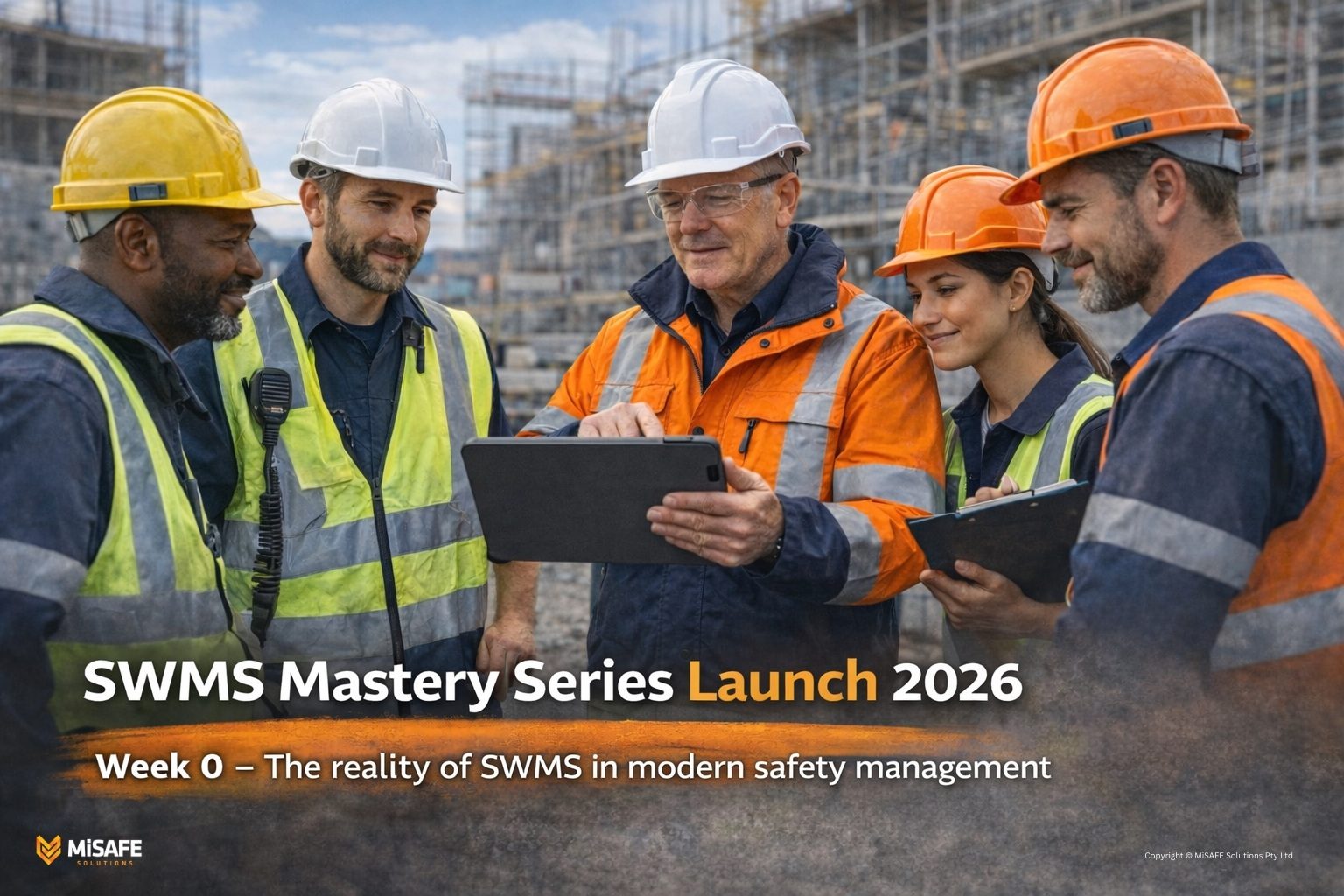
Week 0 – The reality of SWMS in modern safety management
Introduction
The reality of SWMS in modern safety management is far more confronting than most Australian businesses realise. What if the one document you rely on to keep your team safe is actually creating a false sense of security — while quietly exposing your business, your people, and even your personal liability to serious risk every single day on site?
Welcome to Week 0 of SWMS Mastery: 52 Weeks with MiSAFE – your practical, no-nonsense roadmap to mastering the reality of SWMS in modern safety management right across Australia.
[Insert Image 2 here: Photo of a diverse group of construction workers in high-vis vests and hard hats discussing on site, with one holding a tablet, against a backdrop of scaffolding and buildings.]
Access the Full White Paper on the Reality of SWMS in Modern Safety Management
Today we launch the entire series with a complete, in-depth walkthrough of our powerful new 87-page white paper that reveals the reality of SWMS in modern safety management (Document ID: MSSMK002, Revision 1.0, dated 25 February 2026).
You can download the full white paper here: https://misafesolutions.com.au/wp-content/uploads/2026/03/MSSMK002-The-Reality-of-SWMS-in-Modern-Safety-Management-v1.0.pdf
[Insert Image 1 here: Photo of a safety manager in orange high-vis vest typing on a computer displaying the MiSAFE white paper title screen, with construction site visible through the window behind.]
White Paper Overview of the Reality of SWMS in Modern Safety Management
This document is the solid foundation for everything we will explore together over the next 52 weeks. Let me walk you through every major section so you understand exactly what the reality of SWMS in modern safety management looks like in Australia today.
[Insert Image 3 here: Screenshot of the white paper cover page showing MiSAFE logo, company details, title “The Reality of SWMS in Modern Safety Management”, and document ID MSSMK002.]
Executive Summary of the Reality of SWMS in Modern Safety Management
Safe Work Method Statements are a mandatory risk-control tool for high-risk construction work under Australian WHS legislation. When done properly they deliver real safety outcomes and help PCBUs and officers demonstrate genuine due diligence. In practice, however, most traditional SWMS fall short because of version-control problems, superficial consultation, generic templates and poor implementation. The summary highlights the current regulatory reality including industrial manslaughter laws, psychosocial hazard requirements, the engineered stone ban (effective 1 July 2024), strengthened crystalline silica rules (1 September 2024) and the 0.05 mg/m³ respirable crystalline silica exposure standard.
Important Disclaimer
Right up front there is a clear, strong disclaimer: this is general guidance only, not legal or financial advice. AI-assisted SWMS must always receive competent human review and site-specific validation.
Section 1: Purpose, Scope and Methodology
This section covers the evidence-based research approach, primary sources used and clear definitions of every key term relevant to the reality of SWMS in modern safety management.
Section 2: The Regulatory Framework Governing SWMS in Australia
A thorough breakdown of:
- History and evolution of SWMS requirements
- Harmonised WHS jurisdictions (including Western Australia’s adoption on 31 March 2022)
- Victoria’s separate Occupational Health and Safety framework
- Exact mandatory content under Regulation 299
- Worker consultation rules, review triggers and accessibility requirements
For the official Safe Work Australia SWMS information sheet see: https://www.safeworkaustralia.gov.au/system/files/documents/1703/information-sheet-safe-work-method-statement.pdf
Section 3: Where SWMS Break Down in Practice – The Harsh Reality of SWMS in Modern Safety Management
Honest analysis of the most common failures:
- Administrative and version-control disasters
- Worker engagement and consultation gaps
- Knowledge management failures
- Human factors and behavioural challenges
- Audit and enforcement risk exposure
Sections 4 & 5: The Solution Landscape and Market Analysis (Australia, 2026) in the Reality of SWMS in Modern Safety Management
Categorises every type of SWMS system available today – paper, static digital, standalone non-AI, standalone AI-enabled and full integrated enterprise systems. Includes detailed feature comparison tables, data sovereignty and hosting considerations, pricing structures, scalability examples and emerging AI trends.
Section 6: Cost Benefit and Return on Investment Analysis
Realistic modelling of direct and indirect costs, productivity gains, risk-reduction scenarios and ROI examples tailored to different organisation sizes.
Section 7: Legal and Procurement Considerations in the Reality of SWMS in Modern Safety Management
Essential reading for directors and officers covering Australian Privacy Principles, contractual risks, cybersecurity, AI governance, court defensibility of SWMS, industrial manslaughter implications and smart procurement due diligence.
Section 8: Implementation Framework for the Reality of SWMS in Modern Safety Management
Practical, step-by-step guidance on transitioning from paper to digital, change management, securing worker buy-in, training, ongoing monitoring, key performance indicators and continual improvement using the PDCA cycle.
Sections 9–11: WHS Case Studies, AI Risks and Leadership Implications in the Reality of SWMS in Modern Safety Management
Real enforcement examples, incident learnings, risks and limitations of AI in SWMS creation, best-practice human oversight controls, AI ethics and what all of this means for QHSE professionals and company directors.
The paper wraps up with useful appendices (vendor comparison tables, ROI assumptions, procurement checklist and regulatory references) plus a full bibliography.
Why the Reality of SWMS in Modern Safety Management Matters Right Now
With regulators focusing more than ever on the quality and practical use of SWMS (not just whether one exists), truly understanding the reality of SWMS in modern safety management is no longer optional. This document gives you the complete picture so you can move from tick-and-flick compliance to genuine due diligence that actually protects your people and your business.
What Comes Next in the Series on the Reality of SWMS in Modern Safety Management
Over the next 52 weeks we will break every section of this white paper down into short, practical, actionable posts you can put to work straight away.
Key Self-Assessment Questions for the Reality of SWMS in Modern Safety Management
Here are some key self-assessment questions drawn directly from the white paper that you can copy into your own notes or document to evaluate your current SWMS practices:
- Do our SWMS reflect actual site conditions or are they generic templates?
- Is there clear evidence of genuine worker consultation before high-risk work begins?
- Are version control and review triggers clearly documented and followed on site?
- Are control measures specific, practical and based on the hierarchy of controls?
- Is the SWMS readily accessible to workers when the task is being performed?
Discover MiSAFE SWMS Today
Ready to turn the reality of SWMS in modern safety management into real-world action? Register for MiSAFE SWMS here: https://swms.misafesolutions.com.au/register Find out more about MiSAFE SWMS here: https://misafesolutions.com.au/swms2 Contact MiSAFE Solutions Pty Ltd at contact@misafesolutions.com.au or call 07 5641 2101, or fill in our contact form: https://misafesolutions.com.au/contact-misafe-risk-management-software/
Recent Comments