
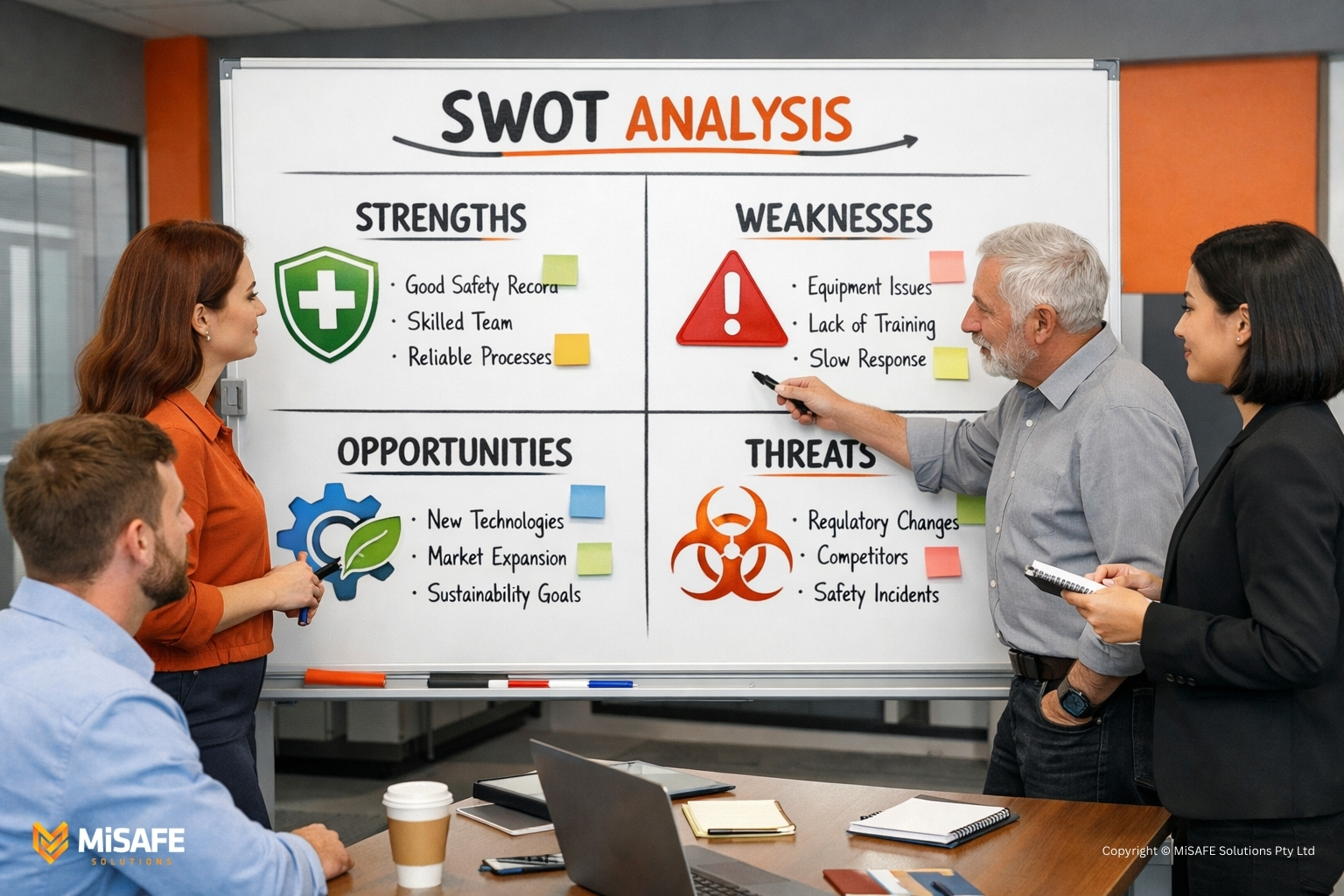
Welcome to Week 9 of MiSAFE Solutions Pty Ltd’s IMS Mastery Series: “Build Your IMS Empire: 53 Weeks of QHSE Insights with MiSAFE”. Building on Week 8’s focus on gathering stakeholder input, this week we introduce SWOT analysis as a strategic tool for your Integrated Management System (IMS). This method helps you weigh internal strengths and weaknesses alongside external opportunities and threats, aligning with the ISO Annex SL structure’s emphasis on context, risks, and opportunities in Quality (ISO 9001), Health & Safety (ISO 45001), and Environment (ISO 14001).
SWOT is not just a brainstorming exercise—it is a rigorous framework to inform your IMS planning and decision-making.
Why Conduct a SWOT Analysis for QHSE?
A SWOT analysis provides a structured way to evaluate your organisation’s QHSE position. It reveals how internal factors like resources intersect with external ones like regulations, enabling proactive risk management. For Australian organisations, this is particularly valuable in high-risk sectors like mining or construction, where overlooking a weakness (e.g., training gaps) could lead to non-compliance with the Work Health and Safety Act. By contrast, identifying opportunities (e.g., new green technologies) can drive environmental improvements under ISO 14001. Without SWOT, your IMS might remain reactive, missing chances for enhancement. However, when applied effectively, it supports continual improvement, reduces vulnerabilities, and positions your business for sustainable success.
The SWOT Framework Explained
SWOT stands for Strengths, Weaknesses, Opportunities, and Threats. Under Annex SL, it ties directly to Clause 4 (context) and Clause 6 (planning):
- Strengths: Internal positives, like a strong safety culture boosting ISO 45001 compliance.
- Weaknesses: Internal negatives, such as limited resources hindering quality controls in ISO 9001.
- Opportunities: External positives, e.g., market demand for eco-friendly practices aligning with ISO 14001.
- Threats: External negatives, like regulatory changes increasing health and safety costs under ISO 45001.
Practical Steps to Perform a QHSE SWOT Analysis
Follow this detailed process to conduct and apply your analysis:
- Assemble a Cross-Functional Team: Include representatives from quality, health & safety, environment, and operations for diverse perspectives.
- Brainstorm and Categorise: List items under each SWOT quadrant, focusing on QHSE-specific examples.
- Analyse and Prioritise: Rate each item’s impact and likelihood, using tools like scoring matrices.
- Develop Strategies: Convert insights into actions—e.g., leverage strengths to exploit opportunities (SO strategies) or mitigate weaknesses against threats (WT strategies).
- Integrate into Your IMS: Update your risk register, objectives, and plans based on findings.
- Review Regularly: Revisit the SWOT quarterly or after major changes to keep your IMS dynamic.
Common Challenges and Solutions
Organisations often face bias in self-assessment or difficulty linking SWOT to actions. For instance, teams might overestimate strengths. To counter this, use anonymous input or external facilitators. Additionally, tie each SWOT item to specific IMS clauses for traceability, ensuring the analysis drives measurable improvements.
Benefits of QHSE SWOT Analysis
This tool uncovers hidden synergies, like using a strength in safety training to address an environmental weakness. It leads to better resource allocation, reduced risks, and enhanced stakeholder satisfaction, ultimately making your IMS a strategic asset rather than a compliance burden.
Get Started with Your Free Tool
Download the QHSE SWOT Analysis Template (Document ID: MISAFE-IMS-TMP-007-V1.0) to conduct and document your analysis effectively.
Stay Tuned
Next week: “Keep It Fresh: Reviewing Your Business Context to Maintain IMS Relevance”. Subscribe for updates.
Ready to act? Contact us today for expert support at https://misafesolutions.com.au/contact-us/ or book a free 1hr consultation meeting to discuss your IMS requirements with MiSAFE at https://calendly.com/misafe/1-hour-ims-development.
Recent Comments