Welcome to Week 9 of MiSAFE Solutions Pty Ltd’s SWMS Mastery Series: 52 Weeks with MiSAFE.
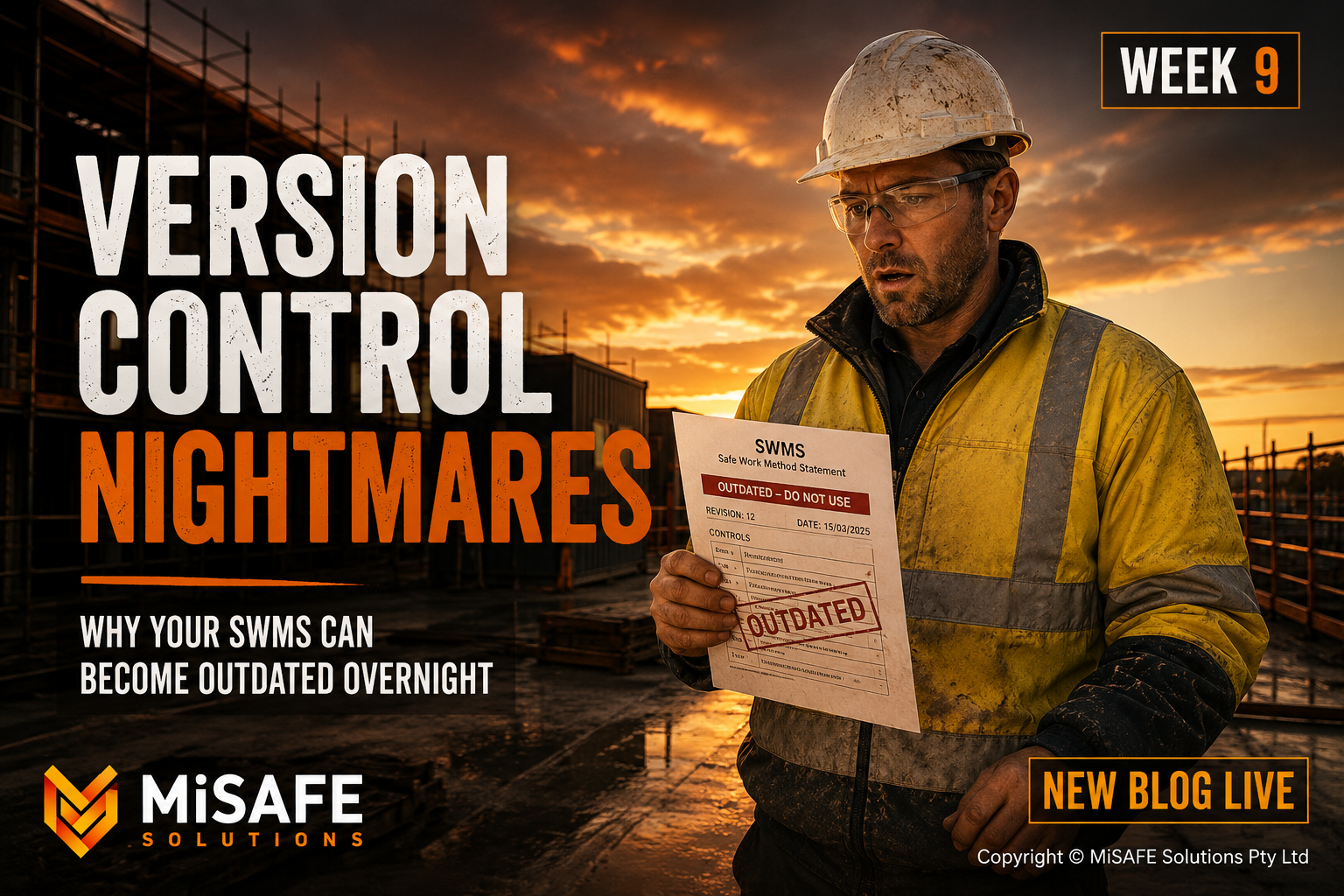
Last week closed Phase 1 with the recent regulatory changes around silica controls and the engineered stone ban. Those changes raise the very next question. When a regulation shifts on a Tuesday, what happens to every safe work method statement issued under the old rules? Most are still sitting in site folders, on shared drives and in worker’s phones, technically referencing rules that no longer apply. Phase 2 of this series unpacks where SWMS break down. We start with the failure that quietly drives more enforcement action, more incidents and more failed audits than any other on Australian construction sites: version control.
When the Law Requires You to Revise a SWMS
The Work Health and Safety Regulation 2017 in harmonised jurisdictions, and equivalents in Victoria and Western Australia, set explicit triggers for reviewing and revising a safe work method statement. Under Regulation 302, a SWMS must be reviewed and, where necessary, revised when a control measure is revised, when there is a change to the system of work that affects the high risk construction work, before high risk construction work that has been suspended resumes, and after a notifiable incident occurs in connection with the work.
The Safe Work Australia Code of Practice on Construction Work reinforces the same expectation and adds practical guidance on consultation, document control and worker access. These are the minimum legal triggers. They are not the only triggers a competent PCBU should plan for, and they are certainly not the only triggers a regulator or coroner will examine after an incident.
The Hidden Triggers That Sit Outside Regulation 302
Most version control failures do not happen because someone ignored Regulation 302. They happen because the work changed in a way that did not obviously fit any of the listed triggers, and no one stopped to ask whether the SWMS still reflected reality.
Common quiet drivers include a contractor swapping out plant for a different make or model partway through a job, a design variation issued by the engineer that changes how a load is rigged or a slab is poured, a Code of Practice or Australian Standard being updated, a new Safe Work Australia exposure standard taking effect, a near miss reported informally and never escalated to a review, workforce turnover where new workers bring different competencies, or a change in subcontractor management with different supervisors and different language preferences on site.
None of those events tick the strict boxes in Regulation 302. All of them can render the existing SWMS inaccurate. Section 19 of the Work Health and Safety Act 2011, which sets the primary duty of a PCBU to ensure health and safety so far as is reasonably practicable, captures every one of them.
Why Outdated SWMS Survive on Site
The realities that keep outdated SWMS in circulation are practical, not theoretical. A PDF was emailed around three weeks ago. A printed copy sits in the site office toolbox. The shared drive has six versions of the same document with cryptic file names. Workers signed a paper copy without anyone recording which version number they signed. The same SWMS was reused across three jobs because no one had the time to tailor it. A reviewer flagged a change but the document was never re-circulated.
Each of those failures is human, predictable and very common. They are not excuses. They are operating realities a serious version control system has to plan for. When an inspector or a court later asks which version of the SWMS was on site at the time of an incident, the absence of a clean audit trail is what creates the legal exposure under Section 27 officer due diligence and the primary duty in Section 19.
What Strong Version Control Looks Like Under WHS Law
A defensible version control system has consistent features regardless of the size of the business. Every SWMS carries a unique document ID and a visible version number on every page. A single source of truth exists, with one published current version and all superseded versions archived but accessible for audit. A review trigger framework captures both the legislative events in Regulation 302 and the quiet operational events that should also prompt revision.
Workers sign against a specific version number, and that signature is recorded with date, time and signature method. Superseded versions are removed from active circulation so field crews cannot accidentally work to an out-of-date document. AS/NZS ISO 31000:2018 reinforces the underlying principle, treating documentation control as part of the risk management process rather than a separate administrative task. The Safe Work Australia Code of Practice on Construction Work expects the SWMS in use on site to be the version that workers were consulted on and that reflects the work as it is actually being performed.
Practical Application on a Live Site
Effective version control combines a few non-negotiable disciplines. Establish a fixed review cycle that is short enough to catch quiet drift, typically every twelve months, and overlay event-driven triggers that capture the changes Regulation 302 lists as well as the operational triggers above. Maintain a SWMS version control register that records the document ID, current version, date issued, date last reviewed, trigger for the next review, author, reviewer, approver, status and superseded version log.
- Use unique document IDs for every SWMS and keep the version number visible in the header or footer of every page.
- Make sure superseded versions are clearly marked and stored separately from active documents so they cannot be picked up by mistake.
- Capture worker signatures against the exact version number they signed, including date, time and method, and retain that record for the statutory period.
- Build the operational review triggers into the version control register itself so they are reviewed when the SWMS is reviewed, not as a separate afterthought.
MiSAFE SWMS handles the version capture and worker signing automatically. When a worker scans the QR code on the document and signs digitally, the signature is bound to the version number that was active at the time, which removes the most common gap in the audit trail.
The Core Takeaway
The most common SWMS failure is not a missing hazard or a poorly worded control. It is the right SWMS, written well, but two versions behind the work being done. The Work Health and Safety Regulation 2017 sets out when a revision is required. Good practice goes further by anticipating the quieter changes that also break the alignment between the document and the work. If your version control depends on someone remembering to email the latest PDF, the system has already failed.
Download the SWMS Version Control Register for free.
Stay Tuned
Next week on SWMS Mastery: Week 10 covers Consultation Gaps, examining when worker input falls short. We dig into why so much SWMS consultation is technically compliant but functionally empty, and what genuine worker input actually looks like on a live site.
Ready to act? Contact us today at https://misafesolutions.com.au/contact-us/ or book a free 1-hour consultation at https://calendly.com/misafe/1-hour-ims-development.
Email: contact@misafesolutions.com.au
Phone: +61 7 5641 2101
Mobile: +61 400 977 769
Book a free consultation: https://calendly.com/misafe/1-hour-ims-development
This article is general guidance. Check the legislation that applies in your state, or talk to us about your situation.