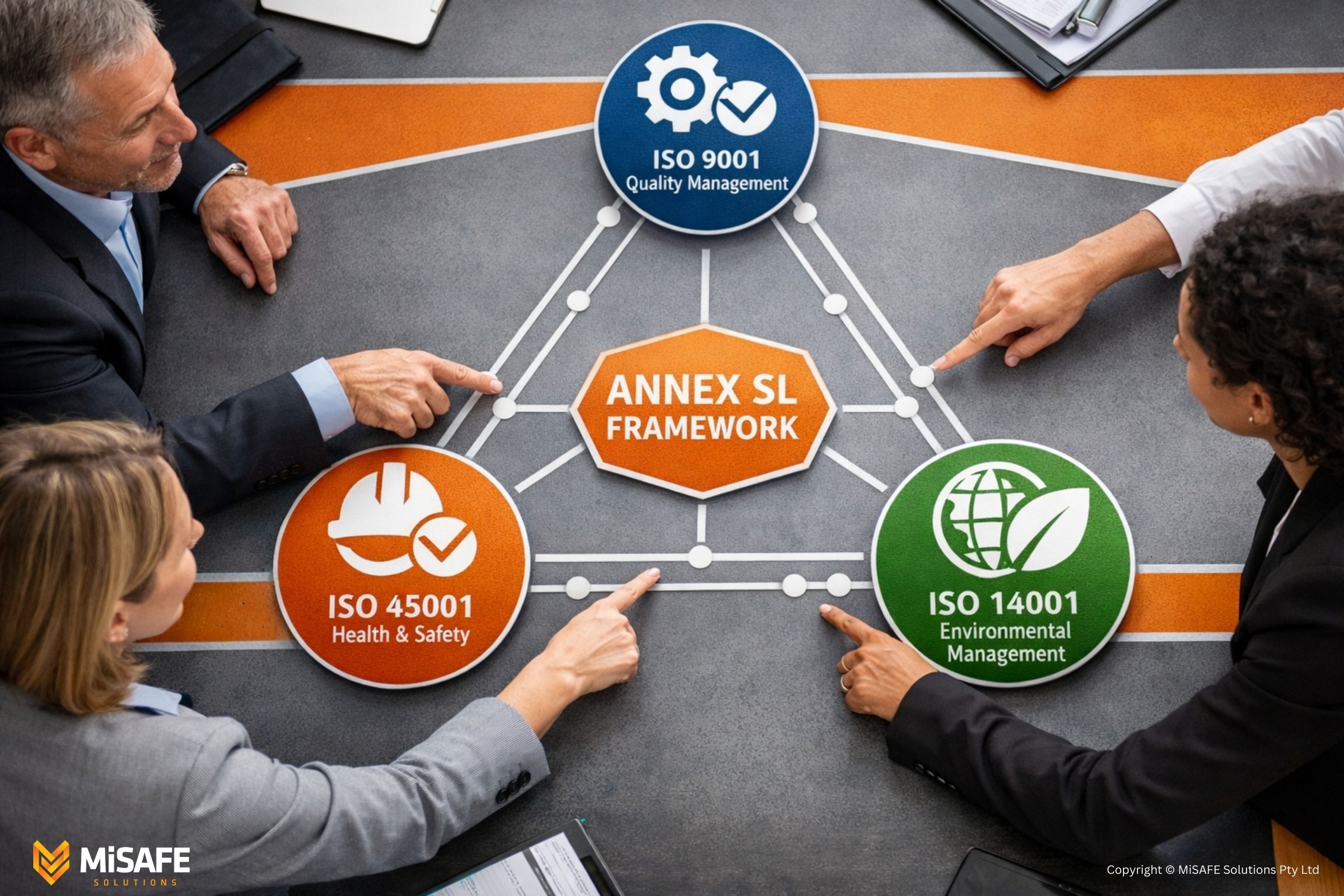
Welcome to Week 2 of MiSAFE Solutions Pty Ltd’s IMS Mastery Series: “Build Your IMS Empire: 53 Weeks of QHSE Insights with MiSAFE”. Building on last week’s scope definition, this week we break down the key ISO standards that form the foundation of your Integrated Management System (IMS). We explain ISO 9001 for quality, ISO 45001 for health and safety, and ISO 14001 for environment, showing how they interconnect under the ISO Annex SL structure.
These standards aren’t just rules—they’re tools to strengthen your business operations.
Why These ISO Standards Matter for Your IMS
ISO standards provide a proven blueprint for managing QHSE effectively. For Australian organisations, they ensure compliance with local regulations like the Work Health and Safety Act while driving efficiency. Without understanding these building blocks, your IMS might lack structure, leading to gaps in risk management or resource allocation. However, integrating them creates a robust system that supports growth and reduces liabilities.
Breaking Down ISO 9001: Quality Management
ISO 9001 focuses on consistent quality delivery to meet customer needs. Key elements include process approach, risk-based thinking, and continual improvement. In practice, this means mapping your workflows to identify quality risks, such as supplier inconsistencies in procurement. For SMEs in trade sectors, it helps build credibility to win contracts.
Exploring ISO 45001: Health and Safety
This standard emphasises worker safety through hazard identification, risk assessment, and emergency preparedness. It promotes worker participation and leadership commitment. For example, in construction, it guides contractor management to prevent incidents. Integrating it into your IMS ensures health and safety align with overall business goals, minimising downtime from injuries.
Understanding ISO 14001: Environmental Management
ISO 14001 targets sustainable practices by managing environmental impacts, like waste and emissions. It requires life-cycle thinking and compliance with laws such as Australia’s Environmental Protection Act. In your IMS, this could involve resource management to cut costs on energy, making your operations greener and more efficient without excess regulation.
How Annex SL Ties Them Together
Annex SL provides a common high-level structure for these standards, with shared clauses on context, leadership, planning, support, operation, performance evaluation, and improvement. This harmony simplifies integration, allowing you to handle QHSE in one cohesive system rather than silos. Here’s a basic mapping of the key headings and how they interconnect:
- Context of the Organisation: All standards require you to understand internal and external issues affecting QHSE. For instance, ISO 9001 links this to customer requirements, while ISO 45001 connects it to worker risks and ISO 14001 to environmental aspects—together, they create a unified view of your business environment.
- Leadership: Emphasises top management commitment across standards. ISO 9001 focuses on quality policy, ISO 45001 on safety roles, and ISO 14001 on environmental objectives; integrated, they ensure leaders drive a single QHSE policy.
- Planning: Involves risk and opportunity assessment. ISO 9001 addresses quality risks, ISO 45001 safety hazards, and ISO 14001 environmental impacts—interconnected, they enable holistic planning that covers all areas.
- Support: Covers resources, competence, and communication. Shared across standards, this ensures training (e.g., HR involvement) and awareness apply uniformly to quality, safety, and environment.
- Operation: Focuses on process controls. ISO 9001 ensures quality outputs, ISO 45001 safe execution, and ISO 14001 eco-friendly methods—together, they support operational efficiency like procurement and contractor management.
- Performance Evaluation: Includes monitoring and audits. Standards interconnect here for combined metrics, allowing a single review of QHSE performance.
- Improvement: Drives corrective actions and continual enhancement. Interlinked, this clause ensures lessons from one area (e.g., a safety incident) improve quality and environmental practices.
Common Implementation Tips
Start by auditing your current practices against these standards. Engage stakeholders for input, and use tools like checklists to track progress. Remember, customisation is key—adapt to your scale to avoid overwhelm.
Get Started with Your Free Tool
Download the ISO Standards Overview Checklist for Building Your Integrated Management System Foundations (Document ID: MISAFE-IMS-CHK-002-V1.0) to evaluate how these standards fit your IMS.
Stay Tuned
Next week: “QHSE Jargon Buster: Simple Definitions to Get You Started”. Subscribe for updates.
This post is optimised for search terms like key ISO standards for IMS, ISO 9001 45001 14001 explained, and Annex SL building blocks.
Ready to act? Contact us today for expert support at https://misafesolutions.com.au/contact-us/ or book a free 1hr consultation meeting to discuss your IMS requirements with MiSAFE at https://calendly.com/misafe/1-hour-ims-development.ISO Standards Overview Checklist for Building Your Integrated Management System Foundations
This article is general guidance. Check the legislation that applies in your state, or talk to us about your situation.