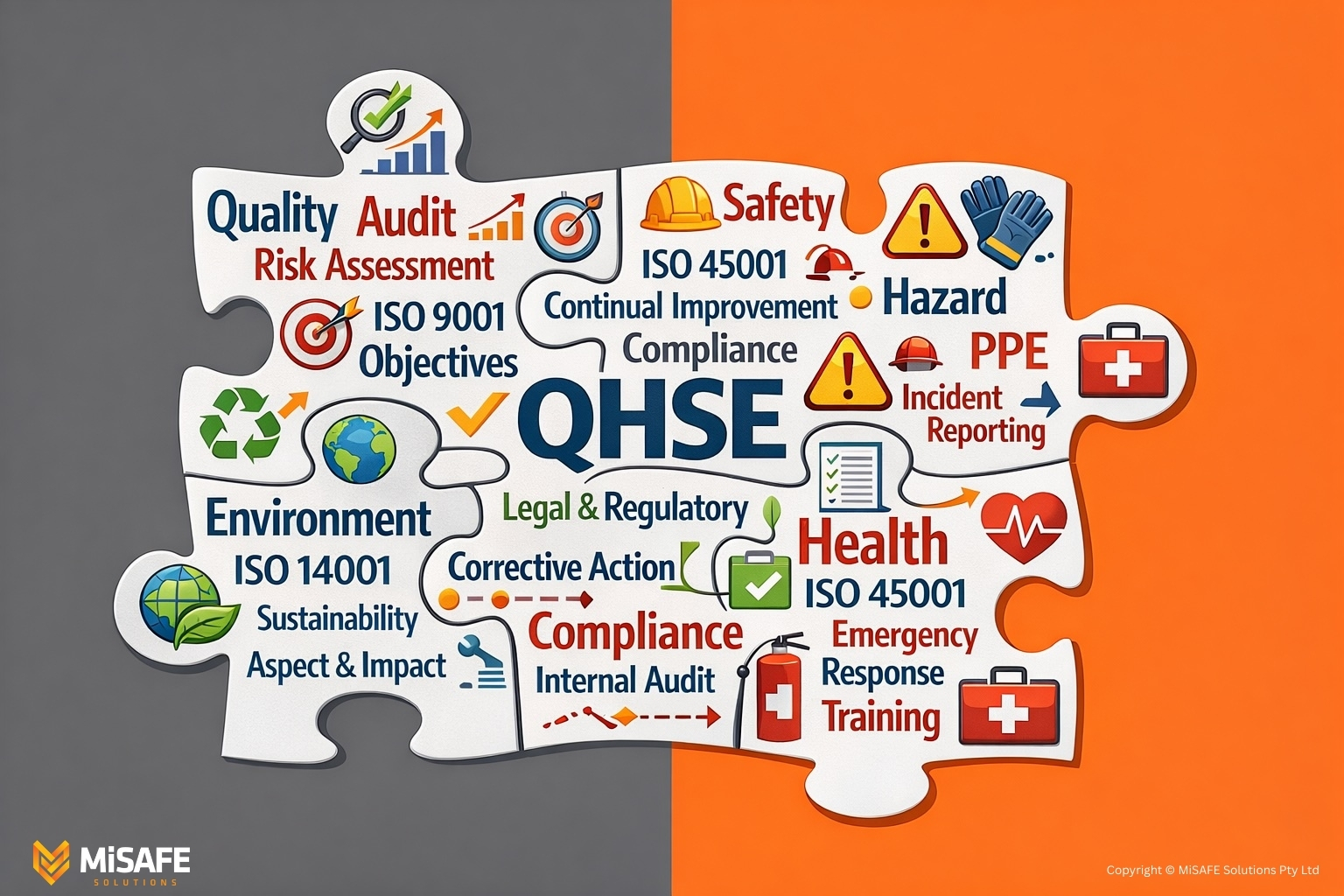
Welcome to Week 3 of MiSAFE Solutions Pty Ltd’s IMS Mastery Series: “Build Your IMS Empire: 53 Weeks of QHSE Insights with MiSAFE”. Following our exploration of ISO standards in Week 2, this week we tackle the often daunting world of QHSE jargon. We provide clear, straightforward definitions for key terms from ISO 9001 (quality), ISO 45001 (health and safety), ISO 14001 (environment), and the unifying Annex SL structure.
Jargon can feel like a barrier. However, understanding these terms empowers you to build a more effective Integrated Management System (IMS). Therefore, we break them down simply, with real-world examples to make them relatable for Australian businesses.
Why Bust QHSE Jargon?
Technical terms in ISO standards can confuse even seasoned professionals, leading to misapplication or oversight in your IMS. For instance, in trade sectors like construction, misunderstanding “risk-based thinking” might result in inadequate hazard controls. By demystifying these, you gain confidence to integrate QHSE seamlessly. Additionally, this ensures compliance and operational smoothness without unnecessary complexity.
ISO standards are written for consistency across industries, not for operational clarity at the coalface. As a result, organisations often implement controls they do not fully understand. For example, they focus on paperwork rather than risk. Moreover, they confuse terminology across Quality, Safety, and Environment. Consequently, they pass audits but fail in real-world performance. In sectors such as construction, this frequently results in generic SWMS and procedures. Additionally, it leads to poor contractor oversight, reactive incident management, or overcomplicated systems that workers disengage from. This glossary translates ISO language into practical meaning. Therefore, it supports consistent interpretation across the business, effective induction and training, clear audit evidence, and a usable, not theoretical, IMS.
Core Integrated Management System (IMS) Terminology
These foundational concepts appear across multiple standards. First, consider the overarching terms that tie everything together.
- Integrated Management System (IMS): A single management framework that integrates quality, health and safety, and environmental requirements rather than managing them in silos. Key intent: One system, one set of processes, one direction. Common misunderstanding: Thinking IMS means “three manuals merged together”. Example: An Australian manufacturing firm uses an IMS to handle supplier audits for both quality and safety in one process.
- Management System: A set of interrelated or interacting elements of an organisation used to establish policies, objectives, and processes to achieve those objectives. Includes: Structure, roles, planning, processes, monitoring, and improvement.
- Policy: A statement of intent and direction approved by top management. Not: A procedure or instruction. Audit focus: Is it communicated, understood, and applied?
- Objective: A measurable outcome aligned with policy and risk. Poor example: “Improve safety.” Good example: “Reduce manual handling injuries by 30 percent within 12 months.”
- Target: A measurable performance requirement used to achieve an objective.
- Process: A set of activities that transforms inputs into outputs. Audit reality: Auditors follow processes, not documents.
- Procedure: A documented way of carrying out a process. Common error: Confusing procedures with work instructions or SWMS.
- Work Instruction: A detailed step-by-step description of how to perform a specific task safely and consistently.
- Record: Evidence that a process was performed. Examples: Inspection checklists, training attendance, permits.
- Effectiveness: The extent to which planned activities are realised and planned results achieved. Audit test: Is it working, not just written?
- Efficiency: The relationship between results achieved and resources used.
- Continual Improvement: Recurring activity to enhance performance over time. Evidence: Trends, reviews, refinements.
- Audit: A systematic examination to verify compliance and effectiveness of the IMS. Internal audits help identify improvements before external certifications.
- Corrective Action: Action to eliminate the cause of a nonconformity. Key test: Root cause addressed, not symptoms.
- Preventive Action: Proactive action to eliminate potential nonconformities. Now embedded within risk-based thinking.
- Nonconformity: Non-fulfilment of a requirement. Sources: Standards, legislation, procedures, customer requirements.
- Major Nonconformity: A significant failure affecting system integrity or legal compliance.
- Minor Nonconformity: An isolated lapse that does not indicate systemic failure.
- Observation: An improvement opportunity identified during audit but not a nonconformity.
- Root Cause: The fundamental reason a nonconformity occurred. Common failure: Stopping at “human error”.
Risk and Opportunity Language (Cross-Standard)
Risk terms form the backbone of proactive QHSE management. Here, we outline them with practical ties across standards.
- Risk: The effect of uncertainty on objectives. Important: Risk is not just negative; it includes opportunity.
- Opportunity: A circumstance that can improve outcomes, performance, or efficiency. Example: Automating inspections to reduce errors and time.
- Risk-Based Thinking: A mindset requiring organisations to proactively identify, assess, and address risks and opportunities as part of normal operations. Not: A separate risk register exercise done once a year.
- Risk Assessment: The overall process of hazard identification, risk analysis, and risk evaluation.
- Risk Analysis: Understanding the nature of risk and determining its level.
- Risk Evaluation: Comparing analysed risk against criteria to determine acceptability.
- Residual Risk: Risk remaining after controls are implemented.
- Risk Register: A documented tool for recording identified risks, controls, and actions. Audit expectation: It reflects real operations, not generic risks.
ISO 9001: Quality Management Terms
ISO 9001 centres on quality. So, these terms help maintain customer focus and process excellence.
- Quality Management System (QMS): The organised set of policies, processes, and procedures for ensuring consistent quality. It forms the core of ISO 9001, helping businesses like SMEs track customer feedback to improve services.
- Process Approach: Managing activities as interconnected processes using PDCA (Plan-Do-Check-Act) cycles. This ensures smooth workflows, such as linking procurement to quality checks.
- Risk-Based Thinking: Proactively identifying and addressing risks and opportunities in quality processes. For example, assessing supplier reliability to avoid delivery delays.
- Customer Focus: Prioritising understanding and meeting customer requirements to enhance satisfaction. Example: Regular surveys in service industries.
- Supplier Evaluation: Assessing and monitoring external providers to ensure they meet quality standards, crucial for procurement.
- Management Review: Periodic meetings where leadership evaluates the QMS’s performance and plans improvements.
- Quality: Degree to which a set of inherent characteristics fulfils requirements.
- Customer: Person or organisation that receives a product or service.
- Customer Satisfaction: Customer perception of the degree to which requirements are met.
- Customer Feedback: Information relating to customer perceptions, complaints, compliments, and suggestions.
- Interested Party (Quality Context): Includes customers, regulators, insurers, shareholders, and end users.
- Product: Output of a process that can be produced without any transaction between organisation and customer.
- Service: Output involving interaction with the customer.
- Conformity: Fulfilment of a requirement.
- Control of Nonconforming Outputs: Actions taken to prevent unintended use or delivery of nonconforming products or services.
- Change Management (Quality): A structured approach to managing changes to processes, suppliers, or outputs.
- Performance Indicator (KPI): Measurable value that demonstrates effectiveness of processes.
ISO 45001: Health and Safety Terms
ISO 45001 prioritises safety. Thus, these terms support worker protection and risk mitigation.
- Occupational Health and Safety Management System (OH&S MS): A system to manage health and safety risks, promoting a safe workplace. It’s essential for high-risk industries like mining, where it guides hazard controls.
- Hazard: A source with potential to cause harm, such as machinery or chemicals. Identification is key, followed by controls like PPE.
- Risk Assessment: Evaluating the likelihood and severity of hazards to prioritise actions. Example: Assessing fatigue in shift work to implement rest breaks.
- Incident: An event that could or did lead to injury, like a slip or near miss. Reporting helps prevent future occurrences.
- Near Miss: An incident that didn’t cause harm but could have, used for learning and prevention.
- Consultation and Participation: Involving workers in OH&S decisions, such as through safety committees, to foster ownership.
- Hierarchy of Controls: A prioritised method for risk reduction, starting with elimination down to PPE.
- Worker: Any person performing work or work-related activities under the control of the organisation. Includes: Contractors, labour hire, apprentices.
- Workplace: Any place where work is performed.
- Occupational Health and Safety (OH&S): Conditions and factors affecting the health and safety of workers.
- Hazard Identification: The process of recognising hazards that could cause harm.
- Health Risk: Risk related to long-term or chronic exposure (e.g. noise, silica, fatigue).
- Safety Risk: Risk related to immediate physical injury.
- Incident Investigation: Structured process to determine causes and contributing factors.
- Emergency Preparedness and Response: Processes to prevent, mitigate, and respond to emergency situations.
- Worker Consultation: Two-way communication enabling workers to contribute to safety decisions.
- Participation: Active involvement of workers beyond consultation.
- Contractor Management: Processes to ensure contractors meet OH&S requirements.
- Permit to Work: Formal authorisation for high-risk activities.
ISO 14001: Environmental Management Terms
ISO 14001 focuses on sustainability. Hence, these terms aid in impact reduction and compliance.
- Environmental Management System (EMS): A framework for managing environmental responsibilities, including policy and objectives. It helps organisations comply with laws like Australia’s Environmental Protection Act.
- Environmental Aspect: An element of your activities that interacts with the environment, such as energy use or waste generation.
- Life Cycle Perspective: Considering environmental impacts from raw materials to end-of-life. For instance, evaluating supplier emissions in procurement.
- Environmental Impact: The change to the environment caused by an aspect, like pollution from emissions.
- Compliance Obligation: Legal and other requirements your organisation must meet, such as permits or voluntary commitments.
- Operational Control: Procedures to manage aspects with significant impacts, like waste handling protocols.
- Environmental Policy: Statement of commitment to environmental protection and compliance.
- Aspect Register: Document identifying environmental aspects and impacts.
- Significant Environmental Aspect: An aspect that has or can have a significant environmental impact.
- Environmental Risk: Risk associated with environmental aspects and compliance obligations.
- Pollution Prevention: Use of processes or practices to reduce environmental harm.
- Sustainable Resource Use: Efficient use of energy, water, and materials.
- Waste Hierarchy: Avoid, Reduce, Reuse, Recycle, Recover, Dispose.
- Environmental Incident: Unplanned event resulting in environmental harm.
- Monitoring and Measurement: Tracking environmental performance and compliance.
- Emergency Environmental Response: Preparedness for spills, leaks, or releases.
Annex SL: Unifying Structure Terms
Annex SL harmonises the standards for easier integration. Accordingly, these terms facilitate cross-standard consistency.
- Annex SL: The high-level structure applied across ISO management system standards to enable integration.
- High-Level Structure (HLS): Common clause structure from Clause 1 to 10.
- Context of the Organisation: Understanding internal and external issues that affect strategic direction and IMS outcomes.
- Internal Issues: Culture, resources, competence, governance.
- External Issues: Legal, regulatory, market, environmental, social.
- Interested Parties: Stakeholders with relevant needs and expectations.
- Scope of the IMS: Boundaries and applicability of the management system.
- Leadership: Active accountability of top management.
- Planning: Systematic consideration of risks, opportunities, objectives, and changes.
- Support: Resources, competence, awareness, communication, documented information.
- Operation: Controlled execution of planned activities.
- Performance Evaluation: Monitoring, measurement, analysis, audits, and management review.
- Improvement: Corrective action and continual improvement processes.
Putting It All Together
These terms interconnect in your IMS—for example, risk assessment (ISO 45001) informs risk-based thinking (ISO 9001) and environmental aspects (ISO 14001). Start by reviewing your scope from Week 1 to apply them practically.
Get Started with Your Free Tool
Download the General QHSE Terms and Definitions Template (Document ID: MISAFE-IMS-TMP-002-V1.0) to create your own customised reference guide.
Stay Tuned
Next week: “Blend the Basics: Uniting Quality, Health, Safety and Environment from Day One”. Subscribe for updates.
Ready to act? Contact us today for expert support at https://misafesolutions.com.au/contact-us/ or book a free 1hr consultation meeting to discuss your IMS requirements with MiSAFE at https://calendly.com/misafe/1-hour-ims-development.
This article is general guidance. Check the legislation that applies in your state, or talk to us about your situation.