
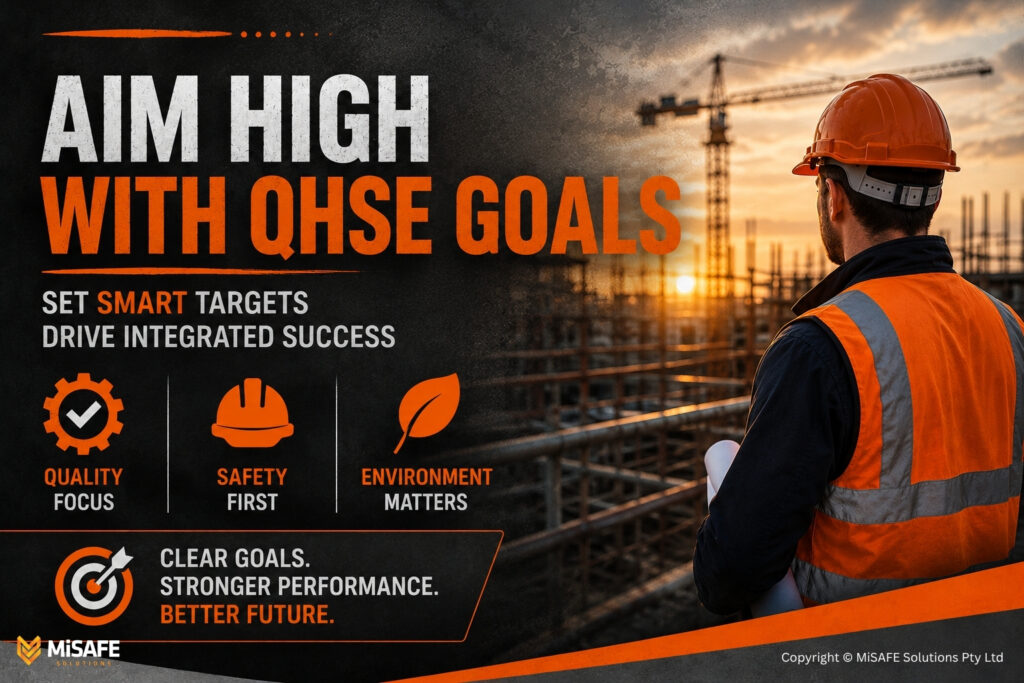
Welcome to Week 20 of MiSAFE Solutions’ IMS Mastery Series: Build Your IMS Empire: 53 Weeks of QHSE Insights with MiSAFE.
Following Week 19’s practical guide to turning risks and opportunities into clear actions, this week we focus on setting ambitious yet achievable QHSE goals. Under the ISO Annex SL structure, Clause 6.2 requires you to establish measurable objectives and plan how to achieve them as part of your Integrated Management System (IMS). This is where Quality (ISO 9001), Health & Safety (ISO 45001), and Environment (ISO 14001) come together to drive real performance improvements.
The best IMS systems don’t just have vague aspirations — they have clear, integrated SMART targets that everyone can understand and work toward.
Why SMART QHSE Goals Matter for Your IMS
Without well-defined goals, even the best risk and opportunity plans drift. In Australian SMEs and trade businesses — especially construction, manufacturing, roofing and plumbing teams — unclear targets often lead to missed opportunities, repeated issues, and wasted effort. SMART goals give you focus, accountability, and a way to measure real progress across all three QHSE areas in one unified system.
What Makes a Goal SMART?
SMART stands for:
- Specific – Clear and focused on a defined outcome
- Measurable – Progress is tracked with numbers or clear indicators
- Achievable – Realistic for your business size and available resources
- Relevant – Directly supports your QHSE policy and business objectives
- Time-bound – Has a clear deadline for completion or review
When integrated across your IMS, these goals link your risk and opportunity actions directly to measurable outcomes — giving your entire team a clear picture of what success looks like.
Practical Steps to Set Integrated QHSE Goals
Here is a straightforward process you can start using straight away:
- Review your risk and opportunity register from last week.
- Identify 3–5 key improvement areas across Quality, Safety, and Environment.
- Draft goals using the SMART criteria.
- Align each goal to your overall QHSE policy and business strategy.
- Assign owners, resources, and timelines for each goal.
- Document everything in one simple register and review progress monthly.
Keep it practical — sensible, achievable targets that protect your people and improve your bottom line without adding unnecessary bureaucracy.
Common Challenges and How to Overcome Them
Many businesses set too many goals or make them too generic. The fix is straightforward: keep the number small, make them measurable, and review them regularly in management meetings. Tie every goal to a real business benefit so it stays relevant and gets buy-in from the whole team.
Benefits of Setting Integrated SMART Targets
When done well, integrated QHSE SMART goals will help you:
- Achieve measurable reductions in incidents and non-conformities
- Improve operational efficiency and cut unnecessary costs
- Build a stronger culture of accountability and continual improvement
- Demonstrate genuine commitment to clients, regulators, and your team
Get Started with Your Free Tool
Download the QHSE Objectives and Targets Template (Document ID: MISAFE-IMS-TMP-016-V1.0) to systematically define, document, track, and review your integrated SMART goals across the entire IMS. Use it as-is or customise it to suit your organisation’s specific needs and industry.
Coming Up Next Week
Week 21: Handle Change Smoothly — Planning Transitions in Your IMS Build.
Ready to Set SMART QHSE Targets for Your Business?
Let MiSAFE’s experts guide you through the process. Get in touch today:
- Email: contact@misafesolutions.com.au
- Phone: +61 7 5641 2101
- Mobile: +61 400 977 769
- Book a free 1-hour IMS consultation
This article is general guidance. Check the legislation that applies in your state, or talk to us about your situation.