
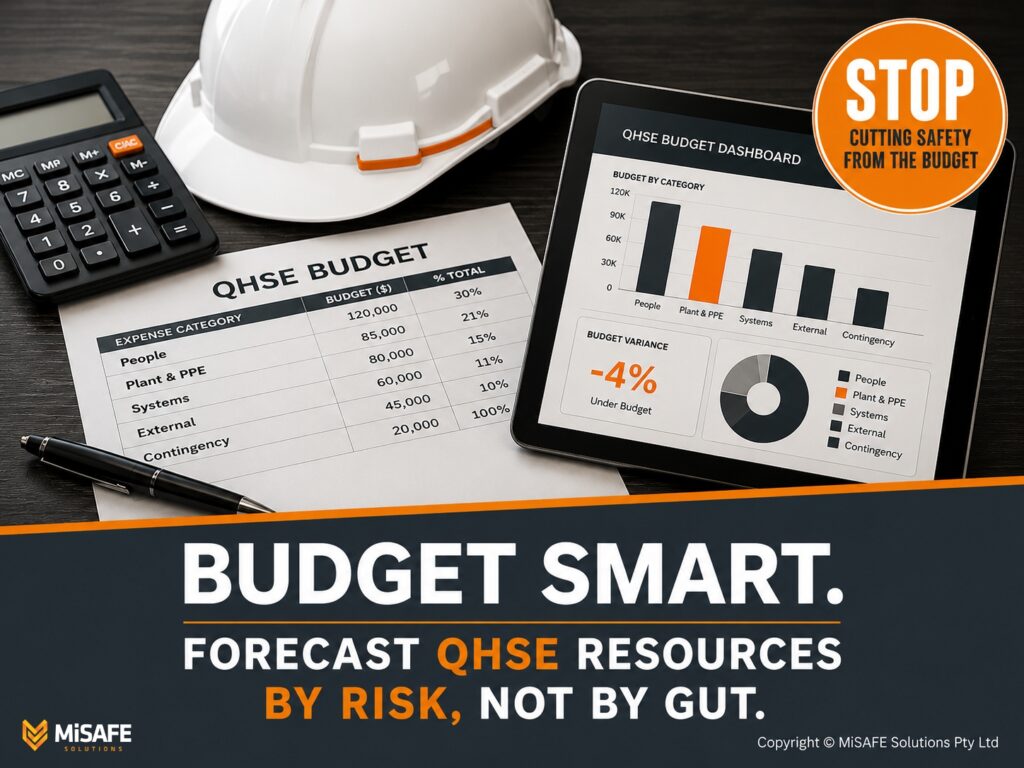
Most QHSE budgets get cut first because they are presented as overhead. A line item without a story. A number without a risk.
That is not a finance problem. That is a planning problem.
ISO 9001:2015, ISO 14001:2015 and ISO 45001:2018 Clause 7.1 all require the organisation to determine and provide the resources needed to establish, implement, maintain and continually improve the IMS. The Act behind WHS in Australia is even clearer. Section 19 of the Work Health and Safety Act 2011 places the primary duty on the PCBU, which includes providing resources reasonably necessary to eliminate or minimise risk.
Resources cost money. QHSE budget forecasting is how you make sure the money is there when the obligation lands.
Why most QHSE budgets fail
Three patterns turn up in nearly every business that gets resource planning wrong.
The first is the lump-sum approach. A single annual figure labelled “WHS” or “Quality”. No breakdown by activity. No link to risk. Finance has nothing to defend at board level when the cost is challenged.
The second is the historical-actuals approach. Last year plus five percent. No reassessment of risks, no reference to changes in the legal register, no recognition that the operating profile has changed.
The third is the wishlist approach. A list of items the QHSE Manager wants this year, divorced from the operational plan and from the risk register. Finance reads it as discretionary and cuts it first.
What ISO Clause 7.1 actually requires
Clause 7.1 of all three Annex SL standards sets a clear obligation. The organisation determines and provides the resources needed for the IMS. That includes people (Clause 7.2 Competence), infrastructure (Clause 7.1.3), the environment for the operation of processes (Clause 7.1.4), monitoring and measuring resources (Clause 7.1.5), and organisational knowledge (Clause 7.1.6).
Read this as a checklist. Every QHSE budget should have a line item against each of these areas, tied back to specific risks, legal obligations and objectives.
If your QHSE objectives from Week 20 are not funded, they are not objectives. They are aspirations.
The QHSE cost categories that actually matter
Build the budget around five categories that map cleanly to Clause 7.1 and to your risk and legal registers.
People and competence covers training delivery, refresher courses, ticketed qualifications under the WHS Regulation (high risk work licences, plant tickets, working at heights), inductions, toolbox talk preparation time and competency assessment. This is the largest line item for most service businesses and the most under-budgeted.
Plant, PPE and infrastructure covers RCDs, harnesses and lanyards, respiratory protection, hi-vis, footwear replacement cycles, calibrated monitoring equipment under Clause 7.1.5, plant inspections, signage and barriers, first aid stations and AEDs. Tie replacement cycles to manufacturer specifications and inspection records.
Systems and tools covers SWMS software, document control systems, incident reporting platforms, audit tools, certification scheme fees and management review preparation. The MiSAFE All-in-One QHSE subscription is a single line item here that consolidates several.
External services covers consulting, certification audits (Stage 1, Stage 2, surveillance, recertification), hygiene monitoring, occupational health, drug and alcohol screening, calibration services and legal compliance reviews. Forecast certification cycles three years out.
Contingency and incident response covers reasonable provision for response costs, root cause investigation, regulator notification support, replacement of damaged plant and short-term contractor cover. Three to five percent of the total QHSE budget is a realistic starting point.
Link the budget to risk and legal obligations
Each line item in the budget should reference the risk it controls or the legal obligation it satisfies. Reference the Risk and Opportunity Register (MISAFE-IMS-TMP-019) and the Legal and Compliance Obligations Register (MISAFE-IMS-TMP-022).
This single change reframes the entire conversation with finance. The training budget is not a request, it is the control for the high-risk-construction-work risk and the duty under Regulation 39 of the WHS Regulation 2011. The plant inspection budget is the control under the Plant chapter of the WHS Regulation. The certification budget keeps you eligible for tenders that require ISO 45001 certification.
Risk-based budgeting also aligns with AS/NZS ISO 31000:2018 Clause 6.5 Risk Treatment, which requires consideration of resources required to treat each risk.
Practical Application
For a Sunshine Coast civil contractor with 25 staff and a $4.5M annual turnover, an indicative QHSE budget runs at around 1.8 to 2.5 percent of turnover, broken down roughly as follows: people and competence 35 to 45 percent of the QHSE budget; plant, PPE and infrastructure 25 to 35 percent; systems and tools 8 to 12 percent; external services 10 to 15 percent; contingency 3 to 5 percent.
These are starting ranges, not rules. Construction-heavy operations push plant and PPE higher. Service-heavy operations push systems and people higher. Highly regulated industries push external services higher because of certification and monitoring cycles.
Track actual against forecast monthly. A variance above ten percent on any category triggers a review at the next QHSE leadership meeting. Variance is data, not failure. It tells you the forecast is wrong or the operating profile has changed.
Conclusion
QHSE budget forecasting is not a finance exercise dressed up as planning. It is the resourcing arm of your risk and legal registers. Build the budget around the five categories, tie every line item to a risk or legal duty, track variance monthly, and the QHSE budget becomes the easiest part of your annual planning cycle to defend.
The MiSAFE All-in-One QHSE subscription includes annual QHSE budget setup inside DS Site, with line items pre-linked to your risk and legal registers, monthly actual vs forecast tracking and variance reporting built in.
Download the Free Template
Download the free QHSE Budget Forecast Workbook and start linking every QHSE budget line to a real risk or legal duty.
This article is general guidance. Check the legislation that applies in your state, or talk to us about your situation.