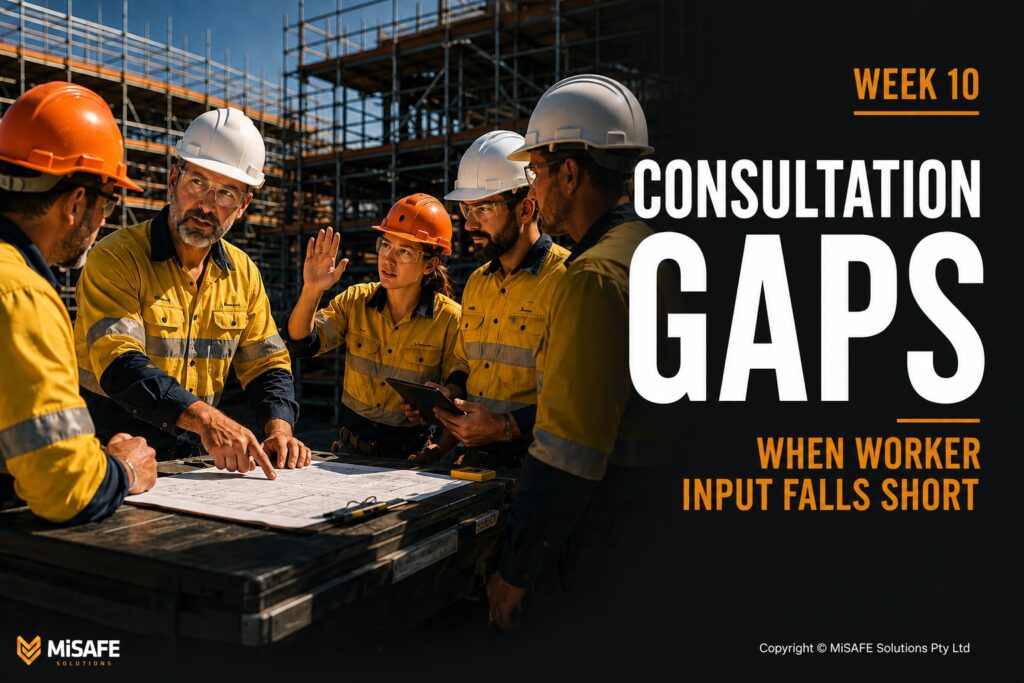
Welcome to Week 10 of MiSAFE Solutions Pty Ltd’s SWMS Mastery Series: 52 Weeks with MiSAFE.
Last week we covered the version control failures that quietly age a SWMS out of compliance. The next failure point in Phase 2 is closer to home. Even the current version of a SWMS, written well, can be functionally empty if the workers performing the work were never genuinely consulted in its development. Sign-off without consultation is the most common form of paperwork-as-compliance on Australian construction sites. It is also the easiest to spot when a regulator or coroner pulls the document apart.
What the WHS Act and Regulation Actually Require
Consultation is not a formality under Australian work health and safety law. Section 47 of the Work Health and Safety Act 2011, applied in the harmonised jurisdictions, places a primary duty on every PCBU to consult, so far as is reasonably practicable, with workers who carry out work for the PCBU and who are, or are likely to be, directly affected by a matter relating to work health or safety. Section 48 sets out the nature of the consultation: relevant information must be shared, workers must be given a reasonable opportunity to express views, raise issues and contribute to decisions, those views must be taken into account, and workers must be advised of the outcome.
Regulation 300 of the Work Health and Safety Regulation 2017 takes that general duty and applies it directly to the SWMS. The SWMS must be prepared in consultation with the workers carrying out the high risk construction work, and reviewed in consultation with those workers if the work changes. Victorian and Western Australian equivalents impose materially similar duties under the Occupational Health and Safety Act 2004 (Vic) and the Work Health and Safety Act 2020 (WA). The Safe Work Australia Code of Practice on Work Health and Safety Consultation, Cooperation and Coordination is the practical reference for what compliance looks like.
The Common Forms of Empty Consultation
Most failed consultation does not look like a refusal to consult. It looks like a process that ticks every visible box and gathers nothing.
The signature page reaches the crew after the SWMS is drafted, approved and printed. The toolbox talk runs for four minutes at the end of a long shift when no one is going to raise a concern. The same SWMS is reused job after job without any chance for the new crew to engage with the controls. The Health and Safety Representative is left out of the loop because the work needs to start. Apprentices and short-tenure casuals stay quiet because they think speaking up will make them look slow. A non-English speaking worker nods through a document written in technical English. The crew signs because the foreman handed them a pen and the truck is loaded.
How Regulators and Courts Read Consultation Records
Regulators do not stop at the signature page. WorkSafe, Workplace Health and Safety Queensland, SafeWork NSW and their state counterparts have published enforceable guidance describing genuine consultation. Inspectors look for three things on site: evidence that workers had a real opportunity to influence the SWMS before they were asked to sign, evidence that the SWMS reflects how the work is actually being performed by those workers, and evidence that any concerns raised were considered and either acted on or formally answered.
After a serious incident the same standard is applied retrospectively. If the matter reaches a coroner, an Industrial Manslaughter prosecution or a Section 32 charge under the WHS Act, the consultation record is one of the first documents subpoenaed. A signature page with eight names and no notes carries almost no weight. A consultation record showing dates, attendees, issues raised, decisions taken and follow-up actions carries significant weight, even where the underlying SWMS turns out to be imperfect.
What Genuine Consultation Looks Like on a Live Site
Genuine consultation has consistent features on any size of job. The SWMS draft is shared with the workers performing the activity in time for them to read it, raise questions and propose changes before approval. The conversation is held in the language those workers actually speak, with diagrams, photographs or onsite walk-throughs where text is not enough. Time is allocated at the start of a shift or before mobilisation, not at the back end of a fatigued day. The Health and Safety Representative is engaged from the outset where one is in place. Apprentices, casuals and short-tenure workers are explicitly invited to contribute, and the supervisor checks in with them after the meeting to surface anything they did not raise in the room.
Issues raised are recorded against the worker who raised them, the response, and the action taken. Workers sign against a specific revision of the SWMS so the consultation record is bound to the version they actually contributed to. None of these steps require more meetings. They require the meetings the law already expects to be run with intent.
Practical Application
Effective SWMS consultation does not require additional layers of process. It requires a small number of fixed disciplines applied consistently.
- Make it a non-negotiable rule that no SWMS is approved until the workers performing the activity have had a documented opportunity to contribute.
- Maintain a SWMS Consultation Record that captures date, attendees, language used, issues raised, decisions taken, responsible person and follow-up action.
- Train supervisors to run a short structured conversation rather than a passive read-through. A good conversation surfaces issues. A passive read-through buries them.
- Build a check into the SWMS sign-off step that confirms HSR engagement where applicable, and explicit engagement with apprentices and casuals.
- For non-English speaking workers, build a translation, interpreter or visual-aid step into the standard workflow rather than relying on a colleague to translate informally.
MiSAFE SWMS captures the consultation event against the SWMS revision directly. When a worker scans the QR code on the document and signs digitally, the signature is bound to that revision and to the consultation record, which closes the audit-trail gap that empty consultation typically leaves behind.
The Core Takeaway
A signature on the back of a SWMS proves only that the worker held a pen. It does not prove consultation occurred and it does not satisfy the duty in sections 47 and 48 of the Work Health and Safety Act 2011. The discipline required is not more documents. It is a small number of consistently applied steps that produce a record of genuine input. Get those steps right and the SWMS becomes a working document the crew owns, rather than paperwork the crew tolerates.
Download the free SWMS Consultation and Sign-Off Record here: SWMS Consultation and Sign-Off Record
The record captures the date, method, language, facilitator, HSR engagement, worker name and role, issues raised, decision taken, action owner, action due date and signature against the specific SWMS revision the worker contributed to. Drop it into your IMS and start using it on the next SWMS review.
Stay Tuned
Next week on SWMS Mastery: Week 11 covers the Generic Template Trap. We unpack the risks of one-size-fits-all SWMS approaches, why generic templates fail under regulator scrutiny, and how to keep the efficiency of templates without losing the site-specific tailoring that the law requires.
Ready to act? Contact us today at https://misafesolutions.com.au/contact-us/ or book a free 1-hour consultation at https://calendly.com/misafe/1-hour-ims-development.
Email: contact@misafesolutions.com.au
Phone: +61 7 5641 2101
Mobile: +61 400 977 769
Book a free consultation: https://calendly.com/misafe/45-min-consultation-meeting
This article is general guidance. Check the legislation that applies in your state, or talk to us about your situation.