
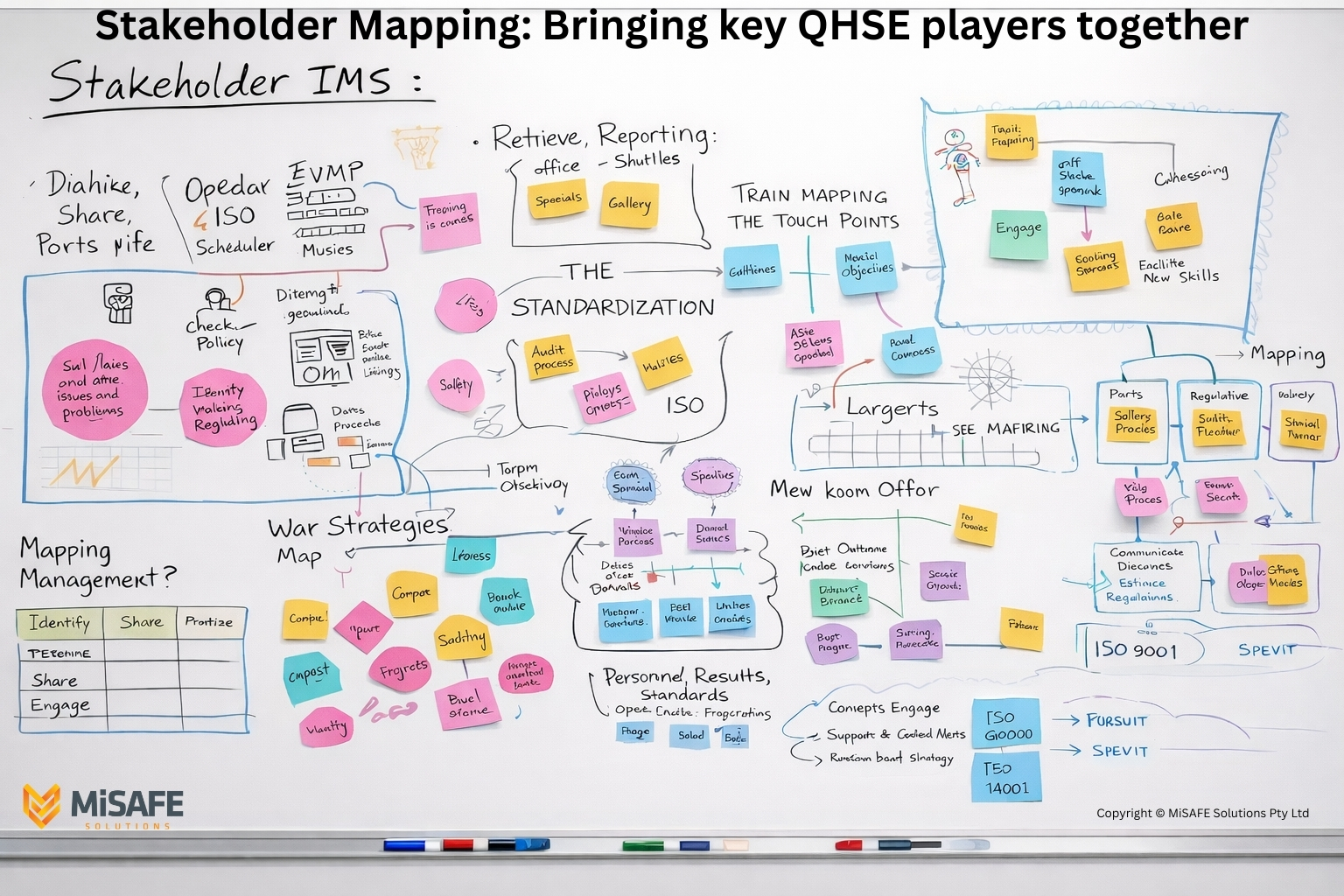
Welcome to Week 7 of MiSAFE Solutions Pty Ltd’s IMS Mastery Series: “Build Your IMS Empire: 53 Weeks of QHSE Insights with MiSAFE”. Following Week 6’s examination of external market and regulatory forces, this week we focus on a critical internal-external bridge: stakeholder mapping. Under the ISO Annex SL structure, identifying and engaging key stakeholders is essential for building a robust Integrated Management System (IMS) that incorporates Quality (ISO 9001), Health & Safety (ISO 45001), and Environment (ISO 14001).
Stakeholders are not just names on a list — they are the people and groups who can influence or be influenced by your QHSE performance. Mapping them effectively ensures your IMS is relevant, supported, and sustainable.
Why Stakeholder Mapping Matters in Your IMS
Stakeholder mapping is more than a compliance exercise. It is a strategic process that helps you understand expectations, manage risks, and secure buy-in. In Australian organisations, especially SMEs in construction and manufacturing, failing to map stakeholders can lead to resistance during implementation, overlooked safety concerns, or environmental complaints from the community. By contrast, a well-mapped stakeholder approach aligns your IMS with real needs, reduces conflicts, and strengthens your licence to operate.
Key Types of Stakeholders to Map
Annex SL requires organisations to identify interested parties. Consider these main categories:
- Internal Stakeholders: Employees, contractors, managers, and leadership. Their daily involvement directly affects QHSE outcomes.
- External Stakeholders: Customers, suppliers, regulators (e.g., Safe Work Australia, EPA), local communities, insurers, and industry associations.
- Influential Stakeholders: Unions, media, or environmental groups who may not have direct contracts but can significantly impact reputation.
Practical Steps to Map and Engage Stakeholders
Follow this structured approach to make stakeholder mapping actionable:
- Identify Stakeholders: Create a comprehensive list of individuals and groups affected by or able to affect your QHSE activities.
- Analyse Influence and Interest: Plot stakeholders on a power-interest grid to prioritise engagement.
- Understand Expectations: Determine what each stakeholder needs or expects from your IMS (e.g., workers want safe conditions, regulators want compliance evidence).
- Develop Engagement Strategies: Define how and when you will communicate and involve them (e.g., toolbox talks for workers, formal reports for regulators).
- Document and Review: Record everything in your IMS and schedule regular reviews to adapt to changes.
Common Challenges and Solutions
Many organisations struggle with incomplete mapping or treating stakeholders as a one-off task. The solution is to make it ongoing. For example, integrate stakeholder feedback into management reviews and use simple tools to track engagement. This prevents surprises and builds stronger relationships over time.
Benefits of Effective Stakeholder Mapping
When done well, stakeholder mapping leads to higher employee engagement, fewer compliance issues, stronger community support, and better overall IMS performance. It transforms potential obstacles into collaborative advantages.
Get Started with Your Free Tool
Download the Stakeholder Mapping Template (Document ID: MISAFE-IMS-TMP-005-V1.0) to begin identifying and analysing your key QHSE stakeholders.
Stay Tuned
Next week: “What They Want: Gathering Input to Shape Your IMS”. Subscribe for updates.
Ready to act? Contact us today for expert support at https://misafesolutions.com.au/contact-us/ or book a free 1hr consultation meeting to discuss your IMS requirements with MiSAFE at https://calendly.com/misafe/1-hour-ims-development.
Recent Comments