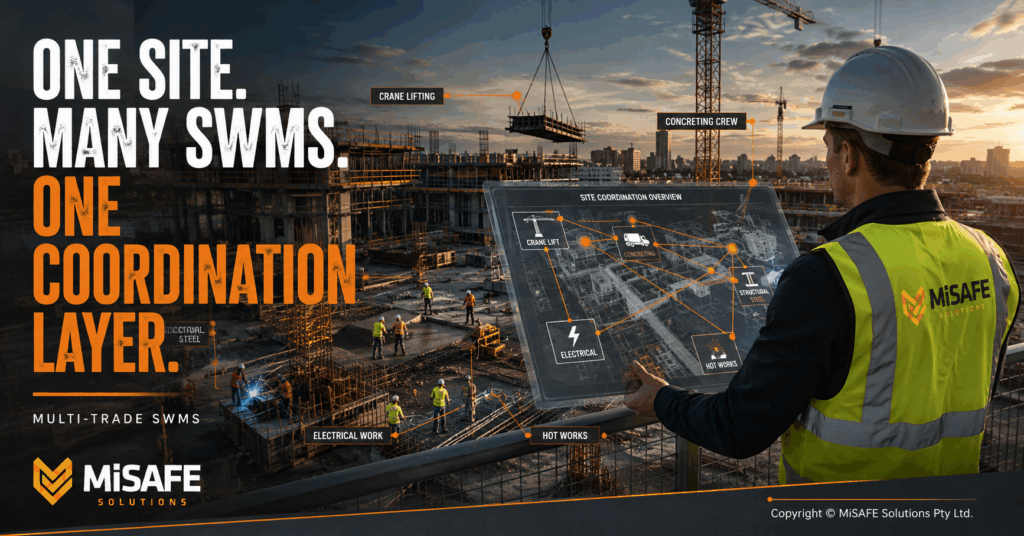
On a single-trade job, one SWMS can cover the work. A multi-trade site is different. Here, the multi-trade SWMS challenge is simple. One master document tries to cover every trade, and it ends up covering none of them well.
Each trade brings its own high risk construction work. Riggers lift. Concreters pour. Electricians energise. Welders cut. As a result, one document cannot carry the specific controls for all of them. The moment it tries, it becomes a generic SWMS that fits any job and protects no one.
So this post looks at three things. First, why one SWMS cannot cover a multi-trade site. Next, where the real risk hides, in the interfaces between trades. Finally, how to coordinate a set of trade-specific SWMS so the gaps close.
What the WHS Act and Regulation actually require
Section 19 of the Work Health and Safety Act 2011 gives each PCBU a primary duty. You must protect the health and safety of your workers and of others your work affects. On a shared site, that includes the workers of every other trade.
Section 46 then makes the shared part explicit. When more than one PCBU holds a duty for the same matter, each must consult, co-operate and co-ordinate with all the others. A multi-trade site is the textbook case. Here, every subcontractor and the principal contractor share that duty for the one workplace.
Regulation 299 of the Work Health and Safety Regulation 2017 requires a SWMS for each high risk construction work activity. Different trades do different HRCW. So each one needs its own SWMS, not a shared one.
In short, the law does not ask for one SWMS. It asks for coordinated SWMS.
Why one SWMS cannot cover a multi-trade site
A SWMS is task-specific by design. Rigging controls, hot works controls and electrical controls do not collapse into one set of steps. As a result, each one loses the detail that makes it work. That specificity is the whole point.
A master SWMS that lists every trade’s hazards is unreadable on site. You cannot brief it well. Each crew skims past the nine trades that are not theirs to find the one that is. So the controls that matter get lost in the noise.
This is the generic template trap, scaled up. A document broad enough to cover every trade is specific enough for none. In other words, a SWMS that could suit any crew does not speak to the crew in front of you.
Where multi-trade SWMS risk really lives: the interfaces
The dangerous part of a multi-trade site is rarely the work inside one trade’s SWMS. It is the overlap. One trade’s work creates a risk for another trade.
Think of a crane lifting over a crew that is not its own. Hot works throw sparks near another trade’s solvents. The formworkers leave a penetration open, and an electrician steps into it. Energised work runs next to a wet trade. Two crews work at different levels with nothing between them.
No single trade’s SWMS controls these risks. Instead, each SWMS sees only its own task. The interface is the gap between documents. On a busy site, that gap is exactly where the incident happens.
How to coordinate multi-trade SWMS without gaps
First, keep each trade’s SWMS task-specific and let it do its job. Then add a coordination layer on top. The principal contractor maps every interface where one trade’s work affects another. They name the control and record who owns it.
Coordinate by sequence and separation. Schedule conflicting work at different times. Separate it in space. Or put a hard control between the trades. That is section 46 in practice. So you consult to find the overlaps, agree the controls, and time the work so two trades never clash.
A coordination register turns the interfaces into a managed list. It records each trade, its SWMS, the trades it interfaces with, the interface risk, the control, and the owner. In addition, it flags whether you have coordinated each one yet. The SWMS stay specific. The register holds them together.
Practical Application
Picture a commercial fit-out running five trades. The riggers lift steel over the concreting zone. So the register flags the interface. The crew runs the lift before the pour, behind an exclusion zone, with a spotter.
Similarly, the welders’ hot works sit near the painters’ solvent store. The register flags this one too. The team clears the store first. Then they run the hot works under a permit, with a fire watch.
Each trade still keeps its own task-specific SWMS. In addition, the register holds the five interface controls and names an owner for each. Two interfaces are still open at induction. So the crew closes them before the overlapping work runs.
When the work runs, no crew leans on another trade’s SWMS to stay safe. After all, someone owns and coordinates every interface. If a regulator reviews the site after an incident, the register proves the principal contractor met its section 46 duty.
Conclusion
One SWMS cannot carry a multi-trade site. First, keep each SWMS task-specific. Then coordinate the interfaces between them. That coordination is the principal contractor’s section 46 duty. In the end, the interfaces are where a busy site either controls the real risk or misses it.
MiSAFE SWMS lets each trade hold its own current SWMS. At the same time, the principal contractor sees the whole set in one place, with live worker sign-ons. So coordinating the interfaces becomes a single view, not a paper chase across folders.
Ready to act? Contact us today or book a free 45-minute consultation.
Download the Free Template
Download the free Multi-Trade SWMS Coordination Register (.xlsx) and turn the gaps between your trades’ SWMS into a managed, coordinated list.
This article is general guidance. Check the legislation that applies in your state, or talk to us about your situation.