
0400 977 769 contact@misafesolutions.com.au
MiSAFE Solutions
  • About
    • FAQs
    • Our Partners
      • QIN-CodeSafe
      • Protecht
  • All-In-One QHSE
  • QLD Tradies Pack
  • Software
    • WHS Management System
    • Safe Work Method Statements
    • OHS Management Software
    • Project management software
    • Complaint Management Software
    • Asset Management Software
    • Risk Management Software
    • Incident Management Software
    • Facility Management Software
    • Compliance Management Software
    • Subcontractor Management Software
    • QHSE Software Systems
  • Consulting
    • Risk Compliance Auditing Services
    • Environmental, Health & Safety Consulting Services
    • HSE Management Systems
    • Risk Management Consulting
    • Health and safety consulting
    • Compliance consulting
  • Contact
  • Blog
Select Page

Outside Forces Revealed: Tracking Market and Regulation Impacts on Your IMS

by MiSAFE Solutions | Feb 2, 2026

external-qhse-influences-tracking-template-for-ims

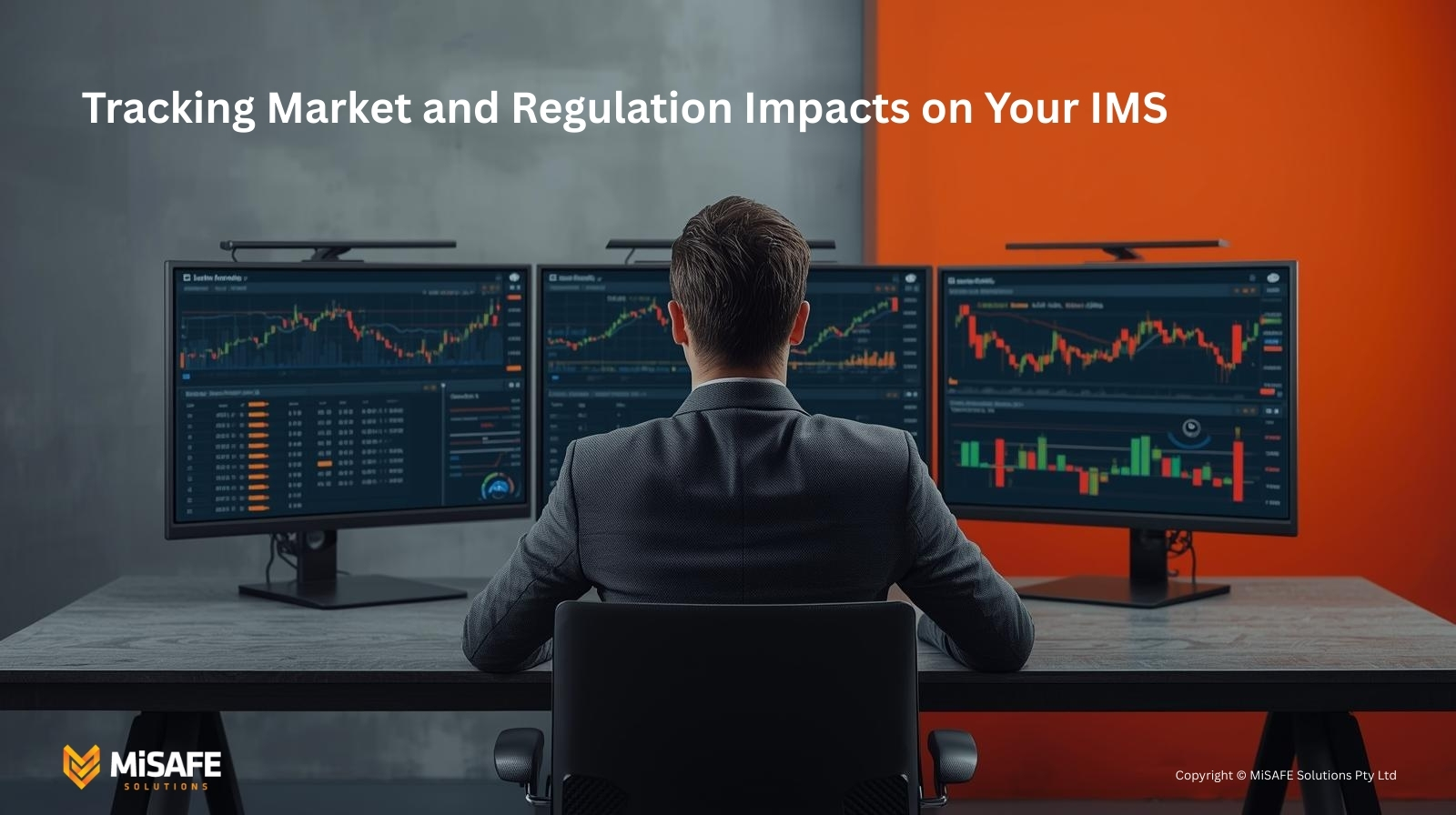
Welcome to Week 6 of MiSAFE Solutions Pty Ltd’s IMS Mastery Series: “Build Your IMS Empire: 53 Weeks of QHSE Insights with MiSAFE”. Following Week 5’s exploration of internal influences, this week we turn our attention outward to the external context. Under the ISO Annex SL structure, tracking market and regulatory impacts is essential for adapting your Integrated Management System (IMS) to Quality (ISO 9001), Health & Safety (ISO 45001), and Environment (ISO 14001).

External forces can either disrupt your QHSE efforts or open new opportunities. Therefore, proactive tracking ensures your IMS remains agile and compliant.

Why Track External QHSE Impacts?

External impacts refer to uncontrollable factors that affect your organisation’s QHSE performance. Overlooking them can lead to sudden compliance failures or missed competitive advantages, such as new environmental regulations increasing operational costs or market demands for sustainable products. For Australian organisations, this involves monitoring updates to the Work Health and Safety Act or the Environmental Protection and Biodiversity Conservation Act. Without vigilant tracking, your IMS risks obsolescence, resulting in penalties, reputational damage, or lost business. However, by systematically identifying these impacts, you fortify your system to anticipate changes, mitigate threats, and capitalise on opportunities, ultimately enhancing long-term sustainability and resilience.

Key External Influences to Track

ISO Annex SL’s Clause 4.1 requires consideration of external context. Focus on these categories to build a comprehensive monitoring strategy:

  • Regulatory and Legal: Government laws, industry standards, and international agreements. For example, changes in Australia’s Model Work Health and Safety Regulations might mandate new safety training protocols.
  • Market and Economic: Customer preferences, competitor actions, and economic shifts. A rise in demand for eco-friendly materials could influence your environmental management under ISO 14001.
  • Technological: Innovations and digital advancements. Adopting AI for hazard prediction could transform health and safety practices in ISO 45001.
  • Social and Cultural: Societal trends, community expectations, and workforce demographics. Growing emphasis on mental health might require updates to your OH&S system.
  • Environmental: Climate change, natural disasters, and resource scarcity. Events like bushfires in Queensland could impact supply chains and quality controls in ISO 9001.

Steps to Track and Analyse External Influences

Implement this detailed process to stay ahead of external dynamics:

  1. Establish Monitoring Sources: Set up alerts from reliable outlets, such as Safe Work Australia, government websites, industry associations, and market reports.
  2. Categorise and Prioritise: Classify influences by type and assess their relevance to QHSE—e.g., a new regulation might have high impact on safety but low on quality.
  3. Conduct Impact Analysis: Use tools like PESTLE (Political, Economic, Social, Technological, Legal, Environmental) to evaluate risks and opportunities, rating severity and likelihood.
  4. Integrate into Your IMS: Update plans, policies, and procedures accordingly— for instance, revise procurement criteria to address new environmental standards.
  5. Review and Adapt Regularly: Schedule bi-annual reviews or trigger them with major events, ensuring your IMS evolves with the external environment.

Common Challenges and Solutions

Tracking externals can overwhelm with information volume or rapid changes. For example, frequent regulatory updates might strain small teams. To mitigate this, automate notifications via RSS feeds or subscription services. Additionally, form a cross-functional team for analysis to distribute the load. This approach not only manages challenges but also uncovers synergies, like turning a market trend into an innovation for quality improvement.

Benefits of Proactive External Tracking

Proactive tracking transforms threats into advantages, strengthening your IMS overall. A construction firm, for instance, might anticipate safety reg changes, updating training ahead of time to avoid disruptions and gain a compliance edge. Over time, this leads to cost savings from foresight, improved stakeholder relations, and a more adaptable business in Australia’s evolving landscape.

Get Started with Your Free Tool

Download the External QHSE Influences Tracking Template (Document ID: MISAFE-IMS-TMP-004-V1.0) to monitor and analyse market and regulatory impacts systematically.

Stay Tuned

Next week: “Map Your Stakeholders: Connecting with Vital Players in QHSE”. Subscribe for updates.

Ready to act? Contact us today for expert support at https://misafesolutions.com.au/contact-us/ or book a free 1hr consultation meeting to discuss your IMS requirements with MiSAFE at https://calendly.com/misafe/1-hour-ims-development.

Recent Posts

  • Site Briefings That Don’t Stick: Why Toolbox Talks Fail to Communicate the SWMS
  • Incorporate Feedback: Refining Your Plans with Stakeholder Input
  • Generic Template Trap: When Standard SWMS Templates Fall Short
  • Budget Smart: Forecasting Resources for QHSE Initiatives
  • Preparing for ISO 45001 Certification: What Businesses Often Miss

Recent Comments

  • Micah Wicham on Choosing the Best HSE & Risk Management Software for your Organisation
  • Mark Robb on Choosing the Best HSE & Risk Management Software for your Organisation
  • captain on 5 Important Aspects of an Effective Emergency Preparedness and Response System!

Archives

  • June 2026
  • May 2026
  • April 2026
  • March 2026
  • February 2026
  • January 2026
  • December 2025
  • November 2025
  • October 2025
  • September 2025
  • August 2025
  • July 2025
  • June 2025
  • May 2025
  • April 2025
  • March 2025
  • February 2025
  • January 2025
  • December 2024
  • November 2024
  • October 2024
  • September 2024
  • August 2024
  • July 2024
  • June 2024
  • May 2024
  • April 2024
  • March 2024
  • January 2023
  • March 2020
  • January 2020
  • August 2019
  • December 2018
  • October 2018
  • September 2018
  • February 2018
  • November 2017
  • May 2017
  • April 2017
  • November 2016
  • September 2016
  • May 2016
  • January 2016
  • June 2015
  • January 2015

Categories

  • Advanced Analytics (Prescriptive Risk Management)
  • AI & Machine Learning in Safety (Predictive Analytics)
  • Asset Management (Inventory & Classification)
  • Auditing, Performance Evaluation & Improvement
  • Auditing, Performance Evaluation & Improvement
  • Business Continuity Planning (ISO 22301)
  • Case Studies
  • Communication & Consultation
  • Communication & Consultation
  • Communication & Consultation
  • Communication & Consultation
  • Communication & Consultation
  • Construction Safety
  • Context of the Organisation (Strategic Planning)
  • Continual Improvement Processes (PDCA, Kaizen, Lean)
  • Corrective and Preventive Actions (CAPA)
  • Corrective and Preventive Actions (CAPA)
  • Corrective and Preventive Actions (CAPA)
  • Corrective and Preventive Actions (CAPA)
  • Emerging Trends & Technology in QHSE
  • Enterprise Risk Management Framework (ISO 31000)
  • Hazard Identification & Risk Assessment
  • IMS Mastery Series
  • Incident Investigation & Root Cause Analysis
  • Industry-Specific Safety & Environmental Topics
  • Injury & Illness Management
  • Integrated Management Systems (Annex SL Alignment)
  • Integrated QHSE (Quality, Health, Safety, Environment)
  • Internal Audits & Inspections
  • Internal Audits & Inspections
  • Internal Audits & Inspections
  • Internal Audits & Inspections
  • ISO Standards
  • Leadership Training & Development
  • Leadership, Governance & Compliance
  • Lessons Learned & Incident Reviews
  • Management of Workers Compensation Claims
  • Mining & Quarrying Safety
  • Occupational Health & Safety (OHS) Management (ISO 45001)
  • Occupational Health & Safety (OHS) Management (ISO 45001)
  • OHS Management System (ISO 45001)
  • Operations
  • Project Risk Management
  • Quality Management (ISO 9001)
  • Quality Management System (QMS)
  • Quality/Health/Safety/Environmental Policies (Integrated QHSE Policy)
  • Risk Communication & Stakeholder Engagement
  • Risk Identification & Analysis
  • Risk Management & Business Continuity (ISO 31000 / ISO 22301)
  • Risk Management & Business Continuity (ISO 31000 / ISO 22301)
  • Risk Treatment & Control Measures
  • Risk-Based Thinking in Quality Planning
  • Safe Work Method Statements
  • Software & Mobile Solutions (QHSE Platforms)
  • Stakeholder Engagement
  • SWMS Mastery Series
  • Training, Competence & Culture
  • Uncategorised
  • WHS
  • Work Health and Safety


MiSAFE SOLUTIONS

Company

  • About Us
  • Contact MiSAFE Solutions
  • MiSAFE Solutions FAQs
  • Sitemap
  • Privacy Policy
  • Capability Statement
  • Articles

Services

  • HSE Management Systems
  • Risk Compliance Auditing Services
  • Health, Safety & Risk Compliance Software Systems
  • WHS Management System
  • Risk Management Software
  • OHS Management Software

Contact

MiSAFE Solutions Pty. Ltd.
ABN: 12 602 392 343
74/84 Currie St,
Nambour QLD 4560
Ph: +61 (0) 7 5641 2101
M: +61 (0) 400 977 769
E: contact@misafesolutions.com.au


© Copyright MiSAFE Solutions Pty. Ltd.
  • Facebook
  • X
  • RSS

Designed by Elegant Themes | Powered by WordPress