
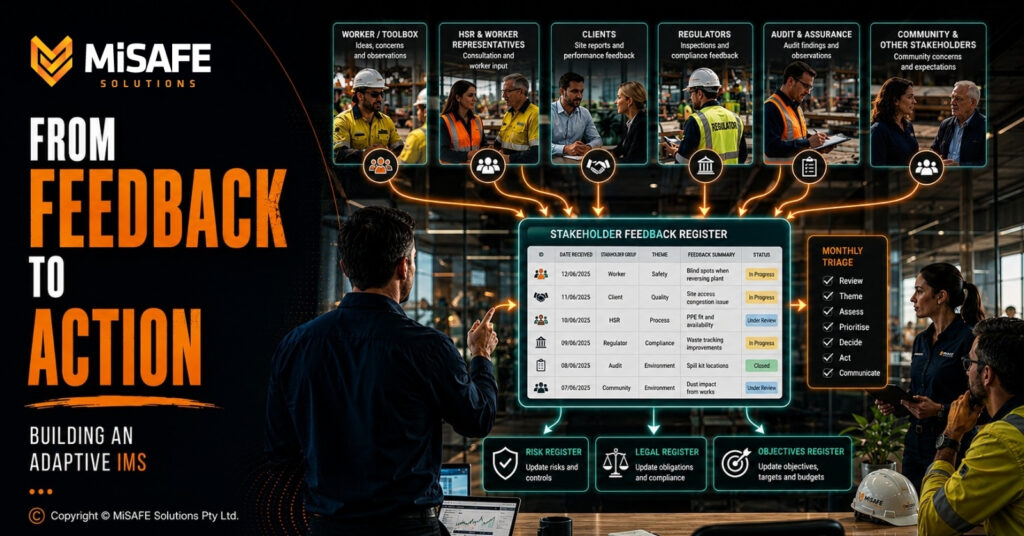
Most QHSE plans are written in a room without the people the plan is meant to protect. The risk register reflects the controls the QHSE Manager could think of on the day. The objectives reflect what the executive wanted last quarter. The procedures reflect how the work was meant to happen, not how it actually does.
Then a worker raises an issue at a toolbox. A client flags a near miss in their site report. A regulator asks a pointed question at an inspection. The plan does not change.
That is the gap stakeholder feedback is meant to close.
What ISO and the WHS Act actually require
ISO 9001:2015, ISO 14001:2015 and ISO 45001:2018 all sit on Annex SL and all three open Planning with Clause 4.2, the needs and expectations of interested parties. The organisation determines who its interested parties are, what they need or expect, and which of those needs and expectations become compliance obligations.
ISO 45001:2018 adds Clause 5.4 Consultation and participation of workers. The organisation establishes, implements and maintains processes for consultation and participation of workers (including non-managerial workers) and worker representatives in the development, planning, implementation and evaluation of the OH&S management system.
Section 47 of the Work Health and Safety Act 2011 places a primary duty to consult with workers who carry out work for the business or undertaking and who are or are likely to be directly affected by a matter relating to work health or safety. Section 48 sets out the nature of consultation: sharing information, giving a reasonable opportunity to express views and raise issues, taking those views into account, and advising of the outcome. Section 49 covers when consultation is required, including when identifying hazards, assessing risks, deciding on control measures, proposing changes that may affect health or safety, and consulting with other duty holders on shared matters.
Stakeholder feedback is not a soft skill. It is a duty.
Who actually counts as a QHSE stakeholder
Most businesses define stakeholders too narrowly. The full list for a typical Australian QHSE-active business includes: workers (employees, casuals, labour hire, apprentices, subcontractors), worker representatives (Health and Safety Representatives, union officials, work group representatives), clients and end users, principal contractors and head contractors, suppliers of plant, materials and services, certification bodies and external auditors, regulators (state WHS regulator, EPA, local council, federal agencies where applicable), insurers, financiers and brokers, neighbours and the local community, and industry associations and peer businesses.
Each group sees a different part of the operation. A worker sees the daily reality. A client sees the deliverable quality. A regulator sees the legal posture. A neighbour sees the environmental impact. Filtering each through a single feedback process is what turns a static plan into an adaptive one.
Why most stakeholder feedback never reaches the plan
Three patterns turn up in nearly every business that consults but never updates.
The first is the orphan feedback. A toolbox raises an issue, the supervisor writes it down, and the note never makes it to anyone with authority to change a procedure or update a risk. The information dies in a clipboard or a notebook.
The second is the disconnected register. A separate spreadsheet for client feedback, another for worker suggestions, another for audit findings, another for incident root causes. None of them are themed or linked. The same recurring issue appears in three registers under three different descriptions and gets actioned nowhere.
The third is the noted-not-actioned response. Feedback is received and acknowledged but never converted into a change. Section 48 of the WHS Act is explicit: consultation includes advising of the outcome. Acknowledgement is not the outcome. A documented decision, with a control or change that follows, is the outcome.
How to build feedback into IMS planning
Start with a single Stakeholder Feedback Register that captures every input regardless of source. The fields must include: stakeholder group, individual or representative name, engagement method (toolbox, survey, site walk, audit interview, regulator visit, client report, complaint), date received, the feedback itself in their words, the theme (quality, safety, environment, process, communication, training, plant, leadership), the linked risk register or legal register entry, the action proposed, the responsible position, the status, the closeout date, and how the outcome was communicated back.
Triage every item against three filters. Does this change something on the Risk and Opportunity Register (MISAFE-IMS-TMP-019)? Does this affect a legal or other requirement on the Legal and Compliance Obligations Register (MISAFE-IMS-TMP-022)? Does this revise an objective or budget line (MISAFE-IMS-TMP-023)? Items that touch one or more of those three registers get a planned action with an owner and a date. Items that touch none get closed out with a logged decision and a reply to the stakeholder.
Run a monthly stakeholder feedback review at the QHSE leadership meeting. Theme trends across all sources. A single complaint is data; three independent reports of the same issue is a planning signal. Update your risk register, legal register or objectives accordingly and record the change in the Document Change Register.
Feed the consolidated themes into your Management Review under ISO 9001 Clause 9.3.2 (inputs include customer satisfaction and feedback), ISO 14001 Clause 9.3 (inputs include communication from interested parties) and ISO 45001 Clause 9.3 (inputs include results of consultation and participation of workers).
Practical Application
For an Australian civil contractor with 25 staff operating across multiple sites, a monthly stakeholder feedback cycle might look like this. Field staff raise observations through toolbox talks (Tuesday and Friday) and a simple QR-code feedback link on every site sign. The HSR meets the QHSE Manager monthly. Client site reports and head contractor audit findings flow in as PDFs and are logged. The local council, EPA and worker compensation insurer correspondence is logged when it arrives.
On the second Tuesday of every month, the Operations Manager and QHSE Manager work through the register. Each item is triaged against the three filters above. Themes are identified. Decisions are made: change a procedure, retire a control that is not working, update a risk score, revise a training matrix, raise an objective. The outcome is communicated back to the originating stakeholder within five working days, satisfying section 48 of the WHS Act.
By the end of the quarter, the register tells a story. Every change to the IMS this quarter is traceable to a stakeholder. That is the evidence base that holds up at an external audit, at a regulator inspection, and at a board meeting where someone asks how QHSE is actually informing the business.
Conclusion
QHSE plans that ignore stakeholder feedback drift away from the work they were built to control. The fix is a single register, monthly triage against your risk, legal and objectives frameworks, and a discipline of closing every loop. Once that cycle runs, the IMS becomes adaptive instead of static and the consultation duty becomes a competitive advantage rather than a compliance chore.
The MiSAFE All-in-One QHSE subscription includes configuration of your Stakeholder Feedback Register inside DS Site, with automated routing from toolbox sign-on sheets, client correspondence inboxes and audit reports, monthly triage workflows, and Management Review-ready theme summaries.
Ready to act? Contact us today or book a free 45-minute consultation.
Download the Free Template
Download the free Stakeholder Feedback Register and start turning every piece of stakeholder input into a real change to your IMS.
This article is general guidance. Check the legislation that applies in your state, or talk to us about your situation.