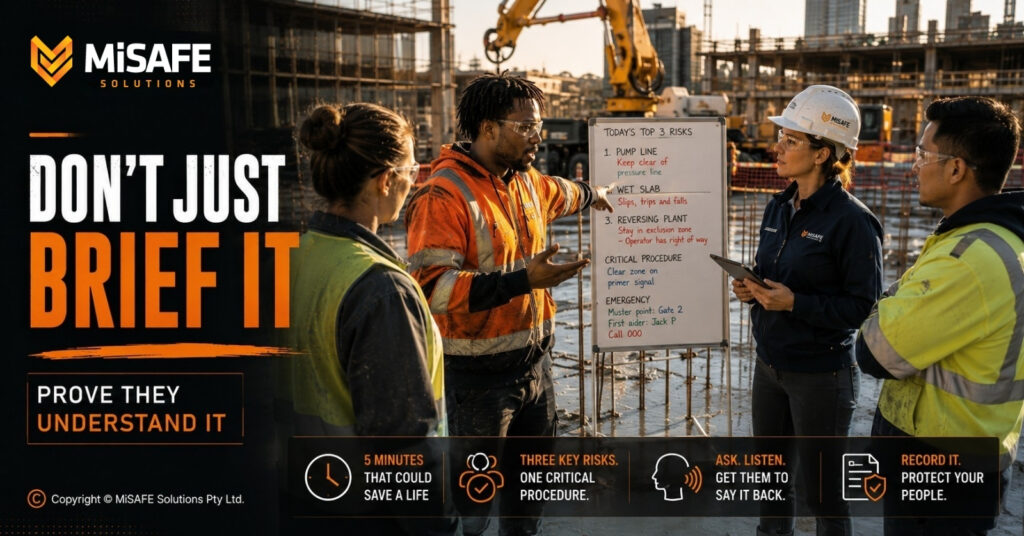
Most pre-start briefings on Australian sites are forgotten before the kettle has cooled. The crew gathers in a half-circle, the supervisor reads aloud from a SWMS picked up minutes earlier, the sign-on sheet goes around, and the work begins.
By morning tea, most of what was said has evaporated. By the time the work turns dangerous, the only evidence the briefing happened at all is a row of signatures, and a signature proves a worker held a pen, not that they understood the controls.
That gap, between a briefing delivered and a briefing understood, is what this post closes.
What the WHS Act actually requires
Section 19(3)(f) of the Work Health and Safety Act 2011 places a duty on the person conducting a business or undertaking to provide the information, training, instruction or supervision necessary to protect workers from risks to their health and safety. The test inside that wording is behavioural. The duty is met when the worker can act safely on what was said, not when the supervisor has finished speaking.
Section 27 carries the duty up to officers, who must exercise due diligence to ensure the business complies. An officer defending a serious incident will be asked whether the briefing the injured worker received was enough to inform the decisions they made on the day. The answer that the SWMS was signed is not an answer to that question.
Regulation 39 of the Work Health and Safety Regulation 2017 sharpens the point. Information, training and instruction must be suitable and adequate having regard to the nature of the work, the nature of the risks, and the control measures in place. The standard is suitability, not delivery. A briefing can be delivered in full and still fall short of suitable.
A pre-start briefing is a legal control, not a courtesy.
Why most pre-start briefings fail
Three patterns turn up in nearly every crew that briefs but does not communicate.
The first is that the briefing reads the SWMS instead of teaching it. The supervisor works through the document section by section, asks whether there are any questions, and reads the silence as agreement. The worker is handed a wall of words at the moment they are least able to absorb one, and what arrives is a blur, not a sequence of decisions they can act on later.
The second is timing and overload. Six in the morning, with cold coffee and rain on the forecast, is not when complex information lands cleanly, and a briefing that lists eleven hazards delivers about four. Attention at pre-start is narrow and shallow, so a briefing that drags past five minutes loses the room while one squeezed under two minutes is too thin to anchor anything.
The third is the missing comprehension check. The sign-on sheet goes round and comes back full, but nobody is asked to say back what they heard or what they would do if a named hazard appeared. The briefing closes with a record and no confirmation. A regulator can see the briefing occurred; they cannot see that the information arrived.
How workers actually retain safety information
Human factors and adult learning research is consistent on three points that matter on a live site. Retention falls away after the third or fourth distinct item, so a briefing built around the three highest-risk hazards on this job holds more usable information, not less, than one that recites the lot.
Concrete beats abstract every time. A line like watch for moving plant is gone before the sheet is back on the table. A line like the excavator is reversing across this access route every fifteen minutes between seven and nine, so if you hear the beeper, stop, look right, and do not move until the operator has seen you, survives because it is situated, physical and procedural.
Teach-back is the single highest-impact move available. Asking workers to put the key points back in their own words before they sign turns a one-way broadcast into a two-way check, and it surfaces the gaps where the message missed while there is still time to close them. Studies of clinical safety briefing have found teach-back roughly doubles recall a day later compared with read-and-sign delivery.
How to run a five-minute teach-back briefing
A briefing that works runs in five short phases, and with a crew of five it lands between four and six minutes. Set the scene in thirty seconds by naming the work, the location, the crew and the SWMS revision in force, using real names and real plant. Then take sixty seconds on the three highest-risk hazards on this job, name the control for each, and stop there. The discipline is in what you leave out.
Spend the next sixty seconds on the one critical procedure that has to be executed correctly to avoid serious harm, and point at the ground you mean. Take thirty seconds on emergency response, compressed to three things a worker can hold at speed: where to go, who to call, and who is in charge. Then close with teach-back. Ask each worker to give one point back in their own words, move the questions around, and sign the record only once the answers are right.
Practical Application
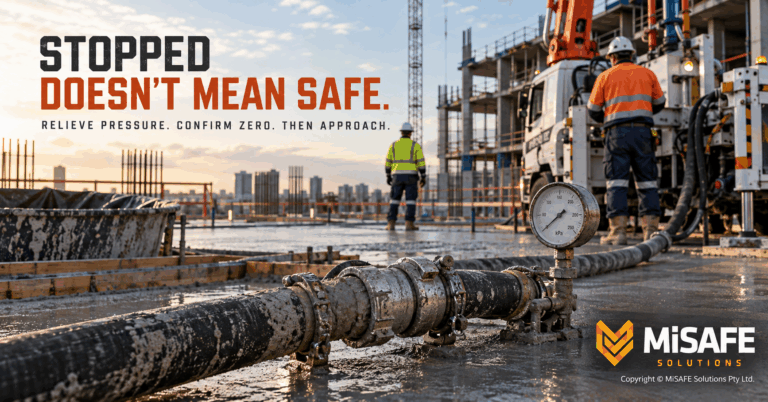
Picture a concreting crew on a multi-storey site, pouring a suspended slab off a boom pump, working to a SWMS that runs to fourteen pages. At pre-start the supervisor does not read it. He names the three risks that matter today: the pump line, the wet slab underfoot, and the boom pump reversing across the access route.
He walks through the one procedure that cannot be missed, that everyone clears to the marked exclusion zone on the primer signal and nobody returns until the crew lead calls it, then names the muster point and the first aider. He asks the traffic controller to repeat the signal he watches for, and the trades assistant when the slab gets cleared. The trades assistant is not sure, so the supervisor re-briefs that point on the spot and notes the correction on the record.
The whole briefing took five minutes. The record shows who attended, the SWMS revision briefed, the questions asked, and that one worker’s understanding was corrected before the pour began. If a regulator ever asks whether the injured worker understood the control that was meant to protect them, that record is the answer. A blank line on a sign-on sheet is not.
Conclusion
A SWMS only controls risk if the people doing the work understand it. The briefing is the transfer, the teach-back is the confirmation, and the record is the evidence. A five-minute briefing built around the three highest risks, the critical procedure, the emergency response and a teach-back is the one that survives both the shift and the audit.
MiSAFE SWMS lets you create, review, approve and brief Safe Work Method Statements in minutes, with workers signing on by scanning the QR code at the top of the document, so authors and reviewers see live who has signed and who still needs the briefing.
Ready to act? Contact us today or book a free 45-minute consultation.
Download the Free Template
Download the free SWMS Pre-Start Briefing and Teach-Back Record and start running pre-start briefings your crew can actually repeat back.
This article is general guidance. Check the legislation that applies in your state, or talk to us about your situation.